120+ Synonyms for Evaluation: Meanings, Examples, and How to Use Them
Finding the right word can make your writing clearer, more natural, and easier to understand. The word evaluation is useful when discussing the quality of a product, the performance of an employee, the progress of a student, or the success of a project. However, using the same word repeatedly can make your sentences feel less engaging.
Learning synonyms for evaluation gives you more ways to express your ideas. Depending on the situation, you might use assessment, appraisal, review, analysis, examination, or judgment. Each word has a slightly different meaning, so choosing the right one helps you communicate more precisely.
For example, a teacher may assess a student’s progress, a business owner may analyze sales figures, and a property expert may appraise a house. All three activities involve evaluation, but they serve different purposes.
In this guide, you will discover more than 120 evaluation synonyms and related expressions, along with easy definitions, original examples, comparisons, antonyms, and practical advice for choosing the best word in everyday, academic, and professional writing.
What Is the Meaning of Evaluation?
Evaluation is the process of examining something to determine its quality, value, effectiveness, importance, or performance. It usually involves gathering information, considering relevant facts, and reaching a conclusion.
Evaluation can take place in almost any area of life.
For example:
- A teacher evaluates a student’s understanding of a subject.
- A manager evaluates an employee’s performance.
- A company evaluates whether a new product meets customer needs.
- A researcher evaluates the results of an experiment.
- A homeowner evaluates different options before buying a property.
The process may involve observation, testing, measurement, comparison, or careful judgment. Some evaluations rely mainly on numerical data, while others depend on professional knowledge and qualitative evidence.
Evaluation Meaning in Simple English
In simple English, evaluation means looking carefully at something and deciding how good, useful, successful, or valuable it is.
For example, if you compare two phones by looking at their price, battery life, and features, you are evaluating them.
Evaluation is not always about finding faults. It can also identify strengths, recognize progress, and help people make better decisions.
What Is Another Word for Evaluation?
Assessment is one of the most common synonyms for evaluation. Other useful alternatives include appraisal, review, analysis, examination, inspection, judgment, and measurement.
The best choice depends on the situation.
| Word | Meaning | Example |
| Assessment | Judging ability, condition, or quality | The teacher completed an assessment of the student’s progress. |
| Appraisal | Formally judging value or performance | The employee received a yearly appraisal. |
| Review | Looking carefully at something | The team completed a review of the proposal. |
| Analysis | Studying information in detail | The analysis revealed a problem with the data. |
| Examination | Investigating something closely | The examination identified several errors. |
| Inspection | Checking condition, quality, or safety | The building passed its safety inspection. |
| Judgment | Reaching an opinion after considering information | Her judgment was based on the available evidence. |
| Measurement | Determining an amount, level, or size | Measurement showed a reduction in delivery time. |
For general writing, assessment is a strong starting point. However, analysis is more suitable when examining data, while appraisal is often appropriate when judging professional performance or estimating financial value.
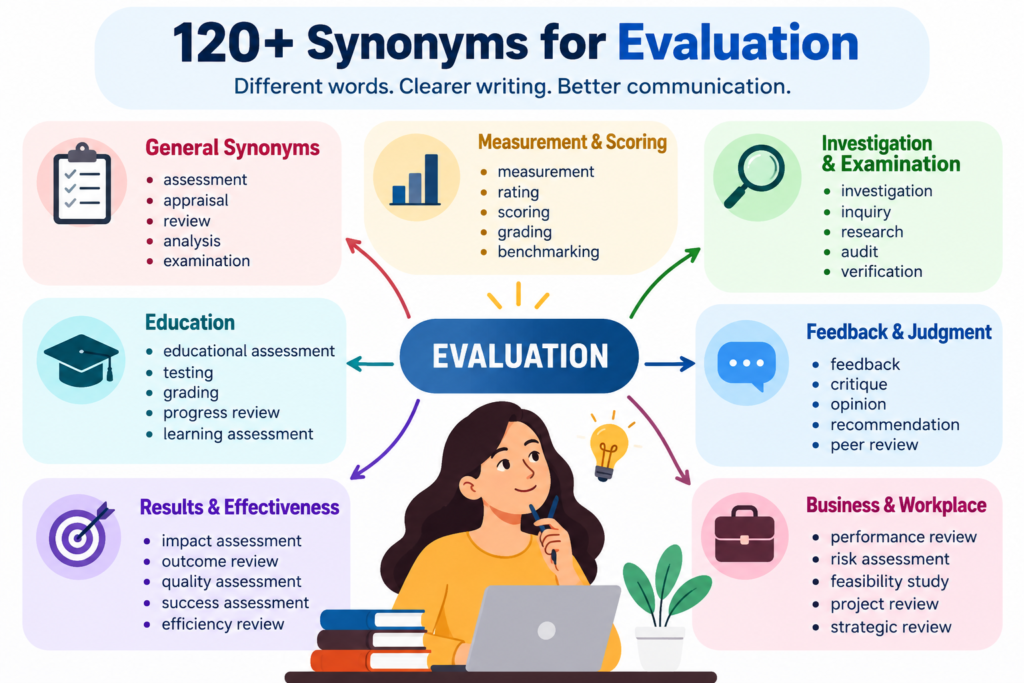
120+ Synonyms for Evaluation With Meanings
The following list includes direct synonyms and related expressions used in different fields. Some terms describe the entire process of evaluation, while others refer to particular methods, outcomes, or purposes.
1. General Synonyms for Evaluation
These words are useful in everyday conversations, essays, reports, and professional communication.
Also Read: 100+ Synonyms for Engineer: Meaning, Definition, Alternatives, and Examples
| No. | Synonym | Meaning | Example |
| 1 | Assessment | A judgment of quality, ability, or condition | The assessment showed that the plan was practical. |
| 2 | Appraisal | A formal judgment of value or performance | Her appraisal highlighted her strongest skills. |
| 3 | Review | A careful examination of something | The manager requested a review of the report. |
| 4 | Analysis | A detailed study of information | The analysis explained the change in sales. |
| 5 | Examination | A close inspection or study | The examination uncovered a missing detail. |
| 6 | Judgment | An opinion formed after considering evidence | His judgment helped the team reach a decision. |
| 7 | Inspection | A check for quality, condition, or problems | The inspection revealed a damaged part. |
| 8 | Study | An organized investigation of a subject | The study examined customer preferences. |
| 9 | Consideration | Careful thought before making a decision | The proposal received careful consideration. |
| 10 | Critique | An explanation of strengths and weaknesses | The editor offered a helpful critique. |
| 11 | Examination of merit | A review of the value or quality of something | The panel conducted an examination of merit. |
| 12 | General review | A broad examination of a subject | The general review covered the main concerns. |
| 13 | Overall assessment | A judgment based on several factors | The overall assessment was favorable. |
| 14 | Critical review | A careful examination that includes judgment | The article received a critical review. |
| 15 | Deliberation | Careful thought or discussion before deciding | After deliberation, the committee approved the plan. |
2. Synonyms Related to Measurement and Scoring
Use these alternatives when evaluation involves numbers, grades, scores, levels, or comparisons.
| No. | Synonym | Meaning | Example |
| 16 | Measurement | Determining the amount or level of something | Measurement showed an improvement in speed. |
| 17 | Rating | A score or level assigned to something | The service received a high customer rating. |
| 18 | Scoring | Assigning points according to specific rules | Scoring helped the judges compare entries. |
| 19 | Grading | Assigning marks or achievement levels | The instructor finished grading the assignments. |
| 20 | Ranking | Arranging items according to position or importance | The ranking placed the team among the top performers. |
| 21 | Benchmarking | Comparing results with an established standard | Benchmarking revealed areas for improvement. |
| 22 | Quantification | Expressing something in numerical terms | Quantification made the results easier to compare. |
| 23 | Calibration | Adjusting a measurement system to a standard | Calibration improved the accuracy of the instrument. |
| 24 | Performance measurement | Tracking results against defined indicators | Performance measurement showed faster delivery times. |
| 25 | Comparative assessment | Judging two or more options using shared criteria | The comparative assessment favored the second design. |
| 26 | Statistical analysis | Studying numerical information using statistical methods | Statistical analysis identified a meaningful pattern. |
| 27 | Score review | Checking scores for accuracy or consistency | The score review corrected two recording mistakes. |
| 28 | Progress measurement | Tracking improvement over time | Progress measurement showed better reading skills. |
| 29 | Standards comparison | Checking results against established requirements | The standards comparison identified a quality gap. |
| 30 | Quantitative assessment | Evaluating something through numerical information | The quantitative assessment measured changes in output. |
3. Synonyms Related to Investigation and Examination
These words are suitable when the purpose is to discover facts, understand a situation, or identify the cause of a problem.
| No. | Synonym | Meaning | Example |
| 31 | Investigation | A systematic search for facts | The investigation examined the cause of the delay. |
| 32 | Inquiry | An effort to obtain information or answers | The inquiry focused on customer complaints. |
| 33 | Research | Organized work to develop or confirm knowledge | The research explored changes in buying habits. |
| 34 | Fact-finding | Collecting information to establish what happened | The fact-finding exercise clarified the sequence of events. |
| 35 | Audit | A structured examination of records or procedures | The audit identified missing documents. |
| 36 | Verification | Checking whether information is correct | Verification confirmed the reported figures. |
| 37 | Validation | Checking whether something meets its intended purpose or requirements | Validation confirmed that the tool met the requirements. |
| 38 | Diagnostic review | An examination intended to identify a problem | The diagnostic review located the source of the error. |
| 39 | Root-cause analysis | Identifying the underlying reason for a problem | Root-cause analysis explained the repeated delays. |
| 40 | Due diligence | Careful investigation before a decision or transaction | The buyer completed due diligence before purchasing the business. |
| 41 | Scrutiny | Close and critical examination | The new policy received careful scrutiny. |
| 42 | Forensic examination | Detailed analysis of evidence, often for legal purposes | The forensic examination revealed altered records. |
| 43 | Compliance check | Checking whether rules or requirements are followed | The compliance check identified an outdated procedure. |
| 44 | Quality inspection | Checking whether something meets quality standards | The quality inspection detected a loose fitting. |
| 45 | Preliminary examination | An initial investigation before a fuller review | The preliminary examination identified two concerns. |
4. Synonyms Related to Feedback and Judgment
These alternatives are useful when evaluation involves opinions, recommendations, comments, or suggestions for improvement.
| No. | Synonym | Meaning | Example |
| 46 | Feedback | Information about performance that can guide improvement | The designer used customer feedback to improve the website. |
| 47 | Criticism | Comments identifying problems or weaknesses | The report included criticism of the approval process. |
| 48 | Commentary | Explanatory or interpretive remarks | The reviewer added commentary on the findings. |
| 49 | Opinion | A person’s view or belief about something | Her opinion reflected the available evidence. |
| 50 | Expert judgment | A conclusion informed by specialist knowledge | Expert judgment helped interpret the unusual results. |
| 51 | Peer review | Examination by people with relevant professional or academic knowledge | The research paper underwent peer review. |
| 52 | Editorial review | An examination of writing for quality and suitability | The article received an editorial review. |
| 53 | Performance feedback | Information about someone’s work or results | The employee received performance feedback after the project. |
| 54 | Constructive criticism | Feedback intended to help someone improve | Constructive criticism helped the student revise the essay. |
| 55 | Review comments | Observations provided during a review | The writer addressed the review comments. |
| 56 | Recommendation | Advice about a suitable action | The report included a recommendation to simplify the process. |
| 57 | Expert opinion | A view based on specialist knowledge | The expert opinion clarified the technical issue. |
| 58 | Reflection | Thoughtful consideration of an experience or result | Her reflection identified lessons from the project. |
| 59 | Self-assessment | A person’s judgment of their own abilities or work | The student completed a self-assessment before the meeting. |
| 60 | Peer assessment | A review of work by another person at a similar level | Peer assessment helped students improve their presentations. |
5. Synonyms Used in Education
In education, evaluation often involves measuring knowledge, identifying learning needs, tracking progress, and checking whether teaching methods work.
| No. | Synonym | Meaning | Example |
| 61 | Educational assessment | A judgment of learning or academic progress | Educational assessment identified gaps in reading skills. |
| 62 | Testing | Using questions or tasks to check knowledge or ability | Testing showed which topics needed more practice. |
| 63 | Examination | A formal test or detailed study | The final examination covered the main course topics. |
| 64 | Grading | Assigning marks to student work | Grading followed the published criteria. |
| 65 | Learning assessment | Measuring what a student has learned | Learning assessment helped the teacher plan the next lesson. |
| 66 | Skills assessment | Checking someone’s ability to perform specific tasks | The skills assessment included a writing exercise. |
| 67 | Diagnostic assessment | Identifying strengths, weaknesses, or learning needs | A diagnostic assessment helped the teacher plan extra support. |
| 68 | Formative assessment | Checking learning during instruction to guide improvement | Formative assessment helped students correct mistakes early. |
| 69 | Summative assessment | Measuring achievement at the end of a learning period | The final project served as a summative assessment. |
| 70 | Progress review | Examining development over a period | The progress review showed stronger reading comprehension. |
| 71 | Competency assessment | Checking whether a person meets defined skill requirements | The competency assessment included a practical task. |
| 72 | Academic appraisal | A judgment of academic work or achievement | The academic appraisal considered coursework and research. |
| 73 | Student evaluation | An examination of student performance or learning | Student evaluation included classwork and a final project. |
| 74 | Program evaluation | Examining whether a program achieves its goals | Program evaluation helped the school improve its tutoring service. |
| 75 | Learning-outcome review | Checking whether intended learning goals were achieved | The learning-outcome review identified two unmet objectives. |
6. Synonyms Used in Business and the Workplace
Businesses use evaluation to review employees, finances, projects, suppliers, customers, and organizational performance.
Also Read: 100 Synonyms for Orbit: Meaning, Definitions, Examples, and Usage
| No. | Synonym | Meaning | Example |
| 76 | Performance review | A structured discussion of an employee’s work | The manager scheduled a performance review. |
| 77 | Employee appraisal | A judgment of an employee’s performance | The employee appraisal highlighted strong communication skills. |
| 78 | Business analysis | A study of business information and operations | Business analysis revealed unnecessary operating costs. |
| 79 | Financial assessment | An examination of financial condition or performance | The financial assessment considered cash flow and expenses. |
| 80 | Financial audit | A formal examination of financial information | The financial audit checked the accuracy of the accounts. |
| 81 | Risk assessment | Identifying and judging possible risks | The risk assessment considered supply delays and price changes. |
| 82 | Feasibility study | An examination of whether a plan is practical | The feasibility study examined the cost of opening another location. |
| 83 | Project review | An examination of a project’s progress or results | The project review identified unfinished tasks. |
| 84 | Strategic review | An examination of an organization’s direction and priorities | The strategic review considered new customer needs. |
| 85 | Operational assessment | A review of how well day-to-day activities work | The operational assessment identified slow approval steps. |
| 86 | Market analysis | A study of a market, its customers, and competitors | Market analysis helped the company choose a target audience. |
| 87 | Customer satisfaction assessment | A review of how well a business meets customer expectations | The customer satisfaction assessment highlighted delivery concerns. |
| 88 | Vendor assessment | A review of a supplier’s suitability or performance | The vendor assessment considered quality and reliability. |
| 89 | Cost-benefit analysis | Comparing the expected costs and benefits of an option | The cost-benefit analysis supported the proposed upgrade. |
| 90 | Return-on-investment analysis | Examining the financial return from an investment | The return-on-investment analysis compared the two campaigns. |
7. Synonyms Related to Results, Quality, and Effectiveness
These alternatives are useful when determining whether a product, policy, process, or program achieves its intended purpose.
| No. | Synonym | Meaning | Example |
| 91 | Effectiveness review | An examination of how well something achieves its purpose | The effectiveness review examined the new support system. |
| 92 | Outcome assessment | A review of the results produced by an activity | The outcome assessment showed improved completion rates. |
| 93 | Impact assessment | An examination of the effects of an action or decision | The impact assessment considered changes in local traffic. |
| 94 | Quality assessment | A judgment of whether something meets quality expectations | The quality assessment identified inconsistent results. |
| 95 | Quality assurance review | A check of procedures intended to maintain quality | The quality assurance review found gaps in documentation. |
| 96 | Process evaluation | An examination of how an activity or program is carried out | Process evaluation revealed delays in registration. |
| 97 | Results analysis | An examination of outcomes and their meaning | Results analysis showed that the second approach performed better. |
| 98 | Outcome review | A review of the effects or achievements of an activity | The outcome review informed the next planning cycle. |
| 99 | Efficiency assessment | A review of how well resources are used | The efficiency assessment identified wasted time. |
| 100 | Success assessment | A judgment of whether intended goals were achieved | The success assessment compared results with the original targets. |
| 101 | Product testing | Checking a product’s performance or features | Product testing revealed a battery problem. |
| 102 | Usability testing | Checking how easily people can use a product or service | Usability testing showed that the menu was confusing. |
| 103 | Reliability assessment | Examining how consistently something performs | The reliability assessment tested the equipment under different conditions. |
| 104 | Compliance assessment | Checking whether requirements and rules are met | The compliance assessment identified missing approvals. |
| 105 | Progress assessment | Measuring development toward a goal | The progress assessment showed that the project was on schedule. |
8. Additional Alternatives for Specific Situations
These words and expressions relate to particular forms of judgment, estimation, observation, or reassessment.
| No. | Alternative | Meaning | Example |
| 106 | Valuation | Estimating the monetary worth of something | The property valuation reflected recent local sales. |
| 107 | Estimate | An approximate calculation of an amount or value | The contractor provided an estimate of repair costs. |
| 108 | Projection | An estimate of a future result based on available information | The sales projection anticipated moderate growth. |
| 109 | Forecast | A prediction based on evidence or trends | The forecast estimated next quarter’s demand. |
| 110 | Diagnosis | Identifying the nature or cause of a problem | The diagnosis pointed to a faulty connection. |
| 111 | Screening | A preliminary check for suitability or potential problems | The initial screening identified eligible applicants. |
| 112 | Monitoring | Observing progress or performance over time | Monitoring revealed a gradual increase in response times. |
| 113 | Observation | Information gathered by watching something carefully | The observation suggested a change in customer behavior. |
| 114 | Survey | A method of collecting information from people | The survey measured customer satisfaction. |
| 115 | Benchmark review | A comparison with an established reference point | The benchmark review showed that response times exceeded the target. |
| 116 | Reassessment | A new assessment based on updated information | A reassessment was needed after the requirements changed. |
| 117 | Reevaluation | A fresh examination of an earlier judgment | New evidence led to a reevaluation of the proposal. |
| 118 | Retrospective review | A review conducted after an activity or project | The retrospective review identified lessons for future projects. |
| 119 | Suitability assessment | A judgment of whether something is appropriate for a purpose | The suitability assessment considered the candidate’s experience. |
| 120 | Value analysis | A study of function, cost, and value | Value analysis identified a less expensive design. |
| 121 | Gap analysis | Identifying differences between current performance and a desired state | The gap analysis revealed missing training. |
| 122 | Needs assessment | Identifying what a person, group, or organization requires | The needs assessment identified a demand for evening classes. |
| 123 | Comparative review | Examining two or more options side by side | The comparative review highlighted differences in cost. |
| 124 | Suitability review | Examining whether something fits a particular need | The suitability review favored the simpler solution. |
| 125 | Evidence review | Examining available information before reaching a conclusion | The evidence review identified gaps in the case. |
These 125 terms offer a broad vocabulary for discussing evaluation. Remember that related expressions are not always exact synonyms. For example, a forecast predicts future results, while an evaluation usually judges available evidence, current performance, or past outcomes.
Synonyms for Evaluate, Evaluating, and Evaluated
The words evaluate, evaluating, and evaluated come from the same verb, but their grammatical forms differ. Choosing the right replacement means considering both the meaning and the sentence structure.
Another Word for Evaluate
Evaluate means to examine something and reach a judgment about it.
Common synonyms for evaluate include:
- Assess
- Appraise
- Analyze
- Examine
- Review
- Judge
- Measure
- Rate
- Inspect
- Investigate
- Test
- Consider
- Compare
- Estimate
- Critically examine
Examples:
- We need to evaluate the proposal.
We need to assess the proposal. - The researchers will evaluate the data.
The researchers will analyze the data. - The specialist will evaluate the property.
The specialist will appraise the property.
The best synonym depends on the activity. Analyze is appropriate for detailed study, while appraise is often used when estimating value or judging performance.
Synonyms for Evaluating
Evaluating describes the act of examining something to make a judgment.
Useful alternatives include assessing, reviewing, analyzing, examining, appraising, inspecting, measuring, rating, judging, and testing.
Examples:
- The committee is evaluating the candidates.
The committee is assessing the candidates. - The team is evaluating the results.
The team is analyzing the results. - The technician is evaluating the equipment.
The technician is inspecting the equipment.
Synonyms for Evaluated
Evaluated is the past tense or past participle of evaluate.
Possible alternatives include assessed, reviewed, analyzed, examined, appraised, inspected, measured, rated, judged, and tested.
Examples:
- The board evaluated the proposal.
The board reviewed the proposal. - The team evaluated the figures.
The team analyzed the figures. - The specialist evaluated the property.
The specialist appraised the property.
The choice should reflect the actual action. A team that reads a proposal reviews it; a team that studies its data analyzes it.
Synonyms for Evaluative
Evaluative is an adjective describing something that involves judgment or assessment.
Depending on the context, related words include judgment-based, analytical, critical, assessment-related, and appraisal-related.
Example:
The report contains evaluative comments about the quality of the evidence.
A possible alternative is:
The report contains critical comments about the quality of the evidence.
Critical is appropriate when the comments examine strengths and weaknesses, although it may not fit every use of evaluative.
Synonym for Evaluator
An evaluator is a person who examines something and forms a judgment.
Depending on the person’s responsibilities, related terms include assessor, reviewer, appraiser, examiner, inspector, and analyst.
For example, a person who reviews employee performance may be called an assessor or reviewer. Someone who estimates a property’s monetary worth is generally called an appraiser.
Use the title that accurately describes the person’s role.
Synonyms for Assess, Assessment, and Assessing
Because assess is closely related to evaluate, its alternatives are useful when writing about progress, condition, ability, risk, or quality.
Assess Synonyms
Common synonyms for assess include evaluate, appraise, examine, judge, measure, estimate, rate, review, and determine.
Example:
The manager assessed the team’s progress.
Alternative:
The manager reviewed the team’s progress.
Synonyms for Assessment
Possible alternatives for assessment include evaluation, appraisal, review, examination, judgment, measurement, and analysis.
The best choice depends on the context. An analysis may explain the causes of a problem, while an assessment may judge its severity or importance.
Another Word for Assessing
Assessing means examining something to understand its condition, quality, ability, or importance.
Possible alternatives include evaluating, reviewing, examining, appraising, measuring, judging, and inspecting.
Example:
The engineers are assessing the damage.
Alternative:
The engineers are examining the damage.
Synonym for Assessed
Assessed can be replaced by evaluated, examined, reviewed, measured, appraised, or judged when the meaning fits.
Example:
The applicants were assessed according to their qualifications.
Alternative:
The applicants were evaluated according to their qualifications.
Evaluation vs. Assessment vs. Appraisal vs. Analysis
These four words are common alternatives to evaluation, but they emphasize different aspects of the process.
| Word | Main focus | Common uses |
| Evaluation | Judging overall quality, value, or effectiveness | Programs, policies, projects, products |
| Assessment | Measuring or judging ability, condition, or progress | Education, skills, risk, performance |
| Appraisal | Formally judging performance or estimating value | Employees, property, professional performance |
| Analysis | Studying information to understand patterns or causes | Research, data, business decisions |
When Should You Use Assessment?
Choose assessment when you need to determine a level of ability, knowledge, condition, risk, or progress.
For example, a school may assess a student’s reading ability, while a company may assess the risks of working with a new supplier.
When Should You Use Appraisal?
Choose appraisal when the focus is a formal judgment of value or performance.
For example, a property owner may request an appraisal to estimate a house’s worth, while a manager may conduct an employee appraisal to discuss work performance.
When Should You Use Analysis?
Choose analysis when you need to examine information in detail and explain what it reveals.
For example, a marketing team may analyze customer behavior to understand why a campaign attracted fewer customers than expected.
When Should You Use Review?
Choose review when the task involves examining a document, plan, process, or situation. A review may be informal or formal and does not necessarily involve numerical measurements.
Synonyms for Evaluation in Different Types of Writing
A word that works well in an academic paper may sound unnecessarily formal in a casual conversation. The following examples show how to choose alternatives for different audiences.
Evaluation Synonyms for Academic Writing
Useful choices include assessment, analysis, examination, critique, and review.
Example:
The evaluation of the evidence supports the researcher’s conclusion.
Alternative:
The analysis of the evidence supports the researcher’s conclusion.
Use analysis when explaining information and critique when discussing the strengths and weaknesses of an argument.
Evaluation Synonyms for Business Writing
Useful choices include appraisal, audit, performance review, feasibility study, risk assessment, and strategic review.
Example:
The company completed an evaluation of the proposed expansion.
Alternative:
The company completed a feasibility study of the proposed expansion.
The second sentence is appropriate when the company wants to determine whether expansion is practical.
Evaluation Synonyms for Education
Useful choices include assessment, grading, testing, progress review, and learning assessment.
Example:
The teacher evaluated the students’ reading progress.
Alternative:
The teacher assessed the students’ reading progress.
Assessment is particularly useful when measuring learning, while program evaluation may be better when examining whether a teaching program meets its goals.
Evaluation Synonyms for Research
Useful choices include analysis, investigation, examination, validation, verification, and impact assessment.
Example:
The researchers evaluated the accuracy of the instrument.
Alternative:
The researchers validated the instrument against the relevant requirements.
Use validation when checking whether something meets its intended purpose or requirements. Use verification when checking whether information or a result is correct.
Evaluation Synonyms for Everyday Conversation
Simple choices include check, review, look at, judge, examine, and assess.
Example:
Let’s evaluate our options before making a decision.
Alternative:
Let’s review our options before making a decision.
Clear, familiar language is usually best when writing for a general audience.
Antonyms for Evaluation and Evaluate
An antonym is a word that expresses an opposite or contrasting meaning. Evaluation does not have one universal antonym because the word can refer to judgment, measurement, examination, or analysis.
Depending on the sentence, useful contrasting terms include:
| Word | Possible opposite or contrast | Explanation |
| Evaluate | Ignore | Choosing not to examine something |
| Evaluate | Disregard | Choosing not to consider something |
| Evaluate | Overlook | Failing to notice an important detail |
| Assess | Neglect | Failing to give something the necessary attention |
| Examine | Ignore | Choosing not to inspect something |
| Verify | Falsify | Making information false rather than checking it |
| Measure | Guess | Estimating without making an actual measurement |
| Analyze | Generalize | Making a broad statement instead of studying details |
These are contextual contrasts, not exact opposites in every situation.
For example, the opposite of evaluate in “The manager evaluated the proposal” might be ignore or disregard. In a sentence about measuring a quantity, guess provides a useful contrast but is not a strict antonym.
Evaluate Synonym and Antonym Examples
| Original word | Synonym | Possible antonym |
| Evaluate | Assess | Ignore |
| Assess | Examine | Neglect |
| Review | Inspect | Disregard |
| Measure | Quantify | Guess |
| Verify | Confirm | Falsify |
| Analyze | Examine | Generalize |
When choosing an antonym, consider the intended meaning rather than relying on a single word from a list.
How to Choose the Best Evaluation Synonym
Selecting a synonym should make your writing more precise. Follow these steps to find the best alternative.
1. Identify the Subject
Ask what you are examining.
- Student learning: assessment
- Employee performance: appraisal or performance review
- Financial records: audit
- Research data: analysis
- Possible dangers: risk assessment
- Property value: appraisal or valuation
- Project results: project review or outcome assessment
2. Consider the Purpose
Think about the result you want to communicate.
If you are examining a document, review may be enough. If you are trying to identify the cause of a problem, analysis may be more suitable. If you want to determine whether a program achieved its goals, evaluation is often appropriate.
3. Match the Level of Formality
Use vocabulary that suits your audience.
For everyday conversation, check, review, and assess are clear choices. In a formal report, appraisal, audit, validation, or impact assessment may be suitable when the term accurately describes the procedure.
Avoid complicated words that add no useful meaning.
Also Read: Synonyms for Nuance: 100 Words, Meanings, Examples, and How to Use Them
4. Keep the Meaning Accurate
Do not replace a word simply because you have already used it several times.
For example, reviewing a report is not necessarily the same as auditing it. A review may focus on clarity, while an audit may involve systematic checks of records or compliance.
Accuracy is more important than variety.
5. Check the Grammar
Evaluation is a noun, while evaluate is a verb. Evaluated and evaluating are verb forms, and evaluative is an adjective.
Correct examples:
- The evaluation was detailed.
- The assessment was detailed.
- We evaluated the results.
- We assessed the results.
- The report contains evaluative comments.
Checking the complete sentence helps you avoid grammatical errors when substituting synonyms.
Common Mistakes When Using Evaluation Synonyms
Treating Every Word as an Exact Substitute
Assessment, analysis, audit, and rating are related to evaluation, but they describe different activities. An analysis studies information, a rating assigns a score, and an audit follows a structured checking process.
Using Overly Formal Language
A complicated expression does not automatically improve a sentence.
For example, “We conducted an examination of the available choices” can often become “We reviewed the options.”
Simple wording is usually more effective when it preserves the meaning.
Confusing Evaluation With Prediction
Evaluation usually judges information, performance, or results. A forecast or projection estimates what may happen in the future.
Reviewing current sales performance is an evaluation. Predicting next quarter’s sales is a forecast.
Repeating the Same Alternative
Replacing evaluation with assessment in every sentence may create another form of repetition.
Instead, describe the specific activity. A report might include an initial assessment, a review of the evidence, and an analysis of the results.
Each phrase adds a different detail.
How Do You Spell Evaluation and Evaluate?
The correct spellings are evaluation and evaluate.
- Evaluation: e-v-a-l-u-a-t-i-o-n
- Evaluate: e-v-a-l-u-a-t-e
- Evaluated: e-v-a-l-u-a-t-e-d
- Evaluating: e-v-a-l-u-a-t-i-n-g
- Evaluative: e-v-a-l-u-a-t-i-v-e
- Evaluator: e-v-a-l-u-a-t-o-r
- Reevaluation: r-e-e-v-a-l-u-a-t-i-o-n
Common misspellings include evaulation, evulation, evlauation, evalutation, and evalutaion. The standard English spellings are evaluation and evaluate.
One way to remember the difference is to connect the words: evaluate is the verb, and evaluation is the related noun.
Frequently Asked Questions
What is the most common synonym for evaluation?
Assessment is one of the most useful general alternatives. It works when discussing ability, progress, quality, condition, or performance. Review and analysis may be better when the context involves examining documents or studying information.
What is another word for evaluation in a report?
The best alternative depends on the report’s purpose. Assessment suits a judgment of condition or performance, analysis suits a detailed study of information, and review suits a general examination. Audit is appropriate when the work involves a structured examination of records, procedures, or compliance.
Is assessment the same as evaluation?
The words overlap, but they are not always identical. Evaluation often emphasizes an overall judgment of quality, value, or effectiveness. Assessment frequently focuses on measuring ability, condition, progress, or risk. Their precise meanings may vary by field.
What is the difference between evaluate and assess?
Both verbs involve examining something and forming a judgment. Assess often emphasizes determining a level, condition, ability, or risk. Evaluate may emphasize judging overall quality, value, or effectiveness. In many contexts, either word can work.
What does evaluated mean?
Evaluated means examined to form a judgment about quality, value, performance, or effectiveness.
For example, “The applications were evaluated by the hiring panel” means the panel examined the applications and judged them using relevant criteria.
What is another word for reevaluate?
Reassess, reconsider, review again, and reexamine are possible alternatives. Reassess is useful when making a fresh judgment, while reconsider emphasizes thinking about a decision again.
What is a synonym for assessed?
Common alternatives include evaluated, examined, reviewed, appraised, measured, and judged. Measured is appropriate when determining a quantity or level, while appraised is useful when judging value or performance.
What are synonyms for evaluation in research?
Useful choices include analysis, assessment, examination, investigation, validation, outcome assessment, and impact assessment. The best term depends on whether the researcher is studying evidence, checking accuracy, or measuring results.
What is the difference between evaluation and valuation?
Evaluation is a broad term for judging quality, effectiveness, performance, or value. Valuation usually refers to estimating the monetary worth of an asset, business, or property.
What is the opposite of evaluate?
There is no single opposite that fits every context. Ignore, disregard, and overlook can contrast with evaluate when the intended meaning is failing to consider something.
What is a formal synonym for evaluation?
Appraisal, assessment, analysis, and examination are common formal alternatives. Audit, validation, and impact assessment are appropriate when they accurately describe the specific process.
What is a simple synonym for evaluation for students?
Assessment, review, and check are useful choices. Assessment works well for learning and performance, while review is appropriate when examining work or information.
Can analysis replace evaluation in academic writing?
Sometimes. Analysis is suitable when the writer studies evidence, data, or information in detail. If the main purpose is to judge the overall success or effectiveness of something, evaluation may be more accurate.
What is a synonym for evaluator?
Depending on the person’s role, alternatives include assessor, reviewer, appraiser, examiner, inspector, and analyst. For example, a professional who estimates property value is generally called an appraiser.
What is the difference between evaluation and evaluative?
Evaluation is a noun referring to a process or judgment. Evaluative is an adjective describing something that involves judgment or assessment.
For example, “The evaluation was thorough” uses the noun, while “The report contains evaluative comments” uses the adjective.
How can I avoid repeating evaluation in an essay?
Choose alternatives based on the specific activity. Use assessment for measuring progress, analysis for studying evidence, review for examining a document, and appraisal for judging value or performance. You can also restructure sentences to avoid unnecessary repetition.
Conclusion
Evaluation is a useful word for discussing quality, value, performance, and effectiveness. However, its many alternatives allow you to communicate with greater precision.
Assessment is a strong general synonym, appraisal is suitable for value or performance, analysis emphasizes detailed study, and review describes a broad examination. More specific expressions, such as risk assessment, program evaluation, and impact assessment, help readers understand exactly what is being examined.
The most effective approach is to choose words according to their meaning, context, and grammatical role. With the right evaluation synonyms, you can write clearer essays, more informative reports, and more professional messages without sacrificing accuracy or readability.