Synonyms for Nuance: 100 Words, Meanings, Examples, and How to Use Them
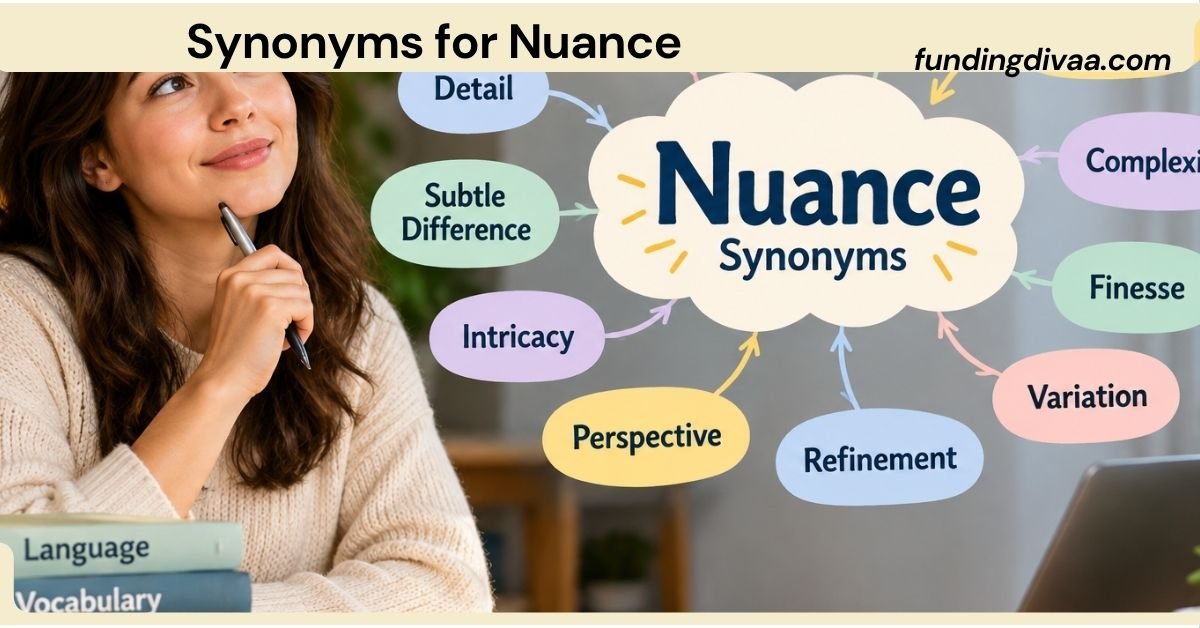
Finding the right synonym for “nuance” can make your writing clearer and more precise. The word often describes a small difference, subtle quality, hidden detail, or slight change in meaning that is easy to miss.
For example, there is a nuance between being “confident” and being “overconfident.” Both words describe a person who believes in their abilities, but the second can suggest that the person has too much confidence.
The best synonym depends on what you mean. “Subtlety” may work when you are talking about a small or difficult-to-notice detail. “Distinction” is better when you want to emphasize a difference between two things. “Shade” can describe a slight difference in feeling or meaning, while “aspect” may describe one particular side of a larger subject.
This guide provides 100 relevant synonyms and related alternatives for “nuance,” explains how they differ, and shows how to use them naturally in sentences.
What Is the Meaning of Nuance?
A nuance is a small difference or subtle feature that can change how something is understood, felt, or interpreted.
The word can describe differences in:
- Meaning
- Emotion
- Tone
- Behavior
- Opinion
- Color
- Language
- Culture
- Writing
- Art
- Relationships
- Arguments
- Situations
For example:
- “There is an important nuance between the two statements.”
- “The actor captured the emotional nuances of the character.”
- “The translation loses some of the nuances of the original language.”
- “She understood the cultural nuances of the conversation.”
The plural form is “nuances.”
In simple English, you can think of a nuance as a “small but meaningful difference.”
What Is the Best Synonym for Nuance?
The closest general synonym for “nuance” is usually “subtlety.”
However, there is no single synonym that works in every sentence.
| Word | Best meaning |
| Subtlety | A small or hard-to-notice difference |
| Distinction | A meaningful difference between things |
| Shade | A slight difference in meaning or feeling |
| Variation | A difference from another form |
| Detail | A small part or feature |
| Aspect | One side of a subject |
| Facet | One particular part or side |
| Complexity | A combination of difficult or connected parts |
| Implication | A meaning suggested rather than directly stated |
| Refinement | A small improvement or adjustment |
So, if you are looking for a “nuance synonym,” first decide what kind of difference you want to express.
100 Synonyms and Related Words for Nuance
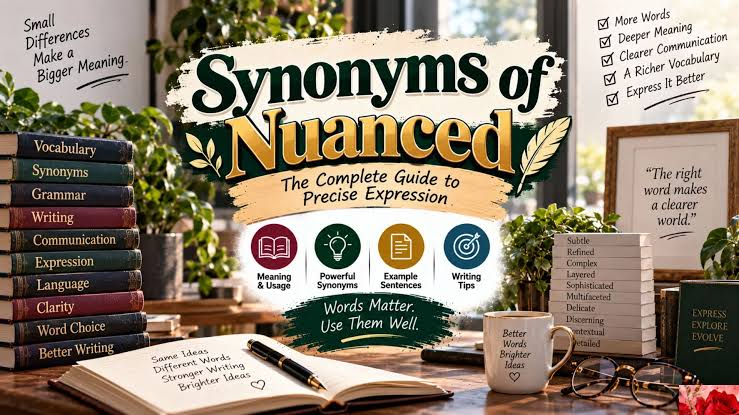
The following words are useful alternatives in different contexts. Some are close synonyms, while others are context-specific alternatives that can replace “nuance” only in certain sentences.
1. Subtlety
A small detail or difference that may be difficult to notice.
Example: “The writer understood the subtlety of the character’s response.”
2. Distinction
A difference between two things that helps separate or identify them.
Example: “The professor explained the distinction between the two theories.”
3. Shade
A slight difference in meaning, feeling, or quality.
Example: “Her answer carried a shade of uncertainty.”
4. Variation
A difference between versions, forms, or examples of something.
Example: “There are regional variations in the way the phrase is used.”
5. Detail
A small piece of information or a particular feature.
Example: “The report includes every important detail.”
6. Difference
A way in which two things are not exactly the same.
Example: “He noticed a small difference in their opinions.”
7. Refinement
A small improvement or change that makes something more precise.
Example: “The proposal needs a few refinements.”
8. Complexity
A quality that comes from having several connected or difficult parts.
Example: “The novel explores the complexity of human relationships.”
9. Intricacy
A complicated and detailed part of something.
Example: “The artist paid attention to the intricacies of human expression.”
10. Aspect
One particular part or side of a larger subject.
Example: “The article examines an important aspect of the problem.”
11. Facet
One side or feature of something that has many parts.
Example: “The interview revealed another facet of her personality.”
12. Dimension
A particular part or perspective of an issue.
Example: “The debate has an important social dimension.”
Also Read: Synonyms for Fairness: 100 Meanings, Examples, and the Right Word for Every Context
13. Layer
A level of meaning, emotion, or complexity within something.
Example: “The film has several layers of meaning.”
14. Element
One individual part that contributes to a larger whole.
Example: “Humor adds an interesting element to the story.”
15. Feature
A noticeable quality, characteristic, or part of something.
Example: “The language has several unusual features.”
16. Characteristic
A quality that helps describe or identify something.
Example: “Patience is an important characteristic of effective leaders.”
17. Quality
A feature or property of a person, object, or idea.
Example: “The painting has a quiet quality that makes it memorable.”
18. Trait
A particular quality or characteristic.
Example: “The character has a thoughtful trait that becomes clearer later.”
19. Particular
A specific detail or individual part of something.
Example: “She paid attention to every particular of the agreement.”
20. Fine point
A small but important detail.
Example: “The lawyer explained the fine points of the contract.”
21. Gradation
A gradual change from one level, state, or quality to another.
Example: “The artist used subtle gradations between light and dark.”
22. Degree
A particular level or amount of something.
Example: “The two opinions differ only in degree.”
23. Level
A particular amount, stage, or degree.
Example: “There are different levels of concern surrounding the issue.”
24. Tone
The feeling, attitude, or quality expressed by words.
Example: “The tone of the email suggests that the writer is concerned.”
25. Mood
The emotional quality or atmosphere created by something.
Example: “The music changes the mood of the scene.”
26. Feeling
An emotional response or quality.
Example: “The statement has a strong feeling of optimism.”
27. Emotion
A feeling expressed or communicated by someone or something.
Example: “The actor conveyed several emotions without speaking.”
28. Impression
The feeling or idea created in someone’s mind.
Example: “His response gave the impression that he disagreed.”
29. Interpretation
A particular way of understanding or explaining something.
Example: “The poem allows more than one interpretation.”
30. Implication
An idea or meaning suggested without being directly stated.
Example: “The decision has serious implications for the company.”
31. Suggestion
An indirect indication of an idea or meaning.
Example: “There was a suggestion of disappointment in her voice.”
32. Hint
A small indication that points toward an idea or feeling.
Example: “His comment contained a hint of sarcasm.”
33. Indication
A sign that provides information about something.
Example: “The change was an indication that the situation was improving.”
34. Sign
Something that provides evidence or communicates information.
Example: “Her hesitation was a sign of uncertainty.”
35. Signal
An action, expression, or feature that communicates something.
Example: “His silence sent a clear signal.”
36. Clue
A piece of information that helps someone understand something.
Example: “The expression on her face was a clue to how she felt.”
37. Meaning
The idea or message communicated by a word, statement, or action.
Example: “Context can change the meaning of a sentence.”
38. Sense
The particular meaning or interpretation of something.
Example: “The word has a slightly different sense in this context.”
39. Significance
The importance or meaning of something.
Example: “The historical significance of the event is easy to overlook.”
40. Connotation
An additional feeling or idea associated with a word beyond its basic definition.
Example: “The word has a negative connotation in this context.”
41. Denotation
The direct or literal meaning of a word.
Example: “The denotation is simple, but the word carries several emotional associations.”
42. Context
The surrounding information that helps explain meaning.
Example: “The meaning becomes clearer when you consider the context.”
43. Perspective
A particular way of viewing or understanding something.
Example: “The article offers a different perspective on the issue.”
44. Viewpoint
A person’s particular position or way of looking at a subject.
Example: “The two writers have different viewpoints.”
45. Point of view
A particular position, opinion, or way of seeing something.
Example: “From a historical point of view, the decision was significant.”
46. Standpoint
The position from which someone considers an issue.
Example: “From a business standpoint, the plan is practical.”
47. Position
A particular opinion or attitude toward an issue.
Example: “Her position on the subject became clearer during the interview.”
48. Opinion
A belief or judgment about something.
Example: “Small differences in opinion can affect the discussion.”
Also Read: Synonyms for Vain: 100+ Meanings, Examples, Antonyms, and Better Alternatives
49. Interpretation
A person’s understanding of the meaning of something.
Example: “Their interpretations of the same event were very different.”
50. Perception
The way someone understands or views something.
Example: “A change in wording can affect public perception.”
51. Understanding
The way someone comprehends an idea or situation.
Example: “A deeper understanding of the culture helps explain the behavior.”
52. Awareness
Knowledge or recognition of something.
Example: “Cultural awareness can prevent misunderstandings.”
53. Recognition
The act of noticing or identifying something.
Example: “Recognition of small differences can improve accuracy.”
54. Observation
Something noticed through careful attention.
Example: “Her observation revealed a subtle change in his behavior.”
55. Noticing
The act of becoming aware of something.
Example: “Noticing small changes can help identify larger problems.”
56. Perceptiveness
The ability to notice and understand small or difficult details.
Example: “His perceptiveness helped him understand the conversation.”
57. Sensitivity
The ability to recognize and respond to subtle differences.
Example: “The translator showed sensitivity to cultural differences.”
58. Discrimination
The ability to recognize differences between similar things.
Example: “The test measures the brain’s ability to make fine distinctions.”
Here, “discrimination” refers to recognizing differences, not unfair treatment of people.
59. Differentiation
The process of identifying how things differ.
Example: “Clear differentiation between the two categories is important.”
60. Distinguishing feature
A characteristic that separates one thing from another.
Example: “The distinguishing feature of the design is its simplicity.”
61. Contrast
A clear difference that becomes visible when two things are compared.
Example: “The author uses contrast to highlight the characters’ personalities.”
62. Divergence
A difference or movement away from a shared position or pattern.
Example: “There is a growing divergence between the two approaches.”
63. Disparity
A noticeable difference, especially between levels, amounts, or conditions.
Example: “The study found a disparity between the two groups.”
64. Variance
A difference from an expected, standard, or usual result.
Example: “The report explains the variance between actual and expected results.”
65. Deviation
A departure from a standard, pattern, or expected result.
Example: “The researcher examined each deviation from the normal pattern.”
66. Alteration
A change made to something.
Example: “A minor alteration changed the meaning of the sentence.”
67. Modification
A change made to improve or adjust something.
Example: “The editor suggested several modifications.”
68. Adjustment
A small change made to improve something or make it fit.
Example: “A slight adjustment to the wording makes the idea clearer.”
69. Change
A difference between one state and another.
Example: “Even a small change in tone can affect meaning.”
70. Shift
A movement or change in position, emphasis, meaning, or attitude.
Example: “There is a subtle shift in the speaker’s attitude.”
71. Transformation
A major change in form, appearance, or character.
Example: “The story describes the transformation of the main character.”
Transformation is usually stronger than “nuance,” so it is not interchangeable in every situation.
72. Development
A change or progression that happens over time.
Example: “The development of the argument reveals several subtle differences.”
73. Evolution
A gradual process of change or development.
Example: “The evolution of the language created new meanings.”
74. Progression
A movement through different stages or levels.
Example: “The progression from doubt to confidence is gradual.”
75. Sophistication
A high level of refinement, complexity, or understanding.
Example: “The analysis shows a high degree of sophistication.”
76. Delicacy
A quality that requires careful handling or attention.
Example: “The writer handles the emotional delicacies of the subject carefully.”
77. Subtle difference
A small distinction between two things.
Example: “There is a subtle difference between criticism and insult.”
78. Fine distinction
A very specific difference between closely related ideas.
Example: “The professor made a fine distinction between evidence and opinion.”
79. Subtle distinction
A difference that may be easy to overlook.
Example: “The two terms have a subtle distinction in meaning.”
80. Fine detail
A small feature that can affect understanding.
Example: “The editor checked every fine detail.”
81. Minor difference
A small difference that does not greatly change the overall picture.
Example: “The two versions have only minor differences.”
82. Delicate difference
A very slight distinction that requires careful observation.
Example: “An experienced listener can hear the delicate differences in pronunciation.”
83. Hidden meaning
An idea that is present but not directly expressed.
Example: “The poem contains a hidden meaning that becomes clearer with context.”
84. Underlying meaning
The deeper idea beneath the obvious message.
Example: “The underlying meaning of the speech is more hopeful than it first appears.”
85. Deeper meaning
An interpretation that goes beyond the surface message.
Example: “The story has a deeper meaning about personal responsibility.”
86. Undertone
A feeling or quality that exists beneath the main message.
Example: “There was an undertone of frustration in his response.”
87. Understatement
A restrained way of expressing something, often making it seem less strong than it really is.
Example: “Calling the result disappointing would be an understatement.”
88. Ambiguity
A situation in which something can have more than one possible meaning.
Example: “The ambiguity of the statement caused confusion.”
Ambiguity is related to nuance but is not a direct synonym. A nuance can make meaning more precise, while ambiguity can make meaning uncertain.
89. Complexity
A combination of several connected parts, ideas, or factors.
Example: “The complexity of the issue makes a simple answer difficult.”
90. Intricacy
A detailed or complicated feature.
Example: “The intricacy of the argument becomes clear after closer examination.”
91. Texture
The combination of qualities that gives something depth or character.
Example: “The dialogue adds emotional texture to the story.”
92. Character
The distinctive qualities that make something recognizable.
Example: “The small details give the town its unique character.”
93. Flavor
A distinctive quality or character, especially in language, writing, or experience.
Example: “The regional expressions give the dialogue a local flavor.”
94. Color
A distinctive quality or character added to speech, writing, or description.
Example: “The author’s humor gives the essay additional color.”
95. Varying shades
Different degrees or forms of a feeling, meaning, or quality.
Example: “The interview revealed varying shades of concern.”
96. Fine gradations
Very small differences between levels or states.
Example: “The study examines the fine gradations between the two conditions.”
97. Subtle variations
Small changes that may not be immediately noticeable.
Example: “The photographer captured subtle variations in light.”
98. Qualifier
A word or phrase that limits, changes, or makes a statement more precise.
Example: “The phrase ‘in some cases’ acts as an important qualifier.”
99. Qualification
A condition or limitation that makes a statement more precise.
Example: “There is one important qualification to that conclusion.”
100. Precision
The quality of expressing something accurately and exactly.
Example: “The revised wording gives the argument greater precision.”
Nuance Synonyms by Context
Not every word on a synonym list can replace “nuance” naturally. Context matters.
Here are the most useful choices for common situations.
Synonyms for Nuances in Meaning
When talking about small differences between meanings, these words work especially well:
- Subtleties
- Shades
- Distinctions
- Connotations
- Implications
- Interpretations
- Variations
- Fine distinctions
- Qualifiers
- Underlying meanings
Example:
“English has many nuances in meaning.”
Possible alternatives:
“English has many subtle distinctions in meaning.”
“The expression has several shades of meaning.”
“The phrase carries different connotations.”
Synonyms for Nuances in Emotions
When discussing feelings, choose words that describe emotional differences rather than physical details.
Good choices include:
- Shades
- Tones
- Undertones
- Moods
- Feelings
- Emotional layers
- Subtleties
- Impressions
- Expressions
- Variations
Example:
“The actor captured the emotional nuances of the scene.”
A natural alternative would be:
“The actor captured the subtle emotional shades of the scene.”
Synonyms for Nuances in Writing
When analyzing a writer’s style, consider:
- Subtleties
- Tone
- Undertones
- Shades
- Connotations
- Implications
- Details
- Layers
- Texture
- Refinements
Example:
“The writer uses subtle nuances to create tension.”
Possible alternative:
“The writer uses subtle shifts in tone to create tension.”
Synonyms for Nuances in Language
For language and vocabulary, useful alternatives include:
- Shades of meaning
- Subtleties
- Distinctions
- Connotations
- Variations
- Meanings
- Interpretations
- Implications
- Context
- Fine distinctions
For example:
“The translation does not fully capture the nuances of the original.”
You could write:
“The translation does not fully capture the subtle shades of meaning in the original.”
Synonyms for Nuances in Culture
When discussing culture, the best choices are often:
- Cultural subtleties
- Cultural differences
- Cultural distinctions
- Cultural variations
- Cultural details
- Cultural context
- Cultural characteristics
- Cultural conventions
- Cultural expectations
Example:
“Understanding cultural nuances can make communication easier.”
A clearer alternative for a general audience might be:
“Understanding cultural differences can make communication easier.”
Synonyms for Nuances in Formal or Academic Writing
For academic and professional writing, consider:
- Distinctions
- Aspects
- Dimensions
- Complexities
- Intricacies
- Implications
- Variations
- Differentiation
- Qualifications
- Refinements
Example:
“The study examines the nuances of public policy.”
A more specific academic version might be:
“The study examines the complex distinctions within public policy.”
Nuance vs. Nuanced
“Nuance” and “nuanced” are related but have different grammatical roles.
“Nuance” is usually a noun.
Example:
“The article explores the nuances of the debate.”
“Nuanced” is an adjective. It describes something that shows careful attention to small differences or complexity.
Example:
“She gave a nuanced explanation of the issue.”
If you need “nuanced synonyms,” useful choices include:
- Subtle
- Sophisticated
- Refined
- Detailed
- Balanced
- Qualified
- Complex
- Sensitive
- Perceptive
- Discerning
- Layered
- Careful
- Precise
- Contextual
- Thoughtful
However, these are not identical in meaning.
For example, “balanced” emphasizes fairness, while “nuanced” emphasizes careful recognition of differences and complexity.
Nuance vs. Subtlety
“Subtlety” is often the closest synonym for “nuance,” but the two words are not always interchangeable.
A subtlety is something that is difficult to notice or understand.
A nuance is usually a small distinction that affects meaning, interpretation, feeling, or quality.
Compare:
“The painting contains several subtle details.”
“The politician’s answer contained several nuances.”
The first focuses on details that are hard to notice. The second focuses more on distinctions in meaning or position.
Nuance vs. Distinction
A distinction is a difference between two things.
A nuance is usually a more delicate or less obvious difference.
Compare:
“There is a distinction between the two legal concepts.”
This suggests a meaningful difference.
“There is a nuance in the way the two legal concepts are applied.”
This suggests a finer difference in interpretation or application.
If your goal is to emphasize comparison, “distinction” may be the better nuance synonym.
Nuance vs. Detail
“Detail” is broader than “nuance.”
A detail can be any small piece of information.
A nuance is usually a detail that changes or adds to meaning, interpretation, feeling, or quality.
For example:
“The report contains many details.”
“The report explains the nuances of the policy.”
The first refers to information. The second suggests that the writer explains subtle differences within the policy.
Nuance vs. Complexity
These words are related but should not be treated as exact synonyms.
“Complexity” means that something has many connected, difficult, or complicated parts.
“Nuance” refers to a fine distinction or subtle feature.
Something can be complex without being nuanced, and something can contain nuances without being particularly complex.
Example:
“The software has considerable complexity.”
“The software has several subtle differences in how its features work.”
Nuance vs. Ambiguity
This is an especially important distinction.
A nuance does not necessarily make something unclear. In fact, recognizing nuances can make an explanation more precise.
Ambiguity occurs when a word, sentence, or situation can reasonably be understood in more than one way.
For example:
“The policy has several nuances.”
This suggests subtle differences or qualifications.
“The policy is ambiguous.”
This suggests that its meaning is unclear or open to multiple interpretations.
Therefore, “ambiguity” is not always a synonym for nuance.
Nuance Synonym and Antonym
There is no single perfect antonym for “nuance.”
The best opposite depends on what aspect of nuance you mean.
Also Read: Synonyms for Internalize: 80+ Alternatives With Meanings and Examples
Possible contrasts include:
- Simplicity
- Generalization
- Uniformity
- Sameness
- Clarity
- Directness
- Explicitness
- Bluntness
- Oversimplification
For example, if nuance means recognizing small differences, “oversimplification” can be an opposite because it removes important distinctions.
If nuance means a subtle quality, “bluntness” may provide a useful contrast.
If nuance means several shades of meaning, “literalness” may sometimes be a useful contrast.
Is “Unclear” an Antonym of Nuanced?
No.
“Nuanced” and “unclear” describe different qualities.
A nuanced explanation can actually be very clear. It may simply recognize several important distinctions rather than reducing everything to one simple answer.
For example:
“The report gives a nuanced explanation of the issue.”
This does not mean the report is confusing.
A better opposite of “nuanced” might be “oversimplified,” depending on the context.
Another Word for Viewpoint
Some related searches use “another word for viewpoint,” “viewpoint synonym,” or “points of view synonym.” These words overlap with the idea of perspective, but they are not direct synonyms for nuance.
Useful alternatives include:
- Perspective
- Point of view
- Standpoint
- Position
- Outlook
- Opinion
- Approach
- Attitude
- Interpretation
- Frame of reference
Example:
“From her viewpoint, the decision was reasonable.”
Possible alternative:
“From her perspective, the decision was reasonable.”
“Perspective” is especially useful when discussing the way a person understands or evaluates an issue.
Synonyms for Distinguish and Differentiation
“Distinguish” is related to nuance because recognizing nuance often requires identifying small differences.
Useful synonyms for “distinguish” include:
- Differentiate
- Identify
- Recognize
- Separate
- Discern
- Tell apart
- Classify
- Contrast
- Characterize
- Detect
For “differentiation,” useful alternatives include:
- Distinction
- Separation
- Classification
- Discrimination
- Contrast
- Variation
- Comparison
Example:
“It is important to distinguish between the two ideas.”
You could write:
“It is important to differentiate between the two ideas.”
Or:
“It is important to recognize the distinction between the two ideas.”
Synonyms for “Unclear”
“Unclear” is another common search related to this topic, but it is not a synonym for “nuance.”
Useful synonyms for “unclear” include:
- Ambiguous
- Vague
- Uncertain
- Confusing
- Indefinite
- Obscure
- Uncertain
- Inexact
- Unresolved
- Difficult to understand
Example:
“The instructions are unclear.”
Possible alternatives:
“The instructions are vague.”
“The instructions are ambiguous.”
“The instructions are difficult to understand.”
Choose the word based on the exact problem. “Ambiguous” means there is more than one possible interpretation, while “vague” means something lacks clear detail.
How to Choose the Right Nuance Synonym
Before replacing “nuance,” ask what you are trying to emphasize.
Use “subtlety” for something hard to notice
Example:
“She noticed the subtlety in his response.”
Use “distinction” for a difference
Example:
“The distinction between the two terms is important.”
Use “shade” for a small difference in meaning or feeling
Example:
“The phrase carries a different shade of meaning.”
Use “variation” for changes between forms
Example:
“The language has several regional variations.”
Use “detail” for specific information
Example:
“The editor checked every detail.”
Use “aspect” for one part of a larger issue
Example:
“The report examines the economic aspect of the problem.”
Use “implication” for an unstated meaning or possible effect
Example:
“The decision has wider implications.”
Use “connotation” for an associated idea or feeling
Example:
“The word has a negative connotation.”
Use “complexity” when there are many connected factors
Example:
“The complexity of the problem makes it difficult to solve.”
Use “refinement” for an improvement
Example:
“The final draft needs a few refinements.”
Common Mistakes When Using Nuance
Mistake 1: Treating every synonym as interchangeable
Words such as “detail,” “distinction,” “complexity,” and “ambiguity” have different meanings.
Replacing “nuance” with any one of them can change the meaning of a sentence.
Mistake 2: Assuming nuance always means something unclear
Nuance does not mean confusion.
A nuanced explanation can be detailed, balanced, accurate, and easy to understand.
Mistake 3: Using “complex” when you mean “subtle”
Complexity and subtlety are different.
If you want to describe a small difference, “subtle” is usually more precise.
Mistake 4: Using “difference” when precision matters
“Difference” is a broad word. It works in many situations, but it may lose the idea that the difference is small or meaningful.
Compare:
“There is a difference between the two statements.”
“There is a subtle distinction between the two statements.”
The second sentence provides more information.
Mistake 5: Confusing nuance with ambiguity
Ambiguity means uncertainty or more than one possible interpretation.
Nuance refers to subtle distinctions and additional layers of meaning.
How to Use “Nuance” in a Sentence
Here are several original examples:
- “The editor preserved the nuance of the author’s argument.”
- “A direct translation may lose some cultural nuance.”
- “The two proposals are similar, but there are important nuances between them.”
- “Her answer showed a clear understanding of the issue’s nuances.”
- “The film explores the emotional nuances of friendship.”
- “The legal language contains several important nuances.”
- “His explanation was simple without ignoring the nuances of the topic.”
- “The teacher helped students recognize the nuances between related words.”
- “Small changes in tone can create important nuances in communication.”
- “The discussion became more useful once everyone understood the nuances involved.”
Frequently Asked Questions About Nuance Synonyms
What is a simple synonym for nuance?
“Subtlety” is usually the simplest and closest general synonym. Depending on the sentence, “detail,” “difference,” “distinction,” “shade,” or “variation” may also work.
What is another word for nuance?
Other words for nuance include “subtlety,” “distinction,” “shade,” “variation,” “aspect,” “facet,” “detail,” “implication,” “undertone,” and “refinement.”
What is the synonym of nuances?
“Subtleties” is one of the closest plural synonyms for “nuances.” Other possibilities include “distinctions,” “shades,” “variations,” “details,” and “fine points.”
Which word is a synonym of nuanced?
Depending on the sentence, “subtle,” “refined,” “balanced,” “complex,” “detailed,” “sophisticated,” “perceptive,” or “qualified” can describe something as nuanced.
What is the best synonym for nuanced?
“Subtle” is often the closest simple adjective, but “nuanced” can carry the additional idea of recognizing multiple distinctions or layers. “Subtle” is therefore not a perfect replacement in every sentence.
Is “complex” a synonym for nuanced?
Not exactly. “Complex” means something has many connected or difficult parts. “Nuanced” means something recognizes or contains fine distinctions. A subject can be complex without being nuanced.
Is “detail” a synonym for nuance?
Sometimes, but they are not identical. A detail is a specific piece of information, while a nuance is usually a subtle distinction, quality, or difference that affects meaning.
What is a synonym for nuance in academic writing?
Useful academic alternatives include “distinction,” “aspect,” “dimension,” “complexity,” “implication,” “variation,” “qualification,” “refinement,” and “intricacy.”
The best choice depends on the sentence.
What is a synonym for nuance in emotional writing?
“Shade,” “subtlety,” “undertone,” “tone,” “mood,” “feeling,” and “emotional layer” can work well when discussing emotions.
What is the difference between nuance and subtlety?
A subtlety is something delicate or difficult to notice. A nuance is generally a subtle distinction or variation that affects meaning, feeling, interpretation, or quality.
Because their meanings overlap, “subtlety” is often the closest replacement for “nuance.”
What is the difference between nuance and ambiguity?
Nuance involves subtle distinctions. Ambiguity involves uncertainty or multiple possible interpretations.
A sentence can contain nuance while still being completely clear.
What is an antonym of nuance?
There is no single exact antonym. Depending on context, possible contrasts include “oversimplification,” “uniformity,” “sameness,” “bluntness,” or “generality.”
What does “nuanced” mean?
“Nuanced” describes something that recognizes or expresses small differences, qualifications, layers, or complexities instead of presenting an issue in an overly simple way.
For example:
“She gave a nuanced answer.”
This means her answer recognized the important differences and qualifications involved.
What is another word for viewpoint?
Common alternatives include “perspective,” “point of view,” “standpoint,” “position,” “outlook,” “opinion,” and “interpretation.”
These words are related to the topic because different viewpoints can produce different interpretations of the same nuance.
Final Thoughts
The best synonym for “nuance” depends on the exact meaning you want to communicate.
If you mean a small or difficult-to-see difference, use “subtlety.” If you mean a clear difference between related ideas, “distinction” may be better. For a slight difference in emotion or meaning, “shade” works well. For one part of a larger subject, choose “aspect” or “facet.” For an unstated meaning, “implication” may be more accurate.
Other useful alternatives include “variation,” “detail,” “undertone,” “connotation,” “interpretation,” “refinement,” “complexity,” “intricacy,” “perspective,” and “qualification.”
The important point is not to find a word that merely looks similar in a thesaurus. The strongest synonym is the one that preserves the meaning of your sentence while making your writing more precise.
A good vocabulary is not simply about having more words. It is about knowing the difference between closely related words and choosing the one that says exactly what you mean.