100 Synonyms of Aware: Meanings, Examples, and How to Choose the Right Word
Finding the right aware synonym can make your English clearer and more natural. Words such as conscious, informed, mindful, alert, knowledgeable, and cognizant are closely related to aware, but each has a slightly different meaning. In this guide, you’ll find useful synonyms for aware, simple meanings, examples, and tips to help you choose the right word for different situations.
What Is the Best Synonym for Aware?
The best synonym for aware depends on what you mean.
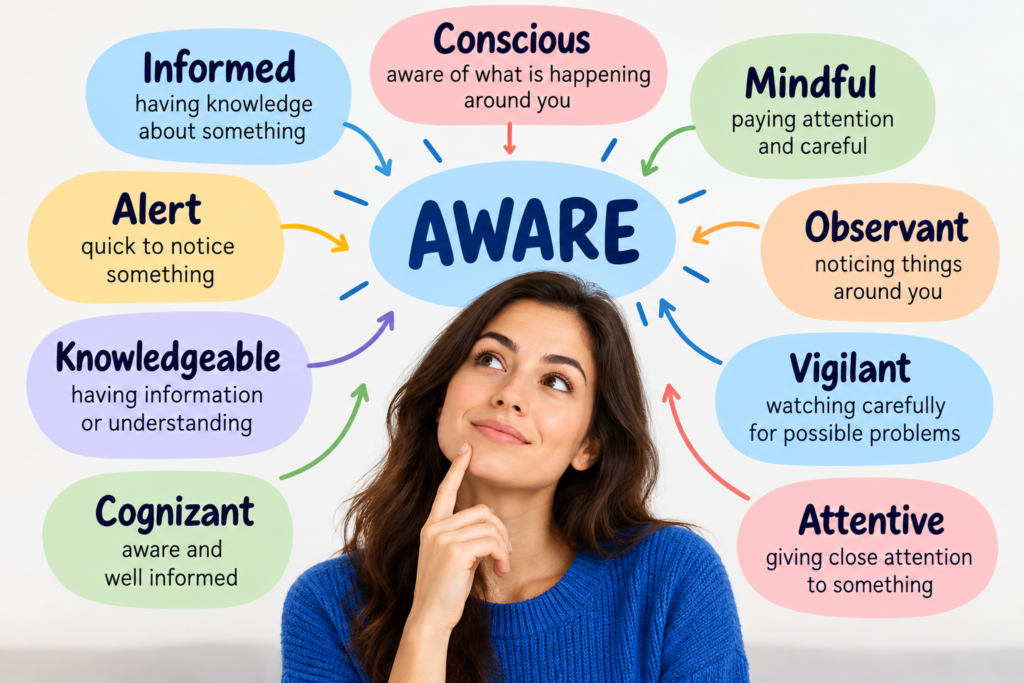
If you mean “knowing something,” useful choices include know, informed, knowledgeable, cognizant, conscious, and familiar with. If you mean “noticing something,” conscious, observant, attentive, perceptive, and alert may work better. If you mean “carefully watching for danger,” vigilant, watchful, wary, and on guard are stronger choices.
The word aware usually means knowing or realizing that something exists, is happening, or is important. It can also describe noticing something through your senses or having knowledge or experience of a subject.
Because of these different meanings, there is no single synonym that works perfectly in every sentence.
For example:
- “I am aware of the problem” can become “I know about the problem.”
- “She became aware of the noise” can become “She noticed the noise.”
- “He is aware of online security risks” can become “He is informed about online security risks.”
- “Stay aware of your surroundings” can become “Stay alert to your surroundings.”
This guide gives you 100 useful words and expressions related to aware, explains their differences, and shows how to use them naturally.
100 Synonyms and Related Words for Aware
Some entries below are direct synonyms. Others are close alternatives, phrases, or context-specific expressions. They are included because English does not always replace aware with one single word without changing the meaning slightly.
1. Conscious
Meaning: Knowing or noticing something.
Example: She was conscious of the change in his attitude.
Best for: Awareness of thoughts, feelings, surroundings, or facts.
2. Cognizant
Meaning: Understanding or realizing something.
Example: The manager was cognizant of the risks.
Best for: Formal, professional, and academic writing.
3. Informed
Meaning: Having information about something.
Example: Customers should be informed about the new policy.
Best for: Facts, decisions, policies, and current information.
4. Knowledgeable
Meaning: Having a lot of knowledge about a subject.
Example: Maria is knowledgeable about digital marketing.
Best for: Subjects, professions, skills, and areas of expertise.
5. Mindful
Meaning: Deliberately paying attention to something or keeping it in mind.
Example: Please be mindful of other people’s time.
Best for: Behavior, consideration, responsibilities, and careful attention.
6. Alert
Meaning: Ready to notice something, especially a danger or change.
Example: Drivers should remain alert in heavy traffic.
Best for: Safety, danger, sudden changes, and surroundings.
7. Attentive
Meaning: Giving close attention to someone or something.
Example: The teacher was attentive to every student’s question.
Best for: People, details, instructions, and situations requiring concentration.
8. Observant
Meaning: Good at noticing details.
Example: An observant employee noticed the small error.
Best for: People who notice things others may miss.
9. Perceptive
Meaning: Quick to notice and understand things.
Example: She made a perceptive comment about the team’s problem.
Best for: Understanding people, behavior, motives, and subtle details.
10. Wary
Meaning: Aware of possible danger and careful because of it.
Example: Buyers should be wary of unrealistic online offers.
Best for: Suspicion, risk, scams, and possible danger.
11. Vigilant
Meaning: Very watchful and careful about possible problems or danger.
Example: Security staff must remain vigilant.
Best for: Security, safety, threats, and monitoring.
12. Watchful
Meaning: Carefully observing something.
Example: The parents remained watchful while their children played.
Best for: Monitoring people, events, or possible problems.
13. Heedful
Meaning: Paying careful attention to something.
Example: Be heedful of the instructions before starting.
Best for: Warnings, advice, rules, and formal writing.
14. Familiar
Meaning: Having knowledge or experience of something.
Example: Are you familiar with this software?
Best for: Previous knowledge or experience.
15. Acquainted
Meaning: Having some knowledge of or experience with something.
Example: She is acquainted with the basic requirements.
Best for: Limited or general familiarity.
16. Apprised
Meaning: Officially informed about something.
Example: The director was apprised of the latest development.
Best for: Formal business and professional communication.
17. Enlightened
Meaning: Having gained greater knowledge or understanding.
Example: The workshop left participants more enlightened about the issue.
Best for: Learning, education, and deeper understanding.
Also Read: 100 Synonyms of Aware: Meanings, Examples, and How to Choose the Right Word
18. Understanding
Meaning: Having knowledge of a situation or showing that you understand it.
Example: He is understanding of the challenges faced by new employees.
Best for: Situations involving comprehension or empathy.
19. Discerning
Meaning: Able to recognize important differences or qualities.
Example: Discerning readers can identify weak arguments.
Best for: Judgment, quality, differences, and subtle distinctions.
20. Awake to
Meaning: Conscious of or responsive to something.
Example: The company is awake to changing customer expectations.
Best for: Formal or literary contexts.
21. Alive to
Meaning: Fully aware of the importance or existence of something.
Example: The team is alive to the risks involved.
Best for: Risks, opportunities, and important developments.
22. Savvy
Meaning: Practically knowledgeable about a particular subject.
Example: Savvy shoppers compare prices before buying.
Best for: Informal American English, business, technology, and practical knowledge.
23. Astute
Meaning: Quick to understand a situation and recognize important details.
Example: An astute manager noticed the warning signs.
Best for: Business, judgment, strategy, and decision-making.
24. Shrewd
Meaning: Good at understanding practical situations and making smart judgments.
Example: She is a shrewd business owner.
Best for: Business, negotiations, money, and practical decisions.
25. Insightful
Meaning: Showing deep understanding.
Example: His insightful observation helped solve the problem.
Best for: Ideas, comments, analysis, and people.
26. Receptive
Meaning: Ready and willing to receive or understand information.
Example: The students were receptive to the new ideas.
Best for: Learning, feedback, suggestions, and communication.
27. Sentient
Meaning: Capable of sensing or experiencing things.
Example: The discussion focused on the treatment of sentient beings.
Best for: Scientific, philosophical, or specialized contexts.
28. Knowing
Meaning: Having knowledge or showing recognition of something.
Example: She gave him a knowing smile.
Best for: General knowledge and certain idiomatic uses.
29. Wise to
Meaning: Aware of someone’s plan, trick, or dishonest behavior.
Example: The customer became wise to the sales tactic.
Best for: Informal language and situations involving deception.
30. Clued-in
Meaning: Well informed about what is happening.
Example: The clued-in employees knew about the change early.
Best for: Informal conversations.
31. In the know
Meaning: Having information that other people may not have.
Example: Only a few people were in the know.
Best for: Informal situations and inside information.
32. Up-to-date
Meaning: Having the latest information.
Example: Make sure your records are up-to-date.
Best for: News, information, technology, records, and research.
33. Abreast
Meaning: Informed about recent developments.
Example: She keeps abreast of changes in the industry.
Best for: Professional and formal writing, usually in “keep abreast of.”
34. Conversant
Meaning: Familiar with the details or principles of a subject.
Example: Applicants should be conversant with basic accounting.
Best for: Formal professional English.
35. Versed
Meaning: Knowledgeable or experienced in a particular area.
Example: He is well versed in computer security.
Best for: Skills, subjects, professions, and expertise.
36. Well-informed
Meaning: Having plenty of accurate information.
Example: A well-informed customer can make a better decision.
Best for: Decisions, opinions, current events, and research.
37. Well-aware
Meaning: Fully conscious or informed about something.
Example: She was well-aware of the possible consequences.
Best for: Emphasizing strong awareness.
38. Tuned in
Meaning: Paying attention to what is happening.
Example: Good leaders stay tuned in to employee concerns.
Best for: Informal professional and everyday English.
39. On guard
Meaning: Alert and prepared for danger or trouble.
Example: The workers remained on guard after the warning.
Best for: Threats, danger, and security.
40. On the lookout
Meaning: Actively watching for something.
Example: We are on the lookout for unusual activity.
Best for: Searching, monitoring, and potential problems.
41. Paying attention
Meaning: Actively focusing on something.
Example: You need to pay attention to the warning signs.
Best for: Everyday English.
42. Noticing
Meaning: Becoming conscious of something through observation.
Example: She started noticing changes in the weather.
Best for: Physical details, changes, and events.
43. Recognizing
Meaning: Identifying or realizing something.
Example: He is recognizing the importance of good communication.
Best for: Identification and realization.
44. Realizing
Meaning: Coming to understand or become conscious of something.
Example: She is realizing how important the decision was.
Best for: New understanding.
45. Understanding
Meaning: Knowing what something means or how it works.
Example: He has a good understanding of the problem.
Best for: Knowledge and comprehension.
46. Knowing about
Meaning: Having information about something.
Example: Do you know about the new rules?
Best for: Simple everyday English.
47. Knowing of
Meaning: Having heard of or being familiar with the existence of something.
Example: I know of several companies that offer this service.
Best for: General familiarity rather than detailed knowledge.
48. Familiar with
Meaning: Having knowledge or experience of something.
Example: Most workers are familiar with the system.
Best for: Skills, systems, places, and subjects.
49. Acquainted with
Meaning: Having some knowledge or experience of something.
Example: I am acquainted with the basic process.
Best for: Formal language and limited familiarity.
50. Informed about
Meaning: Having received information about something.
Example: Employees were informed about the schedule.
Best for: Announcements, policies, and instructions.
51. Informed of
Meaning: Officially told about a fact or event.
Example: The applicants were informed of the decision.
Best for: Formal notices and official communication.
52. Conscious of
Meaning: Knowing or noticing something.
Example: He was conscious of the effect his words had.
Best for: Feelings, effects, behavior, and observations.
53. Mindful of
Meaning: Deliberately keeping something in mind.
Example: Be mindful of the deadline.
Best for: Responsibilities, limits, feelings, and behavior.
54. Alert to
Meaning: Ready to notice something.
Example: Businesses must remain alert to changes in demand.
Best for: Risks, trends, and changes.
55. Aware of
Meaning: Knowing or noticing something.
Example: Are you aware of the new requirements?
Best for: The standard form of the word itself.
56. Aware that
Meaning: Knowing that something is true or happening.
Example: She was aware that the meeting had changed.
Best for: Clauses containing information or facts.
57. Conscious that
Meaning: Knowing or recognizing that something is true.
Example: He was conscious that others were waiting.
Best for: Formal or thoughtful writing.
58. Cognizant of
Meaning: Formally aware of something.
Example: Leaders should be cognizant of changing expectations.
Best for: Formal business, legal, and academic contexts.
59. Apprised of
Meaning: Formally told about something.
Example: The board was apprised of the situation.
Best for: Official communication.
60. Alive to
Meaning: Fully conscious of a risk, fact, or opportunity.
Example: Investors are alive to the possibility of change.
Best for: Risks and important developments.
61. Attuned to
Meaning: Highly aware of or sensitive to something.
Example: Good teachers are attuned to students’ needs.
Best for: Feelings, trends, needs, and subtle changes.
62. Sensitive to
Meaning: Quick to notice or respond to something.
Example: The company is sensitive to customer concerns.
Best for: Feelings, social issues, changes, and reactions.
63. Responsive to
Meaning: Aware enough to react appropriately.
Example: The organization is responsive to customer feedback.
Best for: Organizations, people, systems, and reactions.
64. Observant of
Meaning: Careful about noticing or following something.
Example: He was observant of every detail.
Best for: Details and careful observation.
65. Watchful of
Meaning: Carefully observing something that may cause concern.
Example: Parents should be watchful of unusual behavior.
Best for: Safety and monitoring.
66. Vigilant about
Meaning: Very careful and watchful about something.
Example: The team is vigilant about security.
Best for: Safety, cybersecurity, security, and risks.
67. Wary of
Meaning: Cautious because you recognize a possible problem.
Example: Be wary of offers that seem too good to be true.
Best for: Suspicion and potential danger.
68. Heedful of
Meaning: Giving careful attention to something.
Example: Be heedful of the road conditions.
Best for: Warnings and advice.
69. Conscious of one’s surroundings
Meaning: Noticing what is happening around you.
Example: Hikers should remain conscious of their surroundings.
Best for: Safety and environmental awareness.
70. Environmentally aware
Meaning: Conscious of environmental effects and issues.
Example: More consumers are becoming environmentally aware.
Best for: Climate, conservation, recycling, and sustainability.
71. Socially aware
Meaning: Understanding social issues and their effects.
Example: Socially aware businesses often consider their community impact.
Best for: Society, communities, and social issues.
72. Culturally aware
Meaning: Understanding and respecting cultural differences.
Example: Culturally aware teams communicate more thoughtfully with diverse groups.
Best for: Education, workplaces, travel, and communication.
73. Politically aware
Meaning: Understanding political issues and developments.
Example: Young voters are becoming more politically aware.
Best for: Government, elections, and public issues.
74. Self-aware
Meaning: Understanding your own thoughts, emotions, behavior, strengths, and weaknesses.
Example: A self-aware leader can recognize areas where improvement is needed.
Best for: Personal development and leadership.
75. Self-conscious
Meaning: Very aware of yourself, especially in a way that makes you uncomfortable.
Example: He felt self-conscious speaking in front of the crowd.
Best for: Social discomfort. It is not always a direct synonym for self-aware.
76. Hyper-aware
Meaning: Extremely aware of something.
Example: After the incident, she became hyper-aware of every sound.
Best for: Very strong or heightened awareness.
77. Fully conscious
Meaning: Completely aware of what is happening.
Example: He was fully conscious of the decision he was making.
Best for: Strong emphasis.
78. Highly attentive
Meaning: Giving a very high level of attention.
Example: The staff were highly attentive to customer needs.
Best for: Service, education, and detailed work.
79. Keenly aware
Meaning: Very strongly aware.
Example: She was keenly aware of the pressure.
Best for: Strong emotional or intellectual awareness.
80. Acutely aware
Meaning: Extremely aware, often because something is important or serious.
Example: The company is acutely aware of the financial risks.
Best for: Serious situations and formal writing.
81. Fully informed
Meaning: Having all or most of the relevant information needed.
Example: Customers should be fully informed before making a decision.
Best for: Decisions, agreements, policies, and professional communication.
82. Briefed
Meaning: Given information about a particular situation.
Example: The manager briefed the team before the meeting.
Best for: Work, military, government, and organized activities.
83. Posted
Meaning: Informed or made aware, especially in informal usage.
Example: Keep me posted about any changes.
Best for: Informal communication.
84. Advised
Meaning: Given information or guidance about something.
Example: We were advised of the possible delay.
Best for: Instructions, warnings, and formal communication.
85. Notified
Meaning: Officially told about something.
Example: Customers were notified of the change.
Best for: Official notices and announcements.
86. Alerted
Meaning: Warned or made aware of a possible problem.
Example: The residents were alerted to the danger.
Best for: Emergencies, risks, and warnings.
87. Warned
Meaning: Told about a possible danger or problem.
Example: The driver was warned about the icy road.
Best for: Danger and caution.
88. Enlightened about
Meaning: Given or gaining better knowledge about a subject.
Example: The course enlightened students about online privacy.
Best for: Education and improved understanding.
89. Conscious of the fact
Meaning: Aware that something is true.
Example: She was conscious of the fact that time was limited.
Best for: Formal writing, although simpler wording is often better.
90. Informed about the situation
Meaning: Having knowledge of current circumstances.
Example: The staff were informed about the situation.
Best for: Workplace communication and updates.
91. Up to speed
Meaning: Having the latest information needed to understand what is happening.
Example: Let me bring you up to speed before we begin.
Best for: Informal workplace English.
92. In touch with
Meaning: Aware of or connected to current developments, needs, or opinions.
Example: The company tries to stay in touch with customer expectations.
Best for: Trends, people, and changing needs.
93. On top of
Meaning: Fully aware of and managing something.
Example: She is on top of all the project deadlines.
Best for: Informal professional English.
94. With your eyes open
Meaning: Acting while fully aware of possible results or risks.
Example: You should enter the agreement with your eyes open.
Best for: Decisions involving risk.
95. With it
Meaning: Alert, informed, and mentally aware.
Example: He is still very much with it despite his age.
Best for: Informal English.
96. Informed and prepared
Meaning: Having relevant knowledge and being ready to respond.
Example: The team needs to be informed and prepared before launch.
Best for: Planning, work, and risk management.
97. Conscious and attentive
Meaning: Both aware of something and actively paying attention to it.
Example: Be conscious and attentive to changes in the environment.
Best for: Situations requiring careful observation.
98. Aware of the implications
Meaning: Understanding the possible effects or results of something.
Example: Decision-makers must be aware of the implications.
Best for: Academic, business, and analytical writing.
99. Aware of the risks
Meaning: Understanding that dangers or negative outcomes are possible.
Example: Travelers should be aware of the risks before beginning the trip.
Best for: Safety, finance, health, travel, and decision-making.
100. Aware of the circumstances
Meaning: Understanding the situation and conditions surrounding an event.
Example: The manager was aware of the circumstances before making a decision.
Best for: Professional and general contexts.
What Does Aware Mean?
Aware is an adjective that describes a person who knows, realizes, or notices something. It is normally used after a linking verb rather than directly before a noun.
Common patterns include:
- be aware of something
- become aware of something
- be aware that something is happening
- make someone aware of something
- be made aware of something
- be fully aware
- be well aware
- be very aware
For example:
“Are you aware of the new policy?”
This means:
“Do you know about the new policy?”
The word can also describe noticing something as it happens:
“She suddenly became aware of someone standing behind her.”
In another use, aware can describe a person who understands an area of social, cultural, political, or environmental importance. Oxford notes this use in expressions such as environmentally aware and politically aware.
Aware Synonym by Meaning
Choosing an aware synonym becomes much easier when you first identify the intended meaning.
When aware means “know”
Use:
- know
- informed
- knowledgeable
- cognizant
- well-informed
- conversant
- versed
- familiar with
- acquainted with
Example:
Original: “She is aware of the regulations.”
Better alternatives:
“She knows the regulations.”
“She is familiar with the regulations.”
“She is well-informed about the regulations.”
“She is conversant with the regulations.”
The best choice depends on how much knowledge you want to express.
When aware means “notice”
Use:
- conscious
- notice
- observant
- attentive
- perceptive
- recognize
- realize
- paying attention
Example:
“He became aware of the noise.”
Natural alternatives include:
“He noticed the noise.”
“He became conscious of the noise.”
“He realized there was a noise.”
“Notice” is usually the simplest everyday option.
When aware means “careful about danger”
Use:
- alert
- vigilant
- watchful
- wary
- heedful
- on guard
- on the lookout
- cautious
These words are related, but they are not identical.
For example, alert describes readiness to notice danger, while wary suggests caution because you suspect a possible problem.
When aware means “understand deeply”
Use:
- understand
- comprehend
- recognize
- realize
- insightful
- perceptive
- enlightened
- discerning
Example:
“She became aware of the seriousness of the problem.”
Possible alternatives include:
“She realized how serious the problem was.”
“She understood the seriousness of the problem.”
“She came to recognize the seriousness of the problem.”
What Is Another Word for Aware in Different Situations?
Another word for aware in formal writing
The strongest formal choices include cognizant, conscious of, informed, apprised of, conversant with, knowledgeable, and fully informed.
Cognizant is particularly formal and means understanding or realizing something.
Example:
Less formal: “The company is aware of the problem.”
Formal: “The company is cognizant of the problem.”
However, formal does not always mean better. In many professional documents, simple words such as know, understand, and informed are clearer.
Another word for aware in everyday English
For normal conversation, use:
- know
- notice
- realize
- understand
- familiar with
- paying attention
- alert
- keep in mind
Example:
Instead of “Are you cognizant of the problem?”
Say:
“Do you know about the problem?”
The second sentence sounds much more natural in everyday American English.
Another word for very aware
If you need to emphasize strong awareness, consider:
- highly aware
- fully aware
- well aware
- acutely aware
- keenly aware
- deeply conscious
- hyper-aware
- extremely attentive
Example:
“She was very aware of the risks.”
can become:
“She was acutely aware of the risks.”
or:
“She was fully aware of the risks.”
Aware Synonyms for Common Search Phrases
People often search for an aware synonym because they want to improve a particular phrase rather than replace the word everywhere.
Be aware synonym
Depending on the sentence, try:
- know
- understand
- recognize
- keep in mind
- remember
- take note
- pay attention
- stay alert
Example:
“Be aware of the deadline.”
Possible alternatives:
“Keep the deadline in mind.”
“Remember the deadline.”
“Pay attention to the deadline.”
Become aware synonym
Useful alternatives include:
- realize
- notice
- recognize
- discover
- learn
- come to understand
- become conscious of
- become informed about
Example:
“She became aware of the problem.”
could become:
“She realized there was a problem.”
Made aware synonym
Useful alternatives include:
- informed
- notified
- alerted
- advised
- told
- briefed
- apprised
Example:
“The employees were made aware of the change.”
could become:
“The employees were informed of the change.”
This is often the clearest choice.
Make aware synonym
Depending on the context, use:
- inform
- notify
- alert
- advise
- tell
- brief
- educate
- explain
- bring to someone’s attention
Example:
“The campaign aims to make people aware of online scams.”
could become:
“The campaign aims to inform people about online scams.”
Being aware synonym
Possible alternatives include:
- knowing
- understanding
- noticing
- recognizing
- paying attention
- being conscious
- being informed
- being mindful
The correct option depends heavily on the sentence.
Self-Aware Synonyms
Self-aware is related to aware, but it has a more specific meaning. It describes understanding your own thoughts, emotions, behavior, strengths, weaknesses, or effect on other people.
Possible alternatives include:
- self-conscious
- introspective
- reflective
- self-knowing
- self-understanding
- emotionally aware
- inward-looking
However, these are not perfect replacements.
For example, self-conscious often means feeling uncomfortable because you are thinking too much about how other people see you. Self-aware is usually more neutral and can be positive.
Example:
“She is self-aware enough to recognize her weaknesses.”
A better alternative might be:
“She understands her own weaknesses.”
rather than:
“She is self-conscious enough to recognize her weaknesses.”
Culturally Aware Synonyms
Culturally aware means understanding that people may have different cultural backgrounds, values, traditions, communication styles, and experiences.
Possible alternatives include:
- culturally informed
- culturally sensitive
- culturally knowledgeable
- culturally conscious
- culturally competent
- respectful of cultural differences
- sensitive to cultural differences
These expressions are related but should not automatically be treated as identical. For example, cultural sensitivity emphasizes careful and respectful behavior, while cultural knowledge emphasizes information and understanding.
Aware vs. Conscious
Aware and conscious are often interchangeable, but there is a small difference.
Aware usually focuses on knowing or realizing something.
Conscious often emphasizes noticing or recognizing something, especially through thought or attention. Cambridge lists conscious as a close synonym when conscious means noticing something.
Compare:
“I am aware of the problem.”
“I am conscious of the problem.”
Both can work.
But:
“She became conscious of the noise.”
strongly suggests that she noticed it.
Aware vs. Alert
Aware means knowing or noticing something.
Alert means ready to notice or respond, especially when there may be danger or change.
Compare:
“The driver was aware of the traffic.”
“The driver was alert to the traffic.”
The second sentence suggests active attention and readiness.
That is why alert is usually better for safety instructions:
“Stay alert while driving.”
rather than:
“Stay aware while driving.”
Both can be correct, but they communicate slightly different levels of readiness.
Aware vs. Mindful
Mindful means deliberately keeping something in your thoughts and often includes an idea of consideration.
Compare:
“She is aware of other people’s feelings.”
“She is mindful of other people’s feelings.”
The second sentence can suggest that she actively considers those feelings when making decisions.
Mindful is therefore useful when the intended meaning includes care, consideration, or deliberate attention.
Aware vs. Informed
Aware can mean knowing that something exists.
Informed usually suggests having received useful or relevant information.
For example:
“I am aware of the new policy.”
means you know about it.
“I am informed about the new policy.”
suggests that you have received information about its details.
Cambridge includes informed, apprised, familiar with, and knowledgeable among words related to knowing facts.
Aware vs. Knowledgeable
These words are also different.
Aware means you know about something.
Knowledgeable means you have substantial knowledge about it.
For example:
“I am aware of artificial intelligence.”
This only says that you know it exists or understand something about it.
“I am knowledgeable about artificial intelligence.”
This suggests a much deeper level of knowledge.
Aware vs. Familiar
Familiar means having previous knowledge or experience with something.
Example:
“I am familiar with this software.”
This is often more natural than:
“I am aware of this software.”
The first sentence suggests that you know the software to some degree. The second only establishes awareness of its existence.
Aware vs. Wary
Wary is not a general synonym for aware.
Wary means aware of possible danger and therefore cautious.
Example:
“She was aware of the stranger.”
This simply means she noticed or knew about the stranger.
“She was wary of the stranger.”
This means she viewed the stranger with caution or suspicion.
Aware Antonym: What Is the Opposite of Aware?
The most direct antonym of aware is unaware.
Other related opposites include:
- uninformed
- uninformed about
- unfamiliar
- unacquainted
- oblivious
- ignorant
- unconscious
- unmindful
- inattentive
- unsuspecting
- unwitting
These are not interchangeable in every situation.
For example, unaware means lacking knowledge of something. Oblivious can suggest that someone fails to notice something that is happening around them.
Cambridge and Oxford both identify unaware as the direct opposite of aware.
Synonyms for Awareness
Awareness is the noun form connected to aware. It generally means knowledge or recognition that something exists, happens, or matters. Oxford also uses awareness for knowledge that something exists and is important, as well as interest or concern about a particular subject.
Useful synonyms and related expressions include:
- consciousness
- knowledge
- understanding
- recognition
- realization
- perception
- mindfulness
- attentiveness
- familiarity
- comprehension
- insight
- appreciation
- acknowledgment
- alertness
- attentiveness
- sensitivity
- notice
- consciousness of
- understanding of
- recognition of
Another word for awareness
The best alternative depends on context.
“Public awareness” can become “public understanding” in some contexts.
“Awareness of the problem” can become “recognition of the problem.”
“Environmental awareness” can become “environmental consciousness” or “understanding of environmental issues.”
“Self-awareness” can become “self-understanding” in some contexts.
How to Choose the Right Aware Synonym
Do not choose a synonym simply because a thesaurus lists it. First decide what you are trying to say.
Ask these questions:
- Do I mean knowing a fact?
- Do I mean noticing something?
- Do I mean understanding something deeply?
- Do I mean paying close attention?
- Do I mean being prepared for danger?
- Do I mean having experience with something?
- Do I mean receiving official information?
- Do I mean understanding my own behavior or emotions?
Then select the word that matches that meaning.
For example:
If you mean “know,” use know or informed.
If you mean “notice,” use notice or conscious.
If you mean “pay attention,” use attentive or mindful.
If you mean “watch for danger,” use alert or vigilant.
If you mean “be cautious,” use wary.
If you mean “have experience,” use familiar or acquainted.
If you mean “receive official information,” use informed, notified, or apprised.
This approach produces more natural English than replacing aware with the most formal word available.
Common Grammar Patterns With Aware
The word aware has several common sentence patterns.
Aware of + noun
“I am aware of the problem.”
“She is aware of the changes.”
“They are aware of the risks.”
Aware that + clause
“I am aware that the schedule has changed.”
“She was aware that the situation was serious.”
“They became aware that something was wrong.”
Become aware of
“He became aware of the mistake.”
“She suddenly became aware of the noise.”
Make someone aware of
“The teacher made students aware of the safety rules.”
Be made aware of
“The staff were made aware of the new requirements.”
Well aware
“She is well aware of the consequences.”
Fully aware
“He was fully aware of the possible outcome.”
Very aware
“Consumers are becoming very aware of privacy concerns.”
Oxford lists common patterns such as aware of, aware that, become aware of, and made aware of.
Better Alternatives to “Please Be Aware”
“Please be aware” is correct, but it can sound repetitive in notices, emails, and professional writing.
Depending on the situation, you could use:
- Please note
- Please remember
- Please keep in mind
- Please be advised
- Please take note
- Please consider
- Please remember that
- Kindly note
Example:
“Please be aware that the office will close early.”
Possible alternative:
“Please note that the office will close early.”
“Please be advised that the appointment time has changed.”
The best choice depends on how formal the message needs to sound.
Better Alternatives to “As You Are Aware”
The phrase “as you are aware” is common in professional writing, but it can sometimes sound unnecessarily formal.
Possible alternatives include:
- as you know
- as you may know
- as discussed
- as previously mentioned
- as noted earlier
- as we discussed
- as you already know
Example:
“As you are aware, the deadline has changed.”
A simpler version is:
“As you know, the deadline has changed.”
If the reader may not actually know, “as you know” can sound presumptive. In that situation, “as previously discussed” or “as mentioned earlier” may be more accurate.
When “Aware” Is Better Than a Synonym
You do not always need a replacement.
Aware is short, clear, natural, and widely understood. In many situations, replacing it with cognizant, conversant, or apprised can make a sentence sound unnecessarily complicated.
For example:
“Consumers are aware of privacy concerns.”
This is clear.
“Consumers are cognizant of privacy concerns.”
This is grammatically possible, but more formal.
Good writing is not about using the most complicated synonym. It is about choosing the word that communicates the intended meaning clearly.
Frequently Asked Questions
What is the closest synonym for aware?
Conscious, informed, cognizant, and know are among the closest alternatives, but the best choice depends on context. Conscious often emphasizes noticing, informed emphasizes receiving information, and cognizant is more formal.
What is another word for aware in simple English?
Know, notice, understand, realize, and informed are useful simple alternatives.
What is a formal synonym for aware?
Cognizant is a strong formal synonym. Apprised of, conversant with, and fully informed can also work in appropriate contexts.
What is a professional synonym for aware?
In professional writing, informed, cognizant, conscious of, apprised of, knowledgeable, and fully informed can be useful.
What is a synonym for very aware?
Fully aware, well aware, acutely aware, keenly aware, highly aware, and hyper-aware can express strong awareness.
What is a synonym for becoming aware?
Realizing, noticing, recognizing, discovering, learning, becoming conscious of, and becoming informed are useful alternatives.
What is a synonym for made aware?
Informed, notified, alerted, advised, briefed, and apprised are useful alternatives depending on the context.
What is a synonym for make aware?
Inform, notify, alert, advise, educate, explain, brief, and bring to someone’s attention can work.
What is another word for self-aware?
Self-aware is already a specific term. Depending on the intended meaning, self-understanding, reflective, introspective, and emotionally aware may work, but they do not mean exactly the same thing.
What is a synonym for culturally aware?
Culturally sensitive, culturally informed, culturally knowledgeable, and culturally conscious are related alternatives. The best choice depends on whether you want to emphasize knowledge, sensitivity, or understanding.
What is the difference between aware and conscious?
Both can mean knowing or noticing something. Aware is the broader everyday word, while conscious often emphasizes noticing or recognizing something.
What is the difference between aware and alert?
Aware means knowing or noticing something. Alert means ready to notice or respond, especially when danger or change is possible.
Is mindful a synonym for aware?
Yes, in some contexts. Mindful usually adds the idea of deliberately keeping something in mind or behaving with consideration.
Is knowledgeable the same as aware?
No. A person can be aware of a subject without being knowledgeable about it. Knowledgeable normally suggests a deeper level of information or expertise.
Is wary a synonym for aware?
Only in a limited context. Wary means aware of possible danger and cautious because of it, so it carries a stronger meaning than ordinary aware.
What is the opposite of aware?
The most direct opposite is unaware. Depending on context, oblivious, uninformed, unfamiliar, unmindful, inattentive, or unsuspecting may also describe a lack of awareness.
What is the noun form of aware?
The noun is awareness. It refers to knowledge, recognition, or understanding that something exists or is important.
What is another word for awareness?
Depending on context, alternatives include consciousness, knowledge, recognition, realization, understanding, perception, mindfulness, insight, alertness, and sensitivity.
What is a synonym for realization?
Recognition, understanding, discovery, awareness, comprehension, and insight can be related alternatives. The exact choice depends on whether you mean suddenly understanding something, discovering a fact, or becoming conscious of a situation.
What is a synonym for notice?
Observe, see, detect, recognize, perceive, spot, identify, and become aware of can work depending on the sentence.
What is a synonym for understand?
Comprehend, grasp, recognize, appreciate, realize, perceive, and make sense of are common alternatives.
Final Thoughts
The word aware is simple, useful, and flexible, but its meaning changes slightly depending on the situation. Sometimes it means knowing a fact. Sometimes it means noticing something. In other situations, it describes careful attention, understanding, or sensitivity to an issue.
That is why the best aware synonym is not always the most formal word.
Use know when you simply mean having information. Use notice when you mean becoming conscious of something. Use informed when someone has received relevant information. Use conscious when you want to emphasize recognition. Use mindful when deliberate attention or consideration matters. Use alert or vigilant when safety and readiness are important. Use wary when awareness leads to caution. Use knowledgeable when you mean substantial knowledge.
For formal writing, cognizant, apprised, conversant, and versed can be useful, but they should be used only when their specific meanings and tone fit the sentence.
The most effective vocabulary choice is the one that makes your meaning clearer, not the one that sounds more complicated. Understanding these differences will help you choose better words for essays, emails, professional documents, conversations, and everyday English.