100 Synonyms of Preceding: Meanings, Examples, and Opposites
The word preceding describes something that comes before another thing in time, order, or position. It is commonly used in books, instructions, reports, academic writing, and everyday communication.
For example, in the sentence “Review the preceding section before answering the questions,” the word preceding refers to the section that appears earlier in the document.
Finding another word for preceding can make your writing clearer and more natural. Depending on the sentence, you might use previous, earlier, prior, former, or a phrase such as “that came before.” However, these alternatives do not always have exactly the same meaning.
This guide explains the preceding definition, explores useful preceding synonyms, provides original example sentences, and identifies the opposite of preceding. It also explains related words such as precede, preceded, precedence, and precedent so you can choose the right word for your needs.
What Is the Definition of Preceding?
Preceding is the present participle of the verb precede. It can also function as an adjective.
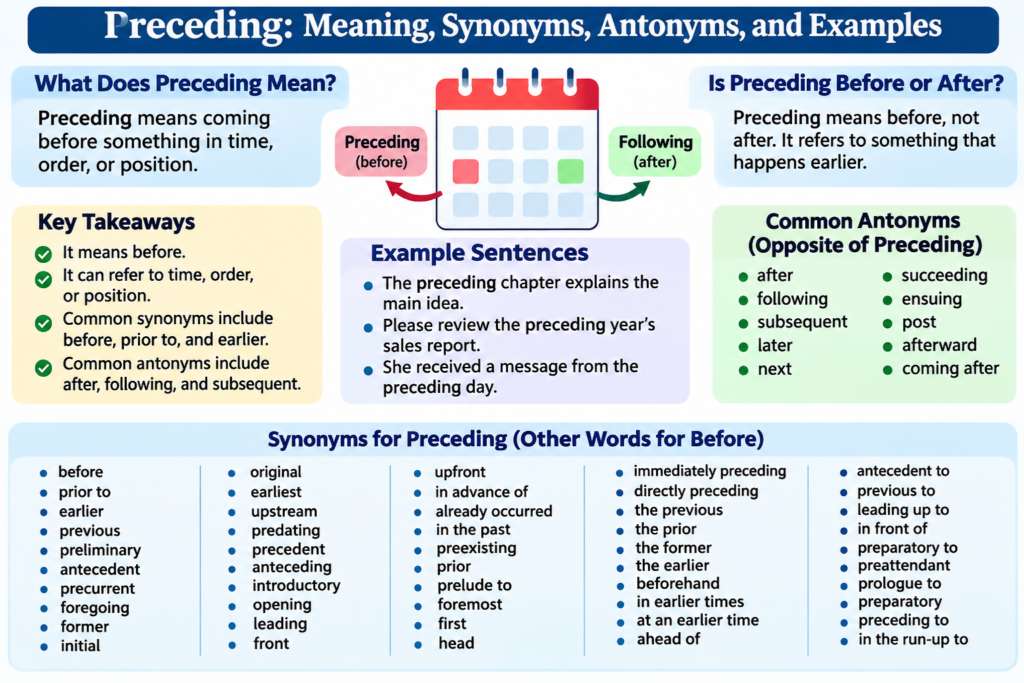
Preceding definition: Coming before something else in time, order, or position.
The word usually identifies an event, period, item, statement, or person that comes before a reference point.
Examples of preceding in a sentence
- Please read the preceding paragraph before moving to the next section.
- The preceding year was difficult for the company.
- The final decision depended on the events preceding the meeting.
- Check the preceding number to understand the pattern.
- The instructions refer to the immediately preceding step.
In each example, preceding points to something that comes before another thing.
What does preceding mean in simple English?
In simple English, preceding means “coming before” or “happening earlier.”
For example:
- The preceding chapter = the chapter before this one.
- The preceding month = the month before the month being discussed.
- The preceding sentence = the sentence immediately before the current sentence, when the context identifies that sentence.
- The preceding event = an event that happened before another event.
The exact meaning depends on what is being discussed. Sometimes preceding refers to something that happened earlier in time. In other cases, it refers to an earlier item in a list, document, process, or sequence.
Does Preceding Mean Before or After?
Preceding means before, not after.
The distinction becomes easier to understand when you compare preceding with following.
| Word | Meaning | Example |
| Preceding | Coming before | Read the preceding page. |
| Following | Coming after | Read the following page. |
| Previous | Existing or occurring before the current reference point | The previous meeting was canceled. |
| Subsequent | Happening or coming afterward | Subsequent meetings addressed the issue. |
Imagine a document containing three sections: A, B, and C.
If you are reading section B, section A is the preceding section, and section C is the following section.
Similarly, if a report discusses events in October, the preceding month is September. The following month is November.
Remember that the reference point matters. A word can describe something before or after a particular event only when you know which event is being used for comparison.
100 Synonyms and Related Alternatives for Preceding
There is no single synonym that works in every situation. Some words describe something that happened earlier, while others identify an earlier position, a previous version, or an event that led to another event.
The following list includes 100 useful synonyms, contextual alternatives, and related expressions. Some are direct substitutes; others work only in particular sentences. They are grouped by meaning to help you avoid choosing a word that changes your intended message.
Also Read: 100+ Synonyms for Difficulty: Meanings, Examples, and Usage Guide
1. Common synonyms for preceding
These are useful alternatives when you want to describe something that existed or happened before the current reference point.
| No. | Synonym | Meaning and example |
| 1 | Previous | The one before the current one. Example: I corrected the previous draft. |
| 2 | Earlier | Happening before a particular time. Example: She arrived earlier than expected. |
| 3 | Prior | Existing or happening before something else. Example: Prior approval was required. |
| 4 | Before | At an earlier time or position. Example: We had met before. |
| 5 | Former | Previously holding a role or status. Example: The former director attended the event. |
| 6 | Past | Belonging to an earlier period. Example: Past experience helped the team. |
| 7 | Foregoing | Already mentioned or stated. Example: The foregoing discussion explains the issue. |
| 8 | Antecedent | Something that comes before another thing, often in a logical or historical relationship. Example: Researchers examined the antecedent conditions. |
| 9 | Earlier-mentioned | Referred to earlier in a discussion or document. Example: The earlier-mentioned rule still applies. |
| 10 | Previously mentioned | Already discussed or identified. Example: Use the previously mentioned method. |
| 11 | Previously stated | Expressed earlier. Example: The previously stated conditions remain unchanged. |
| 12 | Previously discussed | Examined at an earlier point. Example: Return to the previously discussed topic. |
| 13 | Earlier-described | Explained in an earlier passage. Example: Follow the earlier-described procedure. |
| 14 | Previously identified | Recognized or named earlier. Example: The previously identified problem needs attention. |
| 15 | Previously established | Set up or confirmed before the current point. Example: The previously established rules remain in effect. |
2. Words for something that happened earlier
Use these alternatives when the focus is on time, history, or an event that occurred before another event.
| No. | Synonym or alternative | Meaning and example |
| 16 | Earlier-occurring | Happening before another event. Example: Earlier-occurring symptoms were recorded. |
| 17 | Pre-existing | Already present before a specified event or time. Example: The repair revealed a pre-existing defect. |
| 18 | Pre-event | Occurring before an event. Example: The team completed its pre-event checks. |
| 19 | Pre-incident | Occurring before an incident. Example: Investigators reviewed pre-incident records. |
| 20 | Pre-transaction | Existing or taking place before a transaction. Example: The accountant checked pre-transaction balances. |
| 21 | Pre-departure | Taking place before departure. Example: The passengers completed pre-departure checks. |
| 22 | Pre-opening | Occurring before a place or event opens. Example: Staff attended a pre-opening briefing. |
| 23 | Pre-launch | Happening before a product or project launches. Example: Pre-launch testing revealed an error. |
| 24 | Pre-existing condition | A condition that was present before a specified point. Example: The report noted a pre-existing condition. |
| 25 | Historical | Relating to the past. Example: The archive contains historical records. |
| 26 | Bygone | Belonging to an earlier, often distant, period. Example: The museum displays objects from a bygone era. |
| 27 | Formerly existing | Existing at an earlier time but no longer existing in the same form. Example: The formerly existing route has closed. |
| 28 | Earlier in time | Occurring at a time before another event. Example: The second message arrived earlier in time than the first report was issued. |
| 29 | Prior to | Before a particular event or time. Example: Submit the form prior to the deadline. |
| 30 | Beforehand | Before a planned event or action. Example: Please prepare the materials beforehand. |
3. Words for an earlier position or order
These expressions are most useful for lists, documents, instructions, stages, and sequences.
| No. | Synonym or alternative | Meaning and example |
| 31 | Earlier in the sequence | Located before another item in a series. Example: The earlier item in the sequence was incorrect. |
| 32 | Previous in order | Located before another item. Example: Check the previous item in order. |
| 33 | Immediately before | Directly ahead of something in sequence or time. Example: The warning appeared immediately before the error message. |
| 34 | Directly before | Coming right before another item or event. Example: A short introduction appears directly before the main text. |
| 35 | Immediately prior | Directly before a reference point. Example: Save the file immediately prior to updating it. |
| 36 | Earlier in the list | Appearing at an earlier position in a list. Example: The answer appears earlier in the list. |
| 37 | Earlier in the document | Located in a previous part of a document. Example: The definition appears earlier in the document. |
| 38 | Earlier in the chapter | Located in a previous part of a chapter. Example: The example appeared earlier in the chapter. |
| 39 | Earlier in the paragraph | Appearing before another point in the same paragraph. Example: The term was defined earlier in the paragraph. |
| 40 | Previous entry | An item recorded before the current entry. Example: Correct the previous entry in the register. |
| 41 | Previous item | An item that comes before the current one. Example: Select the previous item from the menu. |
| 42 | Previous section | A section that appears earlier. Example: The previous section explains the background. |
| 43 | Previous chapter | A chapter that comes before the current chapter. Example: The previous chapter introduced the characters. |
| 44 | Previous paragraph | A paragraph that comes before the current paragraph. Example: The previous paragraph contains the definition. |
| 45 | Previous sentence | A sentence that comes before another sentence. Example: The previous sentence introduces the main idea. |
4. Alternatives for earlier versions, stages, and periods
These expressions work when discussing changes, development, projects, and time periods.
Also Read: 100+ Synonyms of Coexist: Meaning, Definition, Examples, and Related Words
| No. | Synonym or alternative | Meaning and example |
| 46 | Earlier version | A form that existed before the current version. Example: The earlier version lacked this feature. |
| 47 | Previous version | The version released or used before the current one. Example: Install the previous version if needed. |
| 48 | Prior version | An earlier form of a product or document. Example: The prior version contained an error. |
| 49 | Older version | A version that is less recent. Example: The older version works on this device. |
| 50 | Previous edition | An edition published before the current one. Example: The previous edition included a different chapter. |
| 51 | Earlier edition | An edition released at an earlier time. Example: An earlier edition used a different title. |
| 52 | Previous stage | A stage completed before the current stage. Example: The previous stage required additional testing. |
| 53 | Prior stage | An earlier step in a process. Example: The prior stage established the project goals. |
| 54 | Earlier phase | A phase that occurred before another phase. Example: The earlier phase focused on planning. |
| 55 | Initial phase | The beginning phase of a process. Example: The initial phase involved research. |
| 56 | Opening stage | The stage at the start of an activity. Example: The opening stage introduced the basic rules. |
| 57 | Preliminary | Occurring before a final or more complete stage. Example: Preliminary results were promising. |
| 58 | Introductory | Serving as an introduction or beginning. Example: The introductory section explains the topic. |
| 59 | Original | Present at the beginning or serving as the first version. Example: The original plan included three steps. |
| 60 | Initial | Belonging to the beginning of a process. Example: Initial findings guided further research. |
5. Alternatives for events, records, and circumstances
These words and phrases can help describe earlier actions, records, situations, or circumstances. They are not all direct replacements for preceding.
| No. | Synonym or alternative | Meaning and example |
| 61 | Earlier event | An event that occurred before another event. Example: The earlier event affected attendance. |
| 62 | Prior event | An event that happened before a reference event. Example: The prior event changed the schedule. |
| 63 | Previous occurrence | Something that happened on an earlier occasion. Example: The previous occurrence helped explain the pattern. |
| 64 | Earlier occurrence | A prior instance of something happening. Example: An earlier occurrence was recorded in the log. |
| 65 | Past incident | An incident from an earlier time. Example: The past incident prompted a review. |
| 66 | Previous incident | An incident that happened before the current one. Example: The previous incident led to new procedures. |
| 67 | Earlier development | A change or event from an earlier period. Example: The earlier development influenced the outcome. |
| 68 | Prior action | An action performed before another action. Example: The system checks the prior action. |
| 69 | Previous action | An action taken earlier in a process. Example: Repeat the previous action if necessary. |
| 70 | Earlier decision | A decision made before the current one. Example: The earlier decision affected the budget. |
| 71 | Prior decision | A decision reached before a later decision. Example: The prior decision established the policy. |
| 72 | Previous record | A record created or kept earlier. Example: Compare the previous record with the new one. |
| 73 | Historical record | A record documenting the past. Example: The historical record provides useful context. |
| 74 | Earlier statement | A statement made before another statement. Example: Her earlier statement clarified the issue. |
| 75 | Previous communication | A message or exchange that took place earlier. Example: Review the previous communication before replying. |
6. Words for causes, influences, and earlier conditions
The following alternatives are useful when discussing what happened before something else, especially when earlier events may help explain later results.
| No. | Synonym or alternative | Meaning and example |
| 76 | Antecedent event | An event that came before another event. Example: The antecedent event changed the investigation. |
| 77 | Precursor | Something that comes before and may signal or lead to something else. Example: The early warning was a precursor to the failure. |
| 78 | Precondition | A condition that must exist before something can happen. Example: Approval was a precondition for the project. |
| 79 | Prior condition | A condition that existed before a particular event. Example: The prior condition affected the test results. |
| 80 | Earlier circumstance | A situation that existed at an earlier time. Example: Earlier circumstances shaped the response. |
| 81 | Background event | An earlier event that provides context. Example: The background event helps explain the dispute. |
| 82 | Precedent-setting event | An event that establishes an example for future cases. Example: The ruling became a precedent-setting event. |
| 83 | Predecessor | A person, system, or thing that came before another in a role or sequence. Example: The new model improves on its predecessor. |
| 84 | Forerunner | Someone or something that came before and helped prepare the way for a later development. Example: The early design was a forerunner of the modern device. |
| 85 | Precursor event | An event that occurs before and may signal a later development. Example: Researchers examined the precursor event. |
| 86 | Preceding circumstance | A circumstance that existed before a particular event. Example: The preceding circumstance influenced the outcome. |
| 87 | Earlier factor | A factor that existed or acted before another event. Example: An earlier factor contributed to the delay. |
| 88 | Prior influence | An influence that operated before a later development. Example: Prior influence shaped the team’s decision. |
| 89 | Antecedent condition | A condition that existed before a later event. Example: The antecedent condition was documented. |
| 90 | Pre-existing factor | A factor already present before the event under discussion. Example: A pre-existing factor affected the results. |
7. Useful phrases for formal and everyday writing
These expressions can replace preceding in particular sentences, depending on what you want to emphasize.
| No. | Synonym or alternative | Meaning and example |
| 91 | That came before | A simple way to refer to an earlier item or event. Example: The meeting that came before this one lasted two hours. |
| 92 | That occurred earlier | Refers to something that happened at an earlier time. Example: The problem that occurred earlier has been resolved. |
| 93 | That appeared earlier | Refers to something located earlier in a text or sequence. Example: The chart that appeared earlier shows the trend. |
| 94 | That was mentioned earlier | Refers to something already discussed. Example: Apply the rule that was mentioned earlier. |
| 95 | That existed before | Refers to something already present at a particular time. Example: The damage that existed before the repair was documented. |
| 96 | Coming before | Describes a position or event that is earlier than another. Example: The step coming before the final review is essential. |
| 97 | Occurring before | Describes an event taking place earlier. Example: Conditions occurring before the storm were recorded. |
| 98 | Happening earlier | A plain-language phrase for an earlier event. Example: The changes happening earlier affected the results. |
| 99 | Leading up to | Describes the period or events before a particular event, often with a connection to it. Example: The events leading up to the launch were carefully documented. |
| 100 | In the period before | Refers to a time span before an event. Example: Sales increased in the period before the holiday. |
These 100 options provide a broad vocabulary for discussing earlier events, earlier sections of writing, previous versions, and the order of steps. The best choice depends on the sentence rather than the number of synonyms available.
Best Synonyms for Preceding in Different Contexts
Choosing a synonym becomes easier when you identify what the sentence is describing. A word that works for a document may not work for a person, a date, or a historical event.
What is another word for preceding in formal writing?
In formal writing, prior, foregoing, antecedent, and previous are useful choices.
Examples:
- Original: The preceding findings support the conclusion.
- Alternative: The previous findings support the conclusion.
- Original: The preceding information is relevant to this case.
- Alternative: The foregoing information is relevant to this case.
The word foregoing is especially useful when referring to information already presented in a formal document. Previous is more common in everyday professional writing.
What is another word for preceding in everyday English?
For simple, natural English, use before, earlier, or previous.
Examples:
- Original: Review the preceding instructions.
- Alternative: Review the instructions above.
- Original: The preceding event caused a delay.
- Alternative: The event that happened earlier caused a delay.
- Original: Check the preceding page.
- Alternative: Check the page before this one.
These alternatives help make instructions easier to understand without changing the central idea.
What is a synonym for immediately preceding?
Immediately preceding means coming directly before something, with no other item or event between the two in the relevant sequence.
Suitable alternatives include:
- Immediately before
- Directly before
- Immediately prior
- Directly preceding
- The item right before
- The one directly ahead of it
For example:
“The immediately preceding sentence contains a spelling error.”
You could write:
“The sentence directly before this one contains a spelling error.”
The second version is often easier for a general audience to understand.
What is a synonym for preceding year?
When discussing dates, the best synonym depends on the reference year.
For example, if a report covers 2025, the preceding year is 2024.
Useful alternatives include:
- Previous year
- Prior year
- Year before
- Earlier year, when the exact relationship is clear
Example:
“Revenue increased compared with the preceding year.”
A simpler version is:
“Revenue increased compared with the previous year.”
In financial reports, the term prior year is also common. However, always identify the reference year when a date could be unclear.
What is a synonym for preceding sentence?
When referring to a sentence in a document, useful alternatives include previous sentence, sentence above, sentence before this one, and immediately previous sentence.
For example:
“The preceding sentence explains the main point.”
You could write:
“The sentence above explains the main point.”
If several sentences or paragraphs separate the two statements, use an expression such as “an earlier sentence” instead of “the sentence above.”
Synonyms for Before: Related Words and Phrases
The search terms “before synonyms,” “another word for before,” and “other words for before” are closely related to searches for preceding. However, before can function as a preposition, conjunction, or adverb, so its alternatives depend on how it is used.
Before as a reference to time
When before describes when something happens, these alternatives may work:
- Earlier than
- Prior to
- Ahead of
- In advance of
- Previously
- By an earlier time
Examples:
- Please arrive before noon.
- Please arrive prior to noon.
- Please finish the task ahead of the deadline.
The last example works when ahead of refers to completing something earlier than the required time.
Before as a reference to order
When before refers to position or sequence, use expressions such as:
- In front of
- Ahead of
- Earlier in the sequence
- First in relation to
- Coming before
Example:
“Item A appears before item B.”
A suitable alternative is:
“Item A comes ahead of item B in the list.”
Be careful with in front of because it often refers to physical position rather than time.
Before as a conjunction
Before can connect two actions or events.
Example:
“Check the address before you send the letter.”
A possible alternative is:
“Check the address prior to sending the letter.”
The second version is more formal. In everyday writing, before is usually shorter and clearer.
What is the opposite of before?
The most common opposite of before is after.
| Word | Opposite or contrast | Example |
| Before | After | Wash your hands before eating; wash them again after cooking if needed. |
| Earlier | Later | The first train arrived earlier, and the second arrived later. |
| Previous | Next or following | Review the previous chapter, then read the next chapter. |
| Prior to | Following or after | The briefing occurred prior to the event; the review occurred after it. |
The best opposite depends on the sentence. For instance, next is often more natural than after when discussing the next item in a list.
What Is the Opposite of Preceding?
The most direct antonym of preceding is following. Depending on the context, subsequent, succeeding, next, and later may also work.
1. Following
Following describes something that comes after another item or event.
Example:
“Read the following instructions carefully.”
Here, following means the instructions that come next.
2. Subsequent
Subsequent is a formal adjective that refers to something happening or existing after a particular event.
Example:
“Subsequent reviews identified additional errors.”
This word is useful in research papers, reports, and professional documents.
3. Succeeding
Succeeding can describe something that follows another thing in time or order.
Example:
“The succeeding chapters explore the same subject in greater detail.”
It is less common than following in everyday communication.
4. Next
Next is a simple word for the item or event that comes after the current one.
Example:
“Open the next page.”
It is especially useful in instructions and conversations.
5. Later
Later refers to a time after a reference point.
Example:
“The team discussed the issue later that afternoon.”
Later focuses on time rather than necessarily identifying the next item in a sequence.
Preceding vs. following vs. subsequent
| Word | Main meaning | Best use |
| Preceding | Coming before | Earlier events, items, or sections |
| Following | Coming after | The next item or event |
| Subsequent | Occurring afterward | Formal and academic writing |
| Succeeding | Following in time or order | Sequences and stages |
| Later | At a future or subsequent time | Everyday descriptions of time |
The words are related, but they are not interchangeable in every sentence.
Related Words: Precede, Preceded, Precedes, Precedent, and Precedence
Understanding the word family helps prevent common spelling and vocabulary mistakes.
Also Read: 250+ Synonyms of Wellness: Meanings, Examples, and Words Related to Health
Precede
Precede is a verb meaning to come before something in time, order, or position.
Example:
“A short introduction will precede the main presentation.”
Here, precede describes the action of coming before another thing.
Preceded
Preceded is the past tense and past participle of precede.
Example:
“The announcement was preceded by a short speech.”
The announcement came after the speech.
The phrase “preceded by” is particularly useful for describing the order of events.
Precedes
Precedes is the third-person singular present form of precede.
Example:
“A heading precedes each new section.”
The heading appears before the section.
Precedent
A precedent is an earlier event, decision, or case that provides an example or guidance for later situations.
Example:
“The court considered a previous ruling as a precedent.”
Precedent is related to precede, but it is not a direct synonym for preceding.
A precedent may influence a later decision. Preceding simply describes something that comes before another thing.
Precedence
Precedence refers to priority or the condition of being more important or coming first in a particular order.
Example:
“Safety takes precedence over speed.”
This means safety has greater priority.
The word precedence does not usually replace preceding. They have different meanings and grammatical uses.
Predecessor
A predecessor is a person, product, system, or officeholder that came before another in the same role or sequence.
Example:
“The current manager followed her predecessor.”
A predecessor is a noun referring to the earlier person or thing. Preceding is generally an adjective or participle describing something that comes before another.
Common Mistakes When Using Preceding
The word is straightforward once you understand its reference point, but several mistakes can make a sentence unclear.
Mistake 1: Confusing preceding with proceeding
Preceding and proceeding look similar, but they have different meanings.
Preceding means coming before.
Example: “Read the preceding chapter.”
Proceeding means continuing or moving forward.
Example: “The team is proceeding with the plan.”
A simple way to remember the difference is that preceding points backward in a sequence, while proceeding often describes movement or progress.
Mistake 2: Using preceding when previous sounds more natural
Both words can describe something that came before, but previous is often simpler in ordinary conversation.
Formal: “The preceding meeting addressed the budget.”
Natural: “The previous meeting addressed the budget.”
Neither sentence is inherently incorrect. Choose the version that fits your audience and tone.
Mistake 3: Assuming preceding always means immediately before
Preceding does not always mean directly or immediately before. It can refer to something earlier in a broader sequence.
For example:
“The preceding chapters discuss the history of the region.”
This can refer to multiple chapters, not just the chapter immediately before the current one.
If you mean that nothing intervenes between two items, use immediately preceding or directly before.
Mistake 4: Using former for every earlier event
Former usually describes a person, role, status, or thing that was once the case but is no longer current.
Example: “The former president attended the ceremony.”
It is not always a suitable replacement for preceding.
For instance, “the former sentence” is generally unnatural when you mean the sentence immediately before the current one. “The previous sentence” is the better choice.
Mistake 5: Confusing a precedent with a preceding event
A preceding event simply happened earlier. A precedent is an earlier case or decision that may serve as a model for future situations.
Example:
“The earlier ruling established a precedent for later cases.”
The ruling preceded the later cases, but it became a precedent because it provided a reference for future decisions.
Mistake 6: Using unnecessary formal language
Expressions such as prior to and immediately preceding can be useful in formal documents, but they may make simple instructions harder to read.
Instead of:
“Complete the procedure immediately preceding departure.”
Write:
“Complete the procedure just before departure.”
The second sentence is more direct and easier to understand.
How to Choose the Best Preceding Synonym
Use these practical guidelines to select the most natural alternative.
Step 1: Identify what comes before what
Determine whether the sentence describes a date, event, person, document section, or step in a process.
For a document, previous or earlier may work well. For an event, prior or earlier may be appropriate. For a person who held a role before someone else, former or predecessor may be better.
Step 2: Decide whether the relationship is about time or order
Use earlier or prior when the main focus is time.
Use previous, preceding, or directly before when the focus is a position in a sequence.
Use antecedent when discussing something that comes before another thing in a logical, grammatical, or causal relationship.
Step 3: Consider the level of formality
For everyday writing, prefer simple words such as before, previous, and earlier.
For formal writing, prior, foregoing, and subsequent may be appropriate when they express the intended meaning clearly.
For academic work, choose words based on the specific relationship being discussed rather than selecting the most complicated word.
Step 4: Check the grammar
Not every synonym can fit into the same sentence structure.
For example:
- “The preceding meeting was canceled.”
- “The previous meeting was canceled.”
- “The meeting before this one was canceled.”
All three are grammatical.
However, “The before meeting was canceled” is not a natural substitute.
Step 5: Read the sentence aloud
If the alternative sounds awkward or changes the meaning, return to the original word or choose a simpler phrase.
The goal is accurate communication, not using as many synonyms as possible.
Frequently Asked Questions About Preceding
1. How do you spell preceding correctly?
The correct spelling is preceding: P-R-E-C-E-D-I-N-G.
Common misspellings include “preceeding,” “precedding,” and “preciding.” The word contains one c followed by one e after the initial pre-: pre-ced-ing.
2. What does immediately preceding mean?
Immediately preceding means directly before a particular event, item, or point in a sequence. For example, the immediately preceding paragraph is the paragraph directly before the one being discussed.
3. What is the difference between preceding and antecedent?
Preceding is a general term for something that comes before another thing. Antecedent is more specialized and often describes an earlier event, condition, or grammatical element that relates to something that follows.
For example, an antecedent event may help explain a later outcome, while a preceding paragraph simply appears earlier in a document.
4. Can preceding refer to more than one thing?
Yes. Preceding can describe multiple earlier events, sections, years, or stages. For example, “the preceding months were unusually cold” refers to several months before a particular reference point.
5. Is prior to the same as preceding?
They are similar, but their grammatical roles differ. Prior to is a prepositional phrase that means before a specified time or event. Preceding is commonly used as an adjective or participle to describe something that comes before another thing.
Example: “Prior to the meeting, the team reviewed the preceding report.”
6. What does preceding year mean in a report?
Preceding year means the year before the reference year. If a report covers 2026, the preceding year is 2025. In financial and business writing, previous year and prior year are common alternatives.
7. What is the difference between preceding and previous?
Both words describe something that comes before another thing. Previous is widely used in everyday English, while preceding often sounds more formal and can emphasize order within a sequence.
For example, “the previous page” and “the preceding page” can refer to the same page.
8. What is a good synonym for preceding in academic writing?
Previous, prior, antecedent, and foregoing can all be useful, depending on the context. Use antecedent for an earlier condition or event with a relevant relationship to what follows. Use foregoing when referring to information already presented. Previous is often the clearest general option.
9. What is the opposite of preceding in a sentence?
Following is usually the most direct opposite. Subsequent, succeeding, next, and later may also work depending on the sentence.
For example, “the preceding chapter” refers to an earlier chapter, while “the following chapter” refers to a later one.
10. Is preceding a verb or an adjective?
Preceding is the present participle of precede and can function as an adjective. In “The preceding chapter explains the concept,” it acts as an adjective describing the chapter. In “The announcement is preceding the ceremony on the schedule,” it functions as part of a verb phrase, although that wording is less natural than “The announcement precedes the ceremony.”
11. What does preceding mean in legal or technical writing?
In legal and technical documents, preceding generally identifies something earlier in a sequence, document, period, or set of events. The exact interpretation depends on the sentence and the document’s context. Terms such as preceding paragraph, preceding section, and preceding year identify different reference points.
12. Does preceding mean the same thing as pre-existing?
No. Preceding describes something that comes before another thing. Pre-existing describes something that was already present before a specified time or event.
For example, a preceding meeting took place earlier. A pre-existing problem was already present before the situation being discussed.
Conclusion
Preceding means coming before something in time, order, or position. It is a useful word in formal writing, instructions, reports, and descriptions of events.
The most practical synonyms are previous, earlier, prior, before, and foregoing, but each has its own best use. Immediately before is suitable when you need to emphasize direct sequence, while antecedent is useful for certain logical, grammatical, or causal relationships.
When you need an opposite, following is usually the best choice. Subsequent, succeeding, next, and later can also work in the right context.
The best synonym is not necessarily the longest or most formal one. Choose the word that preserves your intended meaning and makes the sentence easy for your reader to understand.