
100+ Synonyms for Interesting: Meaning, Examples, and Better Words to Use
Have you ever used the word interesting several times in the same paragraph because you could not think of a better alternative? It is a common problem for students, writers, bloggers, professionals, and English learners.
The word interesting is useful because it describes something that attracts attention or makes people curious. However, it does not always explain why something deserves attention. A story might be captivating, a discovery might be fascinating, a conversation might be thought-provoking, and a presentation might be informative. Each word communicates a slightly different idea.
Learning synonyms for interesting can help you express your thoughts more clearly, improve your vocabulary, and make your writing more engaging. Whether you need another word for interesting in an essay, a professional email, a casual conversation, or a creative story, choosing the right adjective can make a noticeable difference.
This guide explores more than 100 useful interesting synonyms, their meanings, and examples. You will also learn how to describe an interesting person, interesting facts, positive and negative experiences, and situations where a more formal or sophisticated word works better.
What Does Interesting Mean?
Interesting is an adjective that describes something that attracts attention, creates curiosity, or encourages people to learn more. It can describe a person, an idea, a conversation, a book, a discovery, or an experience.
The interesting meaning depends on the context. Something may be interesting because it is unusual, entertaining, educational, surprising, or important.
For example:
- The teacher explained an interesting fact about the human brain.
- We had an interesting conversation about artificial intelligence.
- The documentary presented an interesting view of American history.
- Her proposal was interesting, but the team needed more information before making a decision.
In these examples, interesting describes different reasons for paying attention.
Is Interesting an Adjective?
Yes, interesting is an adjective. It describes a person, place, thing, activity, or idea.
Examples include:
- An interesting book
- An interesting person
- An interesting question
- An interesting discovery
- An interesting experience
The word interesting comes from the verb interest. Its related forms include interested, interests, interest, and interestingly.
Interesting vs. Interested
Interesting and interested are related words, but they have different meanings.
Interesting describes something that creates curiosity. Interested describes a person who feels curiosity or wants to learn more.
Examples:
- The documentary was interesting.
- I was interested in the documentary.
- The students found the lesson interesting.
- The students were interested in learning more.
Remember this simple rule: something is interesting, while someone is interested in it.
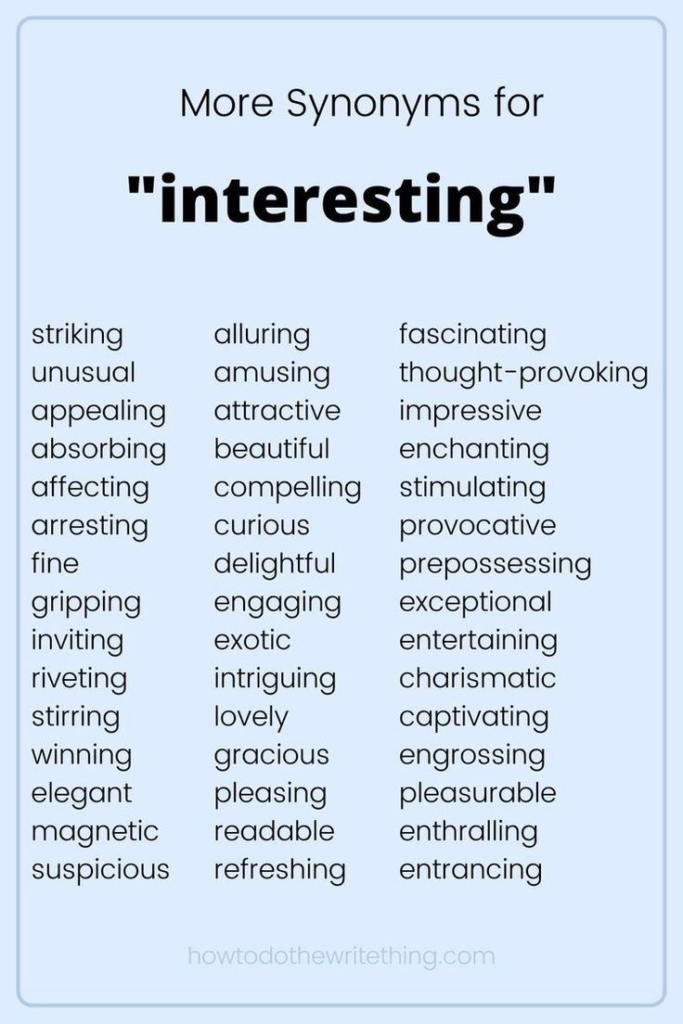
What Are Synonyms for Interesting?
If you want a quick answer to the question “What are some synonyms for interesting?”, these are among the most useful choices:
- Fascinating
- Engaging
- Intriguing
- Captivating
- Compelling
- Exciting
- Informative
- Thought-provoking
- Entertaining
- Insightful
- Absorbing
- Remarkable
- Stimulating
- Enlightening
- Intriguing
- Memorable
- Riveting
- Inspiring
- Unusual
- Noteworthy
These words are not exact substitutes in every sentence. Fascinating expresses strong curiosity, while informative emphasizes useful knowledge. Compelling suggests strong appeal or persuasive power, and remarkable highlights something unusual or impressive.
The best interesting synonym is the one that describes exactly what you mean.
Also Read: 100 Synonyms for Consolation: Meanings, Examples, and Related Words
100+ Synonyms for Interesting With Meanings and Examples
The following interesting words are organized by their meaning and common use. This makes it easier to find the right word instead of choosing a random alternative from a thesaurus.
1. Synonyms That Mean Fascinating or Captivating
Use these words when something holds your attention and makes you want to discover more.
1. Fascinating — Extremely interesting and able to create strong curiosity.
Example: The scientist gave a fascinating explanation of how stars form.
2. Captivating — So engaging that it is difficult to stop watching or listening.
Example: The film opened with a captivating scene.
3. Intriguing — Creating curiosity because something is unusual or mysterious.
Example: The researcher discovered an intriguing pattern in the data.
4. Absorbing — Holding someone’s attention for a long time.
Example: The history book was so absorbing that I finished it in one weekend.
5. Engrossing — Taking up someone’s attention almost completely.
Example: The novel offered an engrossing look at life in a small town.
6. Riveting — Extremely gripping and difficult to ignore.
Example: The journalist told a riveting story about the rescue.
7. Enthralling — Extremely engaging or enjoyable.
Example: The audience watched an enthralling performance.
8. Gripping — Creating strong interest, often through suspense.
Example: The detective story had a gripping ending.
9. Spellbinding — Holding attention through an extraordinary or magical effect.
Example: The storyteller gave a spellbinding performance.
10. Mesmerizing — Holding attention through beauty, movement, or a powerful effect.
Example: The dancers created a mesmerizing display.
11. Enchanting — Delightfully attractive or magical in feeling.
Example: The village had an enchanting atmosphere.
12. Alluring — Attracting people through appealing qualities.
Example: The travel brochure showed the alluring beauty of the coast.
13. Compelling — Strong enough to attract attention or persuade someone.
Example: The writer presented a compelling argument.
14. Intricate — Interesting because it contains many connected details.
Example: The artist created an intricate design from tiny pieces of glass.
15. Evocative — Bringing memories, feelings, or images to mind.
Example: The author used evocative descriptions of childhood.
2. Synonyms That Mean Exciting, Fun, or Enjoyable
These words work well for entertainment, events, activities, and positive experiences.
16. Exciting — Creating enthusiasm or anticipation.
Example: The school announced an exciting new science program.
17. Thrilling — Producing intense excitement.
Example: The final minutes of the game were thrilling.
18. Entertaining — Providing enjoyment or amusement.
Example: The comedian delivered an entertaining performance.
19. Enjoyable — Giving pleasure or satisfaction.
Example: We had an enjoyable afternoon exploring the museum.
20. Amusing — Making people smile or laugh.
Example: He shared an amusing story about his first day at work.
21. Delightful — Giving a strong sense of pleasure.
Example: The children enjoyed a delightful afternoon in the park.
22. Wonderful — Extremely good or pleasant.
Example: The trip was a wonderful learning experience.
23. Marvelous — Exceptionally good or impressive.
Example: The chef prepared a marvelous dinner.
24. Exhilarating — Creating a feeling of energy and excitement.
Example: The mountain hike was exhilarating.
25. Lively — Full of energy, activity, or conversation.
Example: The meeting became a lively exchange of ideas.
26. Vibrant — Full of life, color, or activity.
Example: The city is known for its vibrant arts scene.
27. Dynamic — Active, energetic, or constantly changing.
Example: The company has a dynamic workplace culture.
28. Stimulating — Encouraging thought, activity, or enthusiasm.
Example: The workshop included stimulating discussions.
29. Uplifting — Making someone feel more hopeful or positive.
Example: The film told an uplifting story of friendship.
30. Inspiring — Encouraging someone to think, act, or improve.
Example: Her journey was an inspiring example of perseverance.
3. Synonyms That Mean Thought-Provoking or Informative
These alternatives are useful for school essays, research, educational content, interviews, and professional discussions.
31. Thought-provoking — Encouraging careful thought or reflection.
Example: The book raises thought-provoking questions about technology.
32. Insightful — Showing a deep or useful understanding.
Example: The manager offered insightful advice about teamwork.
33. Informative — Providing useful facts or knowledge.
Example: The guide offers informative explanations for beginners.
34. Enlightening — Helping someone understand something more clearly.
Example: The lecture was enlightening for students new to economics.
35. Educational — Helping people gain knowledge or skills.
Example: The museum organized an educational event for families.
36. Illuminating — Making an unfamiliar or difficult subject easier to understand.
Example: The report provided an illuminating explanation of the problem.
37. Revealing — Showing something previously unknown or hidden.
Example: The survey produced revealing information about consumer habits.
38. Instructive — Teaching a lesson or demonstrating something useful.
Example: The experiment was instructive for the entire class.
39. Perceptive — Showing an ability to notice and understand important details.
Example: She made a perceptive observation about the characters.
40. Reflective — Encouraging or showing careful thought.
Example: The memoir offers a reflective account of growing up.
41. Analytical — Examining a subject carefully and logically.
Example: His analytical review identified weaknesses in the proposal.
42. Philosophical — Exploring fundamental questions about life, knowledge, or values.
Example: Their conversation became philosophical after dinner.
43. Exploratory — Investigating ideas or possibilities.
Example: The team held an exploratory meeting about future projects.
44. Eye-opening — Revealing information that changes how someone understands a subject.
Example: The documentary was an eye-opening introduction to food waste.
45. Enriching — Adding knowledge, experience, or personal growth.
Example: Studying abroad was an enriching experience.
4. Synonyms That Mean Remarkable or Impressive
Choose these words when something attracts attention because it stands out, matters, or exceeds expectations.
46. Remarkable — Worth noticing because it is unusual or impressive.
Example: The student made remarkable progress in mathematics.
47. Noteworthy — Important or unusual enough to deserve attention.
Example: The report identified a noteworthy change in spending.
48. Notable — Worth mentioning or recognizing.
Example: The city has a notable history of scientific discovery.
49. Significant — Important because of its meaning, size, or effect.
Example: The study found a significant difference between the groups.
50. Exceptional — Much better than the usual standard.
Example: The researcher demonstrated exceptional attention to detail.
51. Outstanding — Especially good or impressive.
Example: The team delivered an outstanding presentation.
52. Extraordinary — Far beyond what is ordinary or expected.
Example: The explorer described an extraordinary natural landscape.
53. Impressive — Likely to create admiration.
Example: The engineer developed an impressive design.
54. Striking — Immediately noticeable or powerful in appearance or effect.
Example: The photograph showed a striking contrast between light and shadow.
55. Distinctive — Different in a way that makes something recognizable.
Example: The writer has a distinctive voice.
56. Unusual — Different from what is common.
Example: The scientist observed unusual behavior during the experiment.
57. Unexpected — Not anticipated or predicted.
Example: The interview revealed an unexpected connection.
58. Surprising — Causing surprise because something was not expected.
Example: The results were surprising to the research team.
59. Unprecedented — Without a known earlier example in a particular context.
Example: The event attracted unprecedented public attention.
60. Memorable — Likely to be remembered because of its impact.
Example: The speaker shared a memorable lesson about leadership.
5. Synonyms That Mean Creative or Original
These words are helpful when an idea, project, design, or method stands out because it offers something new.
61. Original — New or independently developed rather than copied.
Example: The student proposed an original solution.
62. Innovative — Introducing a new method or useful improvement.
Example: The company introduced an innovative approach to online learning.
63. Creative — Showing imagination and the ability to develop ideas.
Example: The designer developed a creative advertising campaign.
64. Inventive — Good at creating new and clever solutions.
Example: The engineer found an inventive way to reduce waste.
65. Imaginative — Showing a strong ability to imagine possibilities.
Example: The children wrote imaginative stories about life on Mars.
66. Novel — New or different from what is familiar.
Example: The team tested a novel approach to solving the problem.
67. Fresh — Offering a new or less familiar perspective.
Example: The article presents a fresh view of modern education.
68. Unconventional — Different from traditional methods or beliefs.
Example: The teacher used an unconventional method to explain fractions.
69. Unorthodox — Not following commonly accepted methods.
Example: The coach developed an unorthodox training plan.
70. Experimental — Exploring new methods through trials or tests.
Example: The gallery featured experimental artwork.
71. Resourceful — Skilled at finding practical solutions.
Example: Her resourceful thinking helped the team meet its deadline.
72. Avant-garde — Highly experimental and ahead of established artistic conventions.
Example: The theater staged an avant-garde production.
6. Synonyms That Mean Valuable or Worthwhile
Sometimes something is interesting because it provides useful information, practical benefits, or a reason to spend time exploring it.
73. Valuable — Worth having because of its usefulness or importance.
Example: The mentor shared valuable career advice.
74. Worthwhile — Worth the time or effort involved.
Example: The training course was worthwhile for new employees.
75. Useful — Helping someone complete a task or solve a problem.
Example: The website provides useful information for homeowners.
76. Beneficial — Producing a helpful or positive result.
Example: The discussion was beneficial for the whole team.
77. Meaningful — Having importance, purpose, or personal significance.
Example: They had a meaningful conversation about their future.
78. Relevant — Directly connected to the subject being discussed.
Example: The article includes relevant details about the new policy.
79. Practical — Useful in real-life situations.
Example: The book offers practical advice for first-time managers.
80. Productive — Leading to useful progress or results.
Example: The meeting was productive and focused.
81. Rewarding — Providing satisfaction or a sense of achievement.
Example: Teaching children can be a rewarding experience.
82. Consequential — Likely to produce important effects.
Example: The committee discussed several consequential decisions.
83. Promising — Showing signs of future success or value.
Example: The researchers discovered a promising new approach.
84. Insight-generating — Helping people discover new understanding or ideas.
Example: The interview was insight-generating for the research team.
7. Synonyms That Mean Mysterious or Puzzling
These words are useful when something attracts attention because it is difficult to explain, understand, or solve.
Also Read: 100+ Synonyms of Vanity: Meaning, Examples, and Opposites
85. Mysterious — Difficult to explain or understand.
Example: The old house had a mysterious history.
86. Puzzling — Difficult to understand or solve.
Example: The researchers noticed a puzzling pattern in the results.
87. Perplexing — Confusing because the reason for something is unclear.
Example: The sudden change was perplexing.
88. Curious — Unusual or unexpected in a way that attracts attention.
Example: There was a curious mark on the ancient map.
89. Baffling — Extremely difficult to understand.
Example: The machine’s sudden failure was baffling.
90. Complex — Made up of many connected parts or details.
Example: The article examines a complex social issue.
91. Multifaceted — Having several different aspects or dimensions.
Example: The report explores a multifaceted problem.
92. Layered — Containing several levels of meaning or interpretation.
Example: The novel presents a layered view of family relationships.
93. Ambiguous — Having more than one possible meaning.
Example: The ending of the story was ambiguous.
94. Unexplained — Not yet understood or accounted for.
Example: The team investigated an unexplained change in temperature.
95. Cryptic — Mysterious or difficult to interpret.
Example: The message contained a cryptic warning.
96. Enigmatic — Difficult to understand or interpret.
Example: The painting has an enigmatic quality.
97. Uncharted — Not yet fully explored.
Example: The researchers entered an uncharted area of the field.
8. Synonyms for Interesting in a Bad Way
If you are searching for synonyms for interesting in a bad way, the best word depends on whether the subject is disturbing, confusing, suspicious, or unpleasant.
98. Disturbing — Causing worry or emotional discomfort.
Example: The report revealed disturbing conditions in the building.
99. Unsettling — Making someone feel uneasy.
Example: The documentary presented an unsettling account of the incident.
100. Troubling — Giving reason for concern.
Example: The survey uncovered troubling patterns in employee turnover.
101. Concerning — Suggesting that something needs attention.
Example: The report showed a concerning decline in participation.
102. Alarming — Creating a strong feeling of worry or danger.
Example: The investigation uncovered alarming safety failures.
103. Bizarre — Extremely strange or unexpected.
Example: The story described a bizarre sequence of events.
104. Odd — Different from what is normal or expected.
Example: The device made an odd noise.
105. Strange — Unfamiliar or difficult to explain.
Example: The researchers noticed a strange pattern in the photographs.
106. Uncanny — Strangely familiar or unusually accurate in a way that feels unsettling.
Example: The portrait had an uncanny resemblance to its subject.
107. Macabre — Connected with death or disturbing subjects.
Example: The novel explored macabre themes.
108. Gruesome — Extremely unpleasant, especially when involving injury or violence.
Example: The historical account described a gruesome event.
109. Morbid — Focused on death, suffering, or disturbing subjects.
Example: The conversation took a morbid turn.
110. Suspicious — Giving a reason to doubt someone’s honesty or a situation’s truth.
Example: The investigator noticed suspicious activity.
111. Questionable — Open to doubt or criticism.
Example: The report relied on questionable assumptions.
112. Controversial — Likely to create disagreement.
Example: The article discussed a controversial public policy.
113. Provocative — Likely to trigger strong thought or reaction.
Example: The speaker raised a provocative question.
114. Disconcerting — Causing confusion or unease.
Example: The sudden silence was disconcerting.
115. Unnerving — Making someone feel nervous or less confident.
Example: The experience was unnerving for the new employee.
These words are not direct synonyms in every situation. They are alternatives when something attracts attention for a negative or uncomfortable reason.
Synonyms for Interesting in Different Situations
A word that works in casual conversation may not be suitable for a school assignment or professional report. Use the following examples to find another way to say interesting in different contexts.
Synonyms for Interesting in Essays
When writing an essay, choose a word that explains the value of the idea or evidence.
Useful choices include:
- Thought-provoking
- Insightful
- Informative
- Significant
- Compelling
- Noteworthy
- Relevant
- Illuminating
- Meaningful
- Persuasive
Examples:
Instead of writing, “The book is interesting,” write, “The book offers an insightful analysis of social change.”
Instead of writing, “The study is interesting,” write, “The study presents noteworthy findings about reading habits.”
Instead of writing, “This is an interesting argument,” write, “This is a compelling argument supported by clear evidence.”
These alternatives make the meaning more specific without making the writing difficult to understand.
Synonyms for Interesting in Professional Writing
For business emails, presentations, reports, and meetings, use language that communicates the practical value of the subject.
| Original phrase | Better alternative |
| Interesting results | Noteworthy results |
| Interesting proposal | Promising proposal |
| Interesting meeting | Productive meeting |
| Interesting insight | Valuable insight |
| Interesting trend | Emerging trend |
| Interesting opportunity | Promising opportunity |
| Interesting analysis | Insightful analysis |
| Interesting finding | Significant finding, when justified |
For example, instead of writing, “I found your proposal interesting,” you could write, “I found your proposal promising and would like to discuss the next steps.”
Synonyms for Interesting Stories, Books, and Movies
Use these alternatives when describing entertainment:
- Captivating: holds the audience’s attention.
- Gripping: creates suspense.
- Entertaining: provides enjoyment.
- Moving: creates a strong emotional response.
- Thrilling: produces excitement.
- Absorbing: holds attention over time.
- Compelling: encourages the audience to continue.
- Imaginative: shows creativity.
- Unpredictable: difficult to anticipate.
- Thought-provoking: encourages reflection.
Example:
Instead of saying, “The movie was interesting,” write, “The movie was gripping because every scene revealed a new clue.”
Synonyms for an Interesting Conversation
A conversation may be engaging because it introduces new information, creates debate, or encourages people to think differently.
Useful phrases include:
- Stimulating conversation
- Engaging discussion
- Insightful exchange
- Thought-provoking debate
- Lively discussion
- Informative interview
- Meaningful conversation
- Productive meeting
- Animated debate
- Eye-opening discussion
Example:
“We had an interesting conversation about technology” can become “We had a stimulating conversation about how technology affects education.”
Synonyms for an Interesting Idea
Choose an adjective based on the idea’s main quality.
| Word | Best use |
| Innovative | Introduces a new method |
| Creative | Shows imagination |
| Promising | Has potential value |
| Thought-provoking | Encourages reflection |
| Intriguing | Creates curiosity |
| Practical | Can be applied in real life |
| Unconventional | Differs from common approaches |
| Compelling | Has strong appeal or logic |
| Original | Is new or independently developed |
| Radical | Proposes major change |
An unusual idea is not automatically useful, and a creative idea is not necessarily successful. Choose the word that accurately describes the idea.
Synonyms for an Interesting Person
If you need a synonym for interesting person, consider the qualities that make the person engaging.
| Word | Meaning |
| Fascinating | Inspires strong curiosity |
| Engaging | Makes conversations enjoyable |
| Charismatic | Naturally attracts or influences people |
| Witty | Uses clever humor |
| Insightful | Offers thoughtful observations |
| Knowledgeable | Knows a great deal about a subject |
| Eccentric | Has unusual habits or behavior |
| Intriguing | Makes others want to learn more |
| Thoughtful | Considers ideas and other people’s feelings |
| Articulate | Expresses ideas clearly |
| Perceptive | Notices details others may miss |
| Well-rounded | Has varied knowledge or experience |
Examples:
- “She is an interesting person” becomes “She is an insightful person who notices details others overlook.”
- “He is interesting to talk to” becomes “He is engaging and knowledgeable.”
- “She has an interesting personality” becomes “She has an eccentric personality and an unusual sense of humor.”
Use eccentric when unusual behavior is relevant, not simply because someone is different.
Synonyms for Interesting Facts
If you are searching for synonyms for interesting facts, choose an expression that explains what makes the information worth learning.
Useful alternatives include:
- Fascinating facts
- Surprising facts
- Little-known facts
- Remarkable facts
- Eye-opening facts
- Curious facts
- Unusual facts
- Fun facts
- Noteworthy facts
- Lesser-known details
- Astonishing discoveries
- Intriguing details
Examples:
- Interesting facts about space → Fascinating facts about space
- Interesting facts about history → Little-known historical facts
- Interesting facts about the human body → Surprising facts about the human body
The phrase fun facts usually suggests enjoyable or surprising information. Little-known facts emphasizes information that many people may not know.
If you are researching interesting facts about Chile in South America, interesting facts about the state of Kansas, or interesting facts about Chinese New Year, you can use these phrases to describe unusual geography, history, culture, traditions, and discoveries. Make sure any specific factual claims are accurate and supported by reliable evidence.
Fancy Synonyms for Interesting
Fancy synonyms can make your writing more expressive, but sophisticated vocabulary should improve clarity rather than make a sentence harder to read.
| Word | Meaning | Example |
| Intriguing | Creating curiosity | The proposal raises an intriguing question. |
| Compelling | Strongly engaging or convincing | The author presents a compelling case. |
| Illuminating | Providing a clearer understanding | The article offers an illuminating perspective. |
| Enigmatic | Difficult to interpret | The character remains enigmatic. |
| Arresting | Immediately attracting attention | The photograph has an arresting composition. |
| Exhilarating | Producing intense excitement | The climb was exhilarating. |
| Profound | Deep or significant in meaning | The book explores profound questions. |
| Esoteric | Understood by a small group with specialized knowledge | The lecture covered an esoteric subject. |
| Salient | Particularly important or noticeable | The report highlights several salient points. |
| Perspicacious | Showing sharp judgment or understanding | She made a perspicacious observation. |
| Evocative | Bringing images or feelings to mind | The poem uses evocative imagery. |
| Captivating | Holding attention strongly | The speaker delivered a captivating presentation. |
For most readers, fascinating, engaging, insightful, and thought-provoking are easier to understand and often more effective.
Synonyms for Interesting in French and Spanish
Learning translations can help English learners understand how the meaning changes with context.
Synonyms for Interesting in French
The usual French translation of interesting is intéressant for masculine nouns and intéressante for feminine nouns.
Related French words include:
- Fascinant / fascinante — fascinating
- Captivant / captivante — captivating
- Intrigant / intrigante — intriguing
- Passionnant / passionnante — deeply engaging or exciting
- Instructif / instructive — instructive or informative
- Enrichissant / enrichissante — enriching
- Stimulant / stimulante — stimulating
- Remarquable — remarkable
Examples:
English: The book is interesting.
French: Le livre est intéressant.
English: The documentary is fascinating.
French: Le documentaire est fascinant.
Synonyms for Interesting in Spanish
The common Spanish translation is interesante. This adjective has the same form for masculine and feminine nouns.
Related Spanish words include:
- Fascinante — fascinating
- Intrigante — intriguing
- Atractivo / atractiva — attractive or appealing
- Entretenido / entretenida — entertaining
- Emocionante — exciting
- Enriquecedor / enriquecedora — enriching
- Revelador / reveladora — revealing
- Sorprendente — surprising
- Interesantísimo / interesantísima — extremely interesting
Examples:
English: It is an interesting question.
Spanish: Es una pregunta interesante.
English: The film is exciting.
Spanish: La película es emocionante.
The best translation depends on the sentence and the feeling you want to express.
Synonyms for Interesting, Interested, Interest, and Interestingly
These related words are often confused, but they have different grammatical roles.
Also Read: Synonyms of Loud: 200+ Words for Different Sounds and Situations
| Word | Meaning | Example |
| Interest | Curiosity or the act of attracting attention | Science is an interest of mine. |
| Interesting | Creating curiosity | Science is an interesting subject. |
| Interested | Feeling curiosity | I am interested in science. |
| Interestingly | In a way that attracts attention or introduces a notable point | Interestingly, both studies reached similar conclusions. |
| Interestingness | The quality of being interesting | The editor considered the interestingness of the topic. |
Synonyms for Interested
If you are looking for synonyms for interested, consider these options:
- Curious
- Engaged
- Enthusiastic
- Attentive
- Intrigued
- Eager
- Invested
- Keen
- Fascinated
- Absorbed
Examples:
“I am interested in history” can become “I am fascinated by history.”
“She is interested in the project” can become “She is enthusiastic about the project.”
“They were interested in the mystery” can become “They were intrigued by the mystery.”
Synonyms for Interest and Interests
The noun interest can refer to curiosity, attention, a hobby, or a personal concern.
Depending on the meaning, related words include:
- Curiosity
- Attention
- Fascination
- Concern
- Enthusiasm
- Engagement
- Hobby
- Pursuit
- Preference
- Involvement
For example, “My interests include music and photography” can become “My hobbies include music and photography.”
However, interest has several meanings, so a single synonym will not work in every sentence.
Synonyms for Interestingly
If you want another word for interestingly, the following alternatives may fit:
- Notably
- Remarkably
- Surprisingly
- Curiously
- Intriguingly
- Significantly
- Unexpectedly
- Curiously enough
Example:
“Interestingly, the two studies reached the same conclusion.”
If the result was unexpected, you could write, “Surprisingly, the two studies reached the same conclusion.”
If the point deserves attention, you could write, “Notably, the two studies reached the same conclusion.”
The right word depends on whether you are highlighting surprise, importance, or curiosity.
Synonyms for Self-Interested and Self-Interest
Self-interested describes someone who acts mainly to benefit themselves. It does not mean the same thing as interesting.
Related terms include:
- Self-serving
- Self-focused
- Self-centered
- Personally motivated
- Egoistic
- Opportunistic
- Concerned with personal gain
For example, “His decision seemed self-interested” means that the decision appeared to serve his own advantage.
Self-interest is the concern someone has for their own needs or benefits. Depending on the context, related expressions include personal interest, personal advantage, and individual benefit.
Be careful with these words because some carry a negative judgment, while others describe personal motivation more neutrally.
Interesting vs. Fascinating vs. Intriguing vs. Exciting
These common synonyms for interesting are closely related, but each emphasizes a different quality.
| Word | Main emphasis | Example |
| Interesting | General curiosity or attention | The article was interesting. |
| Fascinating | Strong curiosity | The article about deep-sea animals was fascinating. |
| Intriguing | Mystery or unanswered questions | The article presented an intriguing theory. |
| Exciting | Energy or anticipation | The article announced an exciting discovery. |
| Engaging | Ability to hold attention | The article had an engaging style. |
| Informative | Useful knowledge | The article was informative. |
| Compelling | Strong appeal or convincing power | The article made a compelling case. |
| Thought-provoking | Encourages reflection | The article raised thought-provoking questions. |
| Entertaining | Enjoyment or amusement | The article was entertaining. |
| Remarkable | Unusual or impressive qualities | The article described a remarkable achievement. |
Can Fascinating Replace Interesting?
Yes, when something creates strong curiosity or holds attention exceptionally well.
For example, “The documentary was interesting” expresses a general positive response. “The documentary was fascinating” suggests a stronger level of curiosity or engagement.
Is Intriguing Positive or Negative?
Intriguing is usually neutral or positive. It often describes something mysterious, unusual, or worthy of further investigation.
An intriguing question can inspire curiosity, while an intriguing clue can create suspense. The word does not automatically imply that something is good or bad.
Is Exciting the Same as Interesting?
No. Interesting focuses on curiosity and attention, while exciting emphasizes enthusiasm or anticipation.
A challenging puzzle can be interesting without being exciting. A surprise announcement can be exciting without offering much intellectual depth.
How to Choose a Better Word for Interesting
Learning a long list of interesting synonyms is useful, but selecting the right one is more important than memorizing every word.
1. Identify What Makes the Subject Interesting
Ask yourself why the subject deserves attention.
- Curiosity: fascinating or intriguing
- Suspense: gripping or riveting
- Learning: informative or enlightening
- Excitement: thrilling or exhilarating
- Deep thought: thought-provoking or insightful
- Unusual qualities: remarkable or extraordinary
- Practical value: useful or worthwhile
- Negative feelings: disturbing or unsettling
2. Think About Your Audience
Casual conversations usually work best with familiar words. Academic essays and business reports may require more precise language.
For everyday conversation, “That sounds fascinating” feels natural.
For a research paper, “The findings provide an informative perspective” may be more appropriate.
For a business proposal, “This is a promising opportunity” communicates potential value.
3. Avoid Changing the Meaning
Some synonyms make a stronger claim than interesting.
Interesting research is not automatically significant research. An interesting idea is not necessarily innovative. An unusual person is not necessarily eccentric. A compelling argument is not necessarily proven.
Always choose a word that accurately reflects the evidence and context.
4. Use Specific Descriptions Instead of Repeating Synonyms
Replacing every occurrence of interesting with fascinating can make writing repetitive in a different way.
Instead of writing, “The book was fascinating, the characters were fascinating, and the ending was fascinating,” try:
“The book held my attention with its memorable characters and unpredictable ending.”
This approach communicates more information and sounds more natural.
5. Learn Synonyms in Groups
Organizing interesting words by meaning makes them easier to remember.
For example, learn fascinating, captivating, and absorbing together because they relate to strong engagement. Study informative, enlightening, and insightful as a group because they relate to knowledge and understanding.
Then write your own examples to practice using each word correctly.
Frequently Asked Questions About Interesting Synonyms
1. What is the best synonym for interesting?
Fascinating, engaging, and intriguing are among the most versatile alternatives. The best choice depends on whether you want to express strong curiosity, sustained attention, or mystery.
2. What are three synonyms for interesting?
Three useful choices are fascinating, engaging, and intriguing. They are suitable for many everyday situations, but their meanings are slightly different.
3. What is a synonym for very interesting?
Fascinating, riveting, captivating, enthralling, and absorbing can all describe something very interesting. Use riveting for gripping stories and fascinating for subjects that inspire curiosity.
4. What is another way to say interesting?
You could say fascinating, engaging, compelling, noteworthy, informative, or thought-provoking. Choose the word that best explains why the subject matters.
5. What is an interesting synonym that starts with I?
Intriguing, informative, insightful, illuminating, and inspiring all begin with the letter I. Each describes a different quality, from curiosity to knowledge and motivation.
6. What is a fancy synonym for interesting?
Perspicacious is a sophisticated word related to sharp understanding, while illuminating, intriguing, compelling, and evocative are useful alternatives in formal writing. They have different meanings, so they should not be treated as interchangeable.
7. What is the opposite of interesting?
Common opposites include boring, dull, tedious, monotonous, and uninteresting. Boring suggests a lack of engagement, while tedious emphasizes something tiring or repetitive.
8. What is a good synonym for interesting but not exciting?
Informative, insightful, engaging, intriguing, and thought-provoking are good options. They describe curiosity or intellectual value without suggesting intense excitement.
9. What is another word for an interesting person?
Depending on the person’s qualities, you could use fascinating, engaging, charismatic, witty, insightful, knowledgeable, or intriguing.
10. What is another word for interestingly?
Notably, surprisingly, remarkably, curiously, and intriguingly may work. The right option depends on whether you want to express importance, surprise, or curiosity.
11. How do you spell interesting?
The correct spelling is interesting: I-N-T-E-R-E-S-T-I-N-G.
Common misspellings include intresting, intersting, interestting, interresting, interesing, and intiresting. Remember that the word begins with interest and ends with -ing.
12. Can I use interesting in formal writing?
Yes. Interesting is acceptable in formal writing, but a more precise word can communicate your meaning more clearly. For example, significant may describe an important finding, while informative may describe a useful report.
13. Is noteworthy a synonym for interesting?
Sometimes. Noteworthy means worthy of attention or mention. It is useful when describing a significant detail or an unusual result, but it does not necessarily suggest enjoyment.
14. What is the difference between interesting and intriguing?
Interesting is a broad term for something that attracts attention. Intriguing usually suggests that something creates curiosity because it is unusual, mysterious, or not fully understood.
15. What is a good synonym for interesting in a bad way?
Disturbing, unsettling, troubling, bizarre, and suspicious may work depending on the situation. Use disturbing for something upsetting, bizarre for something extremely strange, and suspicious when there is reason for doubt.
16. What are synonyms for interesting in English?
Common English synonyms include fascinating, captivating, engaging, intriguing, exciting, informative, compelling, thought-provoking, remarkable, and entertaining. Each has a slightly different meaning.
17. What is another word for interesting facts?
Fascinating facts, surprising facts, little-known facts, remarkable facts, and fun facts are useful alternatives. Choose an expression that matches the type of information you are presenting.
18. Is interesting the same as interested?
No. Interesting describes something that attracts attention, while interested describes someone who feels curiosity. For example, “The book is interesting” and “I am interested in the book” are both correct.
19. What is a synonym for interesting in French?
Intéressant or intéressante is the common French translation. Depending on the context, fascinant, captivant, intriguant, or passionnant may also fit.
20. What is a synonym for interesting in Spanish?
Interesante is the standard Spanish translation. Fascinante, intrigante, entretenido, and emocionante can work in particular contexts.
Conclusion
Finding the right synonym for interesting is about expressing your meaning clearly, not simply using a more complicated word.
Fascinating and captivating describe strong engagement. Intriguing suggests curiosity or mystery. Informative and enlightening emphasize learning, while thought-provoking encourages deeper reflection. When something attracts attention for negative reasons, words such as troubling, disturbing, or unsettling may be more accurate.
The next time you look for another word for interesting, consider what makes the subject worth noticing. Is it exciting, unusual, useful, educational, mysterious, or emotionally powerful?
Choosing a word that answers that question will help you improve your vocabulary, write more naturally, and communicate with greater confidence.