Synonyms of Cold: 150+ Alternatives to Improve Your English Vocabulary
Cold is a common English word, but it can express several different ideas. It may describe winter weather, a drink with ice, a low temperature, an unfriendly person, or a lack of emotion. Finding the right synonym for cold helps you communicate these meanings more clearly.
For example, cool describes a mildly low temperature, while freezing suggests intense cold. Crisp often creates a pleasant picture of fresh air, whereas bitter describes cold that feels harsh or uncomfortable. When talking about personality, aloof, distant, and unfeeling communicate different kinds of emotional separation.
Learning words for cold can improve everyday conversations, school assignments, creative writing, professional communication, and English vocabulary. This guide explores common and advanced cold synonyms, their definitions, example sentences, related expressions, and the differences between similar words.
What Are the Synonyms of Cold?
Synonyms of cold are words that have a meaning similar to cold in a particular context. The best alternative depends on whether you are describing temperature, weather, an object, a person’s behavior, or an expression.
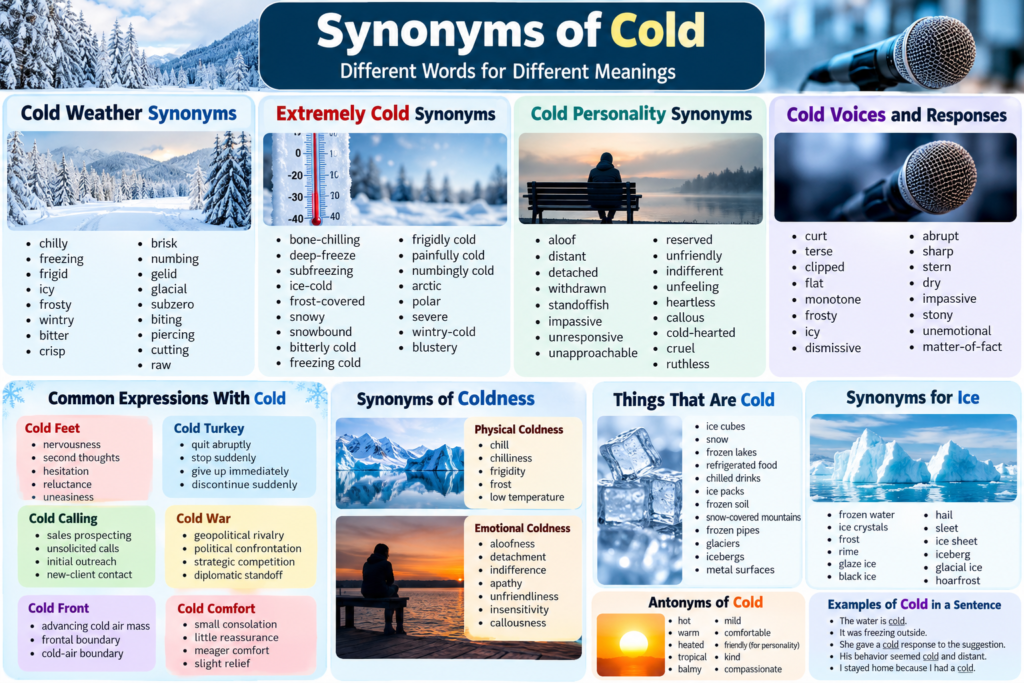
Some common synonyms for cold include:
- Cool
- Chilly
- Freezing
- Frigid
- Icy
- Frosty
- Wintry
- Bitter
- Crisp
- Brisk
- Chilled
- Frozen
- Numbing
- Gelid
- Glacial
- Subzero
- Biting
- Piercing
- Aloof
- Distant
- Detached
- Unfriendly
- Impassive
- Unfeeling
- Indifferent
Not all these words can replace cold in every sentence. Freezing describes intense low temperatures, while aloof refers to someone’s distant behavior. Choosing a synonym with the right meaning makes your writing more natural and precise.
Cold Definition: What Does Cold Mean?
The word cold has several meanings in English. Its interpretation depends on the sentence and the situation.
1. Cold as a low temperature
Cold commonly describes something that has a lower temperature than is comfortable or expected.
Examples:
- The water is cold.
- We experienced a cold night in the mountains.
- My hands became cold while waiting outside.
2. Cold as an emotional quality
Cold can describe someone who seems unfriendly, distant, or unwilling to show affection.
Examples:
- His cold manner made the visitors uncomfortable.
- She gave a cold response to the suggestion.
- The conversation ended with a cold silence.
3. Cold as an illness
A cold is also a common respiratory illness that may cause symptoms such as a runny nose, sneezing, coughing, and a sore throat.
Also Read: 100+ Synonyms for Emperor: Meanings, Examples, and Related Words
Example: I stayed home because I had a cold.
In this meaning, words such as chilly and frigid are not synonyms for the illness. The context determines which alternatives are appropriate.
4. Cold in grammar
Is cold an adjective? Yes. Cold is an adjective in a sentence such as “The room is cold.”
It can also function as a noun, as in “The cold lasted all week.” In certain expressions, it appears in combinations with other words, such as cold-hearted, cold-blooded, and cold weather.
The word cold is spelled C-O-L-D. Its comparative form is colder, and its superlative form is coldest.
Common Synonyms of Cold With Meanings and Examples
The following words are useful alternatives to cold in everyday English.
| Synonym | Meaning | Example sentence |
| Cool | Slightly cold, often comfortable | The room feels cool in the evening. |
| Chilly | Uncomfortably cool | A chilly breeze came through the window. |
| Coldish | Somewhat cold | The water was coldish when we arrived. |
| Coolish | A little cool | The air felt coolish after sunset. |
| Chilled | Made cold or affected by cold | We served chilled lemonade. |
| Crisp | Pleasantly cool and fresh | The crisp morning air felt refreshing. |
| Brisk | Cool and invigorating | They went for a walk in the brisk air. |
| Frosty | Cold enough for frost or resembling frost | Frosty grass covered the lawn. |
| Wintry | Typical of winter | Wintry conditions arrived overnight. |
| Icy | Very cold or covered with ice | The icy surface was slippery. |
| Freezing | Extremely cold | It was freezing outside. |
| Frigid | Intensely cold | Frigid air entered the building. |
| Bitter | Painfully cold | Bitter winds swept across the region. |
| Numbing | So cold that feeling decreases | The numbing air hurt my fingers. |
| Gelid | Extremely cold; formal or literary | Gelid winds crossed the empty plain. |
| Glacial | Extremely cold or associated with glaciers | Glacial air surrounded the mountain camp. |
| Frozen | Turned into ice or made solid by cold | The frozen pond attracted attention. |
| Subzero | Below zero on a temperature scale | The area experienced subzero temperatures. |
| Biting | Sharp and unpleasantly cold | A biting wind blew through the street. |
| Piercing | Intensely cold in a sharp, penetrating way | Piercing cold made the walk difficult. |
| Cutting | Painfully sharp, especially of wind | Cutting winds swept over the hills. |
| Raw | Damp, cold, and unpleasant | It was a raw afternoon. |
| Arctic | Extremely cold, like conditions in the Arctic | Arctic conditions challenged the travelers. |
| Polar | Related to the polar regions | Polar climates are known for severe cold. |
| Severe | Very intense or harsh | Severe cold affected outdoor workers. |
These cold alternative words are not identical in meaning. Cool and chilly usually describe less intense cold, while freezing and frigid suggest stronger conditions. Crisp and brisk often convey freshness rather than discomfort.
Synonyms for Extremely Cold Weather
When you want to describe very cold weather, ordinary words may not communicate the full intensity. Stronger adjectives can help readers imagine the temperature, wind, frost, or snow.
Here are additional words that describe extreme cold:
| Word or phrase | Meaning | Example |
| Deep-freeze | A period or condition of intense cold | The region entered a deep-freeze period. |
| Subfreezing | Below the freezing point | Subfreezing temperatures damaged exposed pipes. |
| Ice-cold | As cold as ice | The water felt ice-cold. |
| Frost-covered | Covered with frost | Frost-covered branches glittered in the sunlight. |
| Snowbound | Trapped or isolated by snow | The mountain village remained snowbound. |
| Snowy | Covered with or characterized by snow | Snowy roads slowed traffic. |
| Blustery | Characterized by strong, gusty winds | A blustery afternoon kept people indoors. |
| Wintry-cold | Cold in a distinctly winterlike way | Wintry-cold air entered the house. |
| Bone-chilling | Extremely cold or producing a strong sensation of cold | A bone-chilling wind crossed the field. |
| Bitterly cold | Unpleasantly and intensely cold | It was bitterly cold before sunrise. |
| Freezing cold | Extremely cold | The freezing-cold water numbed his hands. |
| Frigidly cold | Extremely cold; emphatic wording | The campsite was frigidly cold overnight. |
| Frosty-cold | Cold and frostlike | Frosty-cold air settled over the valley. |
| Painfully cold | Cold enough to cause discomfort or pain | The metal railing was painfully cold. |
| Numbingly cold | Cold enough to reduce sensation | The water was numbingly cold. |
How to describe cold weather naturally
Use the word that explains the actual condition.
- The morning was crisp and clear. This suggests refreshing weather.
- The wind was biting. This emphasizes the uncomfortable wind.
- The temperature was below freezing. This gives a more precise description.
- The roads were icy. This describes a potentially dangerous surface.
- The weather was bleak. This suggests a gloomy atmosphere, not temperature alone.
The phrase “extremely cold” is a straightforward way to describe intense cold. In more descriptive writing, “bitterly cold,” “bone-chilling,” and “numbingly cold” may create a stronger impression.
Synonyms for Cold Personality and Cold-Hearted Behavior
When people search for synonyms of cold-hearted, they are usually looking for words that describe a person who shows little sympathy or compassion. However, not every cold person is cruel. Some people are simply quiet, reserved, or emotionally guarded.
Also Read: 120+ Synonyms for Evaluation: Meanings, Examples, and How to Use Them
Words for an emotionally distant person
| Word | Meaning | Example |
| Aloof | Distant or detached in social situations | He appeared aloof at the party. |
| Reserved | Unwilling to show feelings openly | She is reserved around strangers. |
| Distant | Not emotionally close | He seemed distant after the disagreement. |
| Withdrawn | Quiet and avoiding social interaction | She became withdrawn during the meeting. |
| Detached | Not emotionally involved | The observer remained detached from the argument. |
| Standoffish | Unfriendly or reluctant to socialize | Their neighbor seemed standoffish. |
| Impassive | Showing little outward emotion | His impassive expression revealed nothing. |
| Unresponsive | Showing little reaction | She appeared unresponsive to the criticism. |
| Unapproachable | Difficult to approach or speak with | The supervisor seemed unapproachable. |
| Formal | Polite but not especially personal or warm | Their conversation remained formal. |
Words for a cold-hearted person
These alternatives are stronger and usually suggest a lack of sympathy, concern, or kindness.
| Word | Meaning | Example |
| Heartless | Showing little or no compassion | His heartless decision upset the family. |
| Callous | Insensitive to the suffering of others | The remark sounded callous. |
| Cruel | Causing pain or suffering | The cruel treatment shocked the audience. |
| Merciless | Showing no mercy | The merciless attack left the town devastated. |
| Ruthless | Willing to act harshly to achieve a goal | The ruthless competitor ignored every objection. |
| Unfeeling | Showing little emotion or sympathy | His unfeeling reply hurt her. |
| Unsympathetic | Not understanding or sharing another person’s distress | The response was unsympathetic. |
| Hard-hearted | Unwilling to show pity | The hard-hearted official refused to listen. |
| Remorseless | Showing no regret for wrongdoing | The remorseless offender showed no regret. |
| Inhumane | Lacking compassion or basic kindness | The report exposed inhumane conditions. |
Cold-hearted, heartless, callous, and cruel are related but not interchangeable in every situation. Callous emphasizes insensitivity, while cruel often suggests causing suffering. Ruthless describes harsh determination, which may occur in business, competition, or conflict.
Words for Cold Voices, Expressions, and Responses
Cold can describe how a person speaks or reacts. These synonyms help you explain the exact quality of a conversation.
- Curt: short and possibly rude.
- Terse: using very few words.
- Clipped: delivered in short, sharp phrases.
- Flat: lacking emotion or variation.
- Monotone: spoken with little change in pitch.
- Impassive: showing no visible emotion.
- Stony: displaying a firm, emotionless expression.
- Frosty: unfriendly or cool in manner.
- Icy: extremely unfriendly or hostile.
- Dismissive: treating someone or something as unimportant.
- Abrupt: unexpectedly sudden or direct.
- Sharp: harsh or severe in tone.
- Stern: serious and strict.
- Dry: lacking warmth, or sometimes humor.
- Matter-of-fact: direct and practical, without much emotional expression.
Examples:
- A cold reply can be a curt reply when it is brief and unfriendly.
- A cold facial expression may be described as stony or impassive.
- A cold welcome may be described as frosty or unwelcoming.
- A cold tone may be flat, clipped, or dismissive.
These distinctions are useful in storytelling, workplace communication, essays, and everyday English.
Synonyms of Coldness: Meaning and Examples
Coldness is the noun form used to describe a state or quality of being cold. It can refer to physical temperature or emotional behavior.
Physical coldness
Related terms include chill, chilliness, frigidity, frost, and low temperature.
Examples:
- The coldness of the water surprised us.
- The chill in the air grew stronger.
- The frigidity of the environment made the work difficult.
These words vary in meaning. Frost refers to ice crystals that form on surfaces, while frigidity emphasizes extreme cold.
Emotional coldness
When coldness refers to behavior, possible alternatives include aloofness, detachment, indifference, apathy, unfriendliness, and insensitivity.
Examples:
- His aloofness made it difficult to build a friendship.
- Her indifference disappointed the group.
- The manager’s insensitivity caused frustration.
Coldness synonym: Which word should you choose?
Use aloofness when someone keeps their distance, indifference when they show little concern, and callousness when they seem insensitive to suffering.
The phrase “another word for coldness” therefore has no single answer. The correct synonym depends on whether you mean temperature or emotion.
Coldly Synonym: What Does Coldly Mean?
Coldly is an adverb that describes doing something without warmth, friendliness, or visible emotion.
Possible synonyms of coldly include:
- Curtly
- Impassively
- Unemotionally
- Distantly
- Abruptly
- Sternly
- Indifferently
- Dispassionately
- Flatly
- Dismissively
- Harshly
- Unkindly
Examples:
- He spoke coldly to the visitor.
- She answered curtly and returned to her work.
- The witness described the incident dispassionately.
- The manager dismissed the complaint abruptly.
These words express different shades of meaning. Dispassionately suggests a lack of emotional involvement, while harshly suggests severity. Curtly often means speaking briefly and without friendliness.
Synonyms of Cold in Common Expressions and Idioms
Several keyword searches include phrases such as cold feet, cold turkey, cold calling, cold war, cold front, cold comfort, cold-hearted, and cold-blooded. These expressions have distinct meanings, so they need their own explanations.
Synonyms of cold feet
Cold feet is an idiom for fear, doubt, or nervousness before an important action.
Related expressions include:
- Second thoughts
- Nervousness
- Apprehension
- Hesitation
- Reluctance
- Uneasiness
- Loss of confidence
- Anxiety
Example: “She got cold feet before the wedding” means she became nervous or uncertain about going ahead.
Synonyms of cold turkey
Cold turkey means suddenly stopping a habit or substance rather than gradually reducing it.
Related phrases include:
- Quit abruptly
- Stop suddenly
- Stop all at once
- Give up immediately
- Discontinue suddenly
Example: “He quit smoking cold turkey.”
Stopping some substances suddenly can be dangerous. People who may be physically dependent on alcohol, sedatives, or other substances should seek medical guidance before stopping.
Synonyms of cold calling and cold call
Cold calling is the practice of contacting prospective customers without an established relationship or an expected conversation.
Related terms include:
- Sales prospecting
- Unsolicited sales calls
- Initial sales outreach
- Prospect outreach
- New-client contact
- Unsolicited business contact
A cold call is one instance of this activity. Sales prospecting is broader because it can also involve researching potential customers and finding leads through other methods.
Synonyms of cold war
A cold war is a prolonged rivalry between opposing powers that avoid direct, full-scale warfare while competing politically, economically, militarily, or ideologically.
Related expressions include:
- Geopolitical rivalry
- Political confrontation
- Strategic competition
- Diplomatic standoff
- Prolonged international tension
- Hostile rivalry
These expressions describe aspects of a cold war, not exact replacements for the historical term.
Synonyms of cold front
A cold front is a boundary where a colder air mass advances into an area occupied by warmer air.
Related descriptions include:
- Advancing cold air mass
- Cold-air boundary
- Frontal boundary
- Boundary between air masses
A cold front can cause changes in wind direction, temperature, cloud cover, and precipitation. In meteorology, cold front remains the clearest technical term.
Synonyms of cold comfort
Cold comfort refers to something that provides little reassurance or relief during a difficult situation.
Related expressions include:
- Small consolation
- Little reassurance
- Limited comfort
- Meager consolation
- Slight relief
- Weak consolation
Example: “Knowing that other teams had also lost was cold comfort.”
Synonyms of cold-blooded
Cold-blooded can refer to behavior that appears deliberate and merciless, or to an animal whose body temperature depends substantially on its environment.
When describing behavior, related words include:
- Calculated
- Merciless
- Ruthless
- Callous
- Unfeeling
- Heartless
- Deliberate
Example: “The cold-blooded attack shocked the community.”
In biology, cold-blooded has a separate scientific meaning. It should not be replaced with words such as cruel or heartless when discussing animals and body-temperature regulation.
Synonyms of cold-hearted
Cold-hearted describes someone who seems to lack sympathy, kindness, or compassion.
Related words include:
- Heartless
- Callous
- Unfeeling
- Cruel
- Unsympathetic
- Hard-hearted
- Merciless
- Uncompassionate
Example: “His cold-hearted response showed little concern for the family’s suffering.”
These words are related but differ in strength. Unfeeling can describe a lack of emotional expression, whereas cruel more strongly suggests harmful behavior.
Other Words for Ice and Things That Are Cold
Some people searching for another word for cold are actually looking for words related to ice or examples of cold things. These topics are connected, but ice and cold are not the same concept.
Synonyms and related terms for ice
Common words and expressions include:
- Frozen water
- Ice crystals
- Frost
- Rime
- Glaze ice
- Black ice
- Hail
- Sleet
- Ice sheet
- Iceberg
- Glacial ice
- Hoarfrost
These terms refer to different forms of frozen water or ice-related features. Frost forms when water vapor deposits as ice crystals, hail forms in thunderstorms, and an iceberg is a large mass of ice that floats in water. They are not interchangeable synonyms for ice.
Things that are cold
Examples of things that may be cold include:
- Ice cubes
- Snow
- Frozen lakes
- Refrigerated food
- Chilled drinks
- Ice packs
- Frozen soil
- Snow-covered mountains
- Winter air
- Frozen pipes
- Refrigerated medicine
- Glaciers
- Icebergs
- Metal surfaces exposed to winter weather
A cold object does not necessarily contain ice. A metal spoon kept in a refrigerator may feel cold even though it has not frozen.
Cold things that start with G
Examples include glaciers, glacial ice, frozen grapes, and gel packs.
These are examples of cold things rather than synonyms of cold. This distinction is useful when choosing keywords for vocabulary articles and word lists.
Cold Synonyms in English: Choosing the Right Word
The best synonym depends on the sentence, intended meaning, and level of formality.
| Situation | Best word choices |
| Slightly low temperature | Cool, coolish, chilly |
| Extreme winter weather | Freezing, frigid, bitter |
| Refreshing outdoor air | Crisp, brisk |
| Ice-covered surfaces | Icy, frost-covered |
| Temperature below zero | Subzero, below freezing |
| A person who avoids others | Aloof, distant, withdrawn |
| A person who lacks sympathy | Callous, heartless, unfeeling |
| A short, unfriendly reply | Curt, terse, clipped |
| A lack of emotional expression | Impassive, flat, unemotional |
| A gloomy winter scene | Bleak, wintry |
| A refrigerated item | Chilled, refrigerated |
| A sudden decision to stop a habit | Cold turkey |
| Nervousness before an event | Cold feet |
Tips for choosing a cold synonym
First, identify the meaning of cold in the original sentence. Then choose a word that preserves the meaning while adding useful detail.
Also Read: 100+ Synonyms for Already: Definitions, Examples, and Better Alternatives
For example, “It was cold” is a general statement. “The air was crisp” creates a fresher impression, while “the wind was biting” suggests discomfort. If you are describing someone’s personality, use distant for emotional separation and callous for a lack of sensitivity.
Avoid using an advanced word merely to make a sentence sound impressive. Natural and accurate language is more effective than unusual vocabulary that does not fit the context.
Antonyms of Cold: What Is the Opposite of Cold?
The most common antonym of cold is hot. However, warm may be a more natural opposite when describing comfortable weather or a friendly personality.
| Cold word | Opposite or contrast |
| Cold | Hot, warm |
| Chilly | Warm |
| Freezing | Hot or comfortably warm |
| Frigid | Warm, mild |
| Icy | Warm, heated |
| Frosty | Mild, warm |
| Aloof | Friendly, approachable |
| Detached | Involved, emotionally engaged |
| Indifferent | Concerned, interested |
| Unfriendly | Friendly, welcoming |
| Heartless | Compassionate, kind |
| Impassive | Expressive, emotionally responsive |
There is no universal opposite for every meaning of cold. A warm drink is the opposite of a cold drink in temperature, but a friendly person is the opposite of an emotionally cold person.
Frequently Asked Questions About Cold Synonyms
What are the best synonyms of cold?
Common choices include cool, chilly, freezing, frigid, icy, and frosty. For a cold personality, aloof, distant, detached, and unfeeling may be more appropriate.
What is another word for cold in English?
Cool, chilly, freezing, and frigid are common alternatives for temperature. The correct word depends on how cold something is and the meaning of the sentence.
What is a synonym for colder?
Chillier and cooler are common comparative alternatives. More frigid may also work in some contexts, although it is less natural in everyday conversation.
What is the difference between cold and coldish?
Coldish means somewhat cold. It is an informal word that suggests a lower temperature without necessarily indicating severe discomfort.
How do you spell cold and colder?
Cold is spelled C-O-L-D. Colder is spelled C-O-L-D-E-R. Coldest is the superlative form used to describe the lowest temperature among a group or within a comparison.
What does cold mean in Latin?
The Latin adjective for cold is commonly given as frigidus in the masculine form, with frigida and frigidum as the feminine and neuter forms. Latin word choice depends on grammatical gender and context.
Is cold a noun or an adjective?
Cold is both a noun and an adjective. It describes temperature in “cold water” and names an illness in “a common cold.” It can also refer to low temperatures as a general condition.
What is another word for coldness?
For physical temperature, chilliness or frigidity may fit. For emotional coldness, aloofness, detachment, indifference, or callousness may be more accurate.
What is a synonym for icy?
Frozen, ice-covered, frosty, and ice-cold may work when describing physical conditions. Frosty and icy can also describe an unfriendly manner.
What does coldly mean?
Coldly means acting without warmth, friendliness, or visible emotion. Depending on the context, synonyms include curtly, distantly, impassively, and unemotionally.
What is the opposite of ice?
Heat is a common contrast to ice, while water is the liquid form of the same substance. The exact opposite depends on whether the question concerns temperature, physical state, or vocabulary.
What does “it is cold” mean?
“It is cold” usually means that the surrounding temperature is low. It may refer to weather, a room, or another environment. More specific alternatives include “It is chilly,” “It is freezing,” and “The air is crisp.”
What are some descriptive words for cold?
Useful descriptive words include crisp, bitter, biting, numbing, icy, frigid, frosty, piercing, and bone-chilling. Each word emphasizes a different quality of cold.
Are cold and chilly the same?
No. Chilly generally means uncomfortably cool, while cold covers a wider range of low temperatures. Freezing and frigid often suggest more intense cold.
Conclusion
Synonyms of cold help you describe temperature, weather, objects, personalities, and everyday expressions with greater precision. Cool and chilly are useful for mild cold, while freezing, frigid, and bitter convey stronger conditions. Words such as aloof, distant, and callous describe emotional qualities rather than temperature.
The best cold synonym is the one that communicates your intended meaning naturally. Consider the context, the intensity, and the tone before choosing an alternative. With a better understanding of cold words, their definitions, and their differences, you can build a stronger English vocabulary and write with greater clarity.