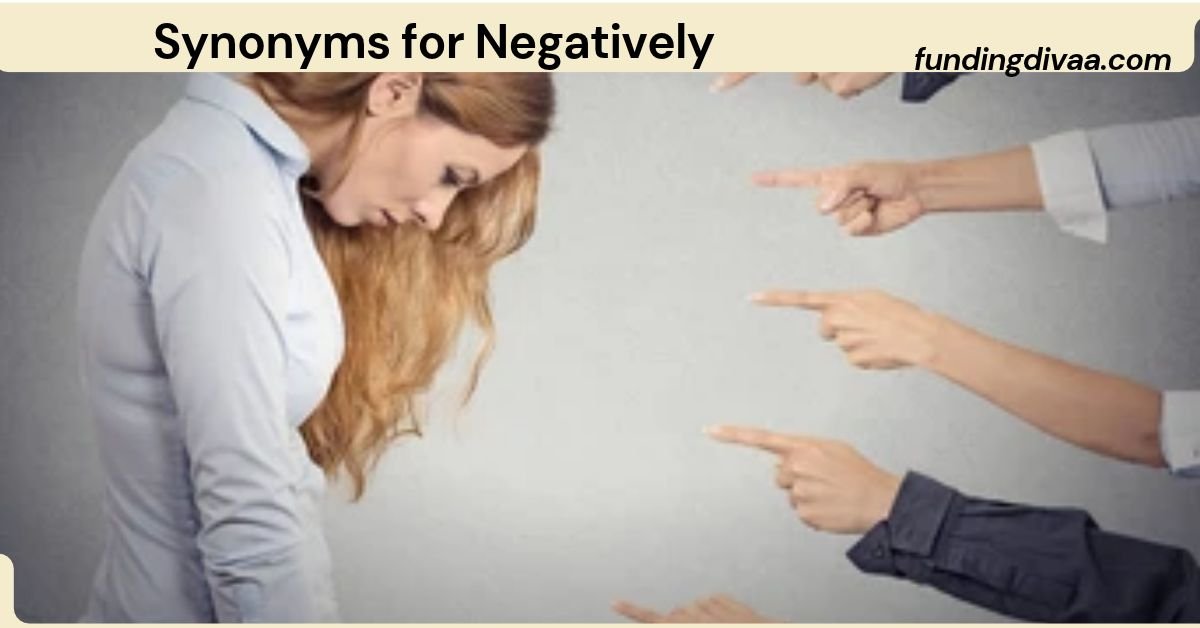
100 Synonyms for Negatively With Meanings and Examples
Choosing the right words can make a big difference in how your message sounds. The word negatively is useful, but it can sometimes feel too general. Depending on the situation, you may want to describe harm, express disagreement, show doubt, or explain an unfavorable result.
For example, a change might adversely affect a business, a reviewer might criticize a movie harshly, or a person might react skeptically to an unexpected claim. Each expression communicates a different kind of negative response.
Learning synonyms for negatively helps you express your ideas more clearly in essays, workplace reports, emails, reviews, and everyday conversations. It also gives you more choices when describing negative effects, unfavorable attitudes, and difficult situations.
In this guide, you will discover 100 related words, their meanings, practical examples, formal alternatives, and tips for choosing the most accurate expression.
What Does Negatively Mean?
Negatively is an adverb that generally means in an unfavorable, harmful, critical, or disapproving way. The exact meaning depends on the context in which the word appears.
Here are a few examples:
- The unexpected expense affected the family negatively.
- The manager responded negatively to the suggestion.
- The reviewer wrote negatively about the film.
- Investors reacted skeptically to the announcement.
In the first sentence, negatively describes an undesirable effect. In the second, it describes an unfavorable reaction. In the third, it refers to critical writing. In the fourth, skeptically expresses doubt.
These examples show why choosing the right negatively synonym matters. A word that describes damage may not work when discussing an attitude or opinion.

Negative, Negatively, and Negativity: What Is the Difference?
These words are related, but they have different grammatical roles.
| Word | Part of speech | Meaning | Example |
| Negative | Adjective | Unfavorable, harmful, or expressing denial | The report received a negative review. |
| Negatively | Adverb | In an unfavorable or harmful way | The delay affected sales negatively. |
| Negativity | Noun | A tendency toward pessimism, criticism, or unfavorable thinking | Constant negativity can discourage a team. |
| Negate | Verb | To cancel, deny, or make ineffective | Extra costs may negate the savings. |
| Negation | Noun | An expression or act of denial | The sentence contains a negation. |
Understanding these differences helps you select the correct negative synonym without creating grammatical mistakes.
What Is Another Word for Negatively?
The best alternative depends on what you want to communicate.
| Synonym | Meaning | Example |
| Adversely | In a harmful or unfavorable way | The storm adversely affected local businesses. |
| Unfavorably | In a way that produces a poor evaluation | The proposal was received unfavorably. |
| Critically | In a way that identifies faults | The reviewer examined the product critically. |
| Pessimistically | With the expectation of a poor outcome | She spoke pessimistically about the future. |
| Detrimentally | In a damaging way | The delay detrimentally affected productivity. |
| Disapprovingly | In a way that shows disapproval | He looked disapprovingly at the decision. |
| Harshly | In a severe or unkind manner | The manager criticized the work harshly. |
| Skeptically | With doubt | The audience listened skeptically to the claim. |
| Dismissively | As if something does not deserve attention | She responded dismissively to the question. |
| Poorly | In an unsatisfactory way | The system performed poorly during testing. |
For example, if a new rule causes financial losses, adversely may be appropriate. If someone disagrees with the rule, disapprovingly or critically may fit better.
Also Read: 120+ Synonyms for Evaluation: Meanings, Examples, and How to Use Them
The goal is not to replace negatively mechanically. It is to choose a word that explains the situation more precisely.
100 Synonyms for Negatively With Meanings and Examples
The following list covers several meanings associated with negatively. Some words are close synonyms, while others are useful alternatives only in particular contexts.
A. Synonyms for Harmful or Unfavorable Effects
These words are useful when negatively describes damage, reduced performance, lost opportunities, or another undesirable consequence.
1. Adversely
Meaning: In a way that produces an unfavorable effect.
Example: Rising fuel prices adversely affected delivery costs.
2. Detrimentally
Meaning: In a manner that causes harm or disadvantage.
Example: Poor communication detrimentally affected the team’s progress.
3. Harmfully
Meaning: In a way that causes harm.
Example: Certain chemicals can harmfully affect aquatic life.
4. Deleteriously
Meaning: In a damaging or harmful manner, usually in formal writing.
Example: Air pollution can deleteriously affect environmental quality.
5. Inj uriously
Meaning: In a way that causes injury or damage.
Example: The untreated leak affected the building’s structure injuriously.
6. Damagingly
Meaning: In a manner that causes damage to something.
Example: The false statement damagingly affected the company’s reputation.
7. Destructively
Meaning: In a way that causes serious damage or destruction.
Example: The dispute affected the organization destructively.
8. Disadvantageously
Meaning: In a way that places someone or something in a less favorable position.
Example: The revised terms affected smaller suppliers disadvantageously.
9. Unfavorably
Meaning: In a way that produces an undesirable result or judgment.
Example: The policy affected part-time workers unfavorably.
10. Severely
Meaning: To a serious or substantial degree.
Example: The shortage severely affected manufacturing.
11. Badly
Meaning: In an undesirable or harmful manner.
Example: The error badly damaged the project’s credibility.
12. Poorly
Meaning: In an unsatisfactory or ineffective way.
Example: The website performed poorly during the launch.
13. Counterproductively
Meaning: In a way that works against the intended goal.
Example: Excessive restrictions can counterproductively reduce motivation.
14. Undesirably
Meaning: In a way that is unwanted or unfavorable.
Example: The material reacted undesirably to extreme temperatures.
15. Prejudicially
Meaning: In a way that causes unfair harm or disadvantage.
Example: The disputed evidence could prejudicially influence the proceedings.
16. Disruptively
Meaning: In a way that interrupts normal activity.
Example: The unexpected change affected the workflow disruptively.
17. Unproductively
Meaning: In a way that fails to produce useful results.
Example: The team spent hours arguing unproductively.
18. Ineffectively
Meaning: Without achieving the desired result.
Example: The company responded ineffectively to customer complaints.
19. Negligently
Meaning: Without the necessary care or attention.
Example: The equipment was negligently maintained.
20. Inefficiently
Meaning: In a way that wastes time, effort, or resources.
Example: The outdated process used employee time inefficiently.
B. Synonyms for Criticism and Disapproval
These words work when negatively refers to an unfavorable opinion, critical comment, or lack of approval.
21. Critically
Meaning: In a way that identifies faults, weaknesses, or limitations.
Example: The editor evaluated the proposal critically.
22. Disapprovingly
Meaning: In a way that shows a lack of approval.
Example: Her father looked disapprovingly at the unfinished assignment.
23. Disparagingly
Meaning: In a way that belittles someone or something.
Example: He spoke disparagingly about a competitor.
24. Derogatorily
Meaning: In an insulting or disrespectful manner.
Example: The speaker referred derogatorily to his opponents.
25. Pejoratively
Meaning: In a way that expresses contempt or an unfavorable judgment.
Example: The label was used pejoratively during the debate.
26. Dismissively
Meaning: In a way that treats an idea or person as unimportant.
Example: The supervisor responded dismissively to the employee’s concern.
27. Harshly
Meaning: In a severe or unkind manner.
Example: The reviewer judged the first draft harshly.
28. Judgmentally
Meaning: In a way that quickly or unfairly judges others.
Example: She spoke judgmentally about other people’s choices.
29. Condemningly
Meaning: In a way that expresses strong disapproval.
Example: The report spoke condemningly about the misuse of public funds.
30. Censoriously
Meaning: In a manner that strongly focuses on finding faults.
Example: The critic wrote censoriously about the performance.
31. Disdainfully
Meaning: In a way that shows superiority or contempt.
Example: He looked disdainfully at the imitation.
32. Contemptuously
Meaning: In a manner that shows deep disrespect.
Example: She spoke contemptuously about the dishonest proposal.
33. Scornfully
Meaning: In a way that expresses strong disrespect or ridicule.
Example: He laughed scornfully at the suggestion.
34. Reproachfully
Meaning: In a way that expresses disappointment or blame.
Example: The teacher looked reproachfully at the student who had ignored the instructions.
35. Accusingly
Meaning: In a manner that suggests someone is responsible for wrongdoing.
Example: The manager looked accusingly at the employee.
36. Uncharitably
Meaning: In an unfairly critical or ungenerous way.
Example: The reviewer interpreted the author’s remarks uncharitably.
37. Unsympathetically
Meaning: Without understanding or compassion.
Example: The complaint was handled unsympathetically.
38. Fault-findingly
Meaning: In a manner that focuses on identifying faults.
Example: The supervisor examined the proposal fault-findingly rather than looking for solutions.
39. Unfavorably
Meaning: In a way that communicates a poor evaluation.
Example: The committee viewed the incomplete application unfavorably.
40. Negatively
Meaning: In a way that expresses an unfavorable opinion.
Example: Several customers spoke negatively about the confusing checkout process.
C. Synonyms for Pessimism, Doubt, and Worry
Use these words when negatively describes an expectation, prediction, or attitude toward an uncertain outcome.
41. Pessimistically
Meaning: With the expectation that something will turn out badly.
Example: He spoke pessimistically about meeting the deadline.
42. Gloomily
Meaning: In a sad, discouraged, or hopeless manner.
Example: She spoke gloomily about the team’s recent losses.
43. Bleakly
Meaning: In a way that suggests little hope for improvement.
Example: Analysts described the economic outlook bleakly.
44. Doubtfully
Meaning: With uncertainty about whether something is true or likely to succeed.
Example: The investors looked doubtfully at the ambitious forecast.
45. Skeptically
Meaning: With doubt about a claim or explanation.
Example: Customers listened skeptically to the company’s promises.
46. Cynically
Meaning: With distrust of people’s motives, often assuming selfish intentions.
Example: He cynically questioned the purpose of the announcement.
47. Suspiciously
Meaning: In a way that shows distrust or suspicion.
Example: The guard examined the unfamiliar package suspiciously.
48. Apprehensively
Meaning: With worry about what might happen.
Example: The students waited apprehensively for their results.
49. Fearfully
Meaning: In a manner that shows fear or concern.
Example: Residents watched fearfully as the storm approached.
50. Hesitantly
Meaning: With uncertainty or reluctance.
Example: She hesitantly agreed to the unfamiliar assignment.
51. Uncertainly
Meaning: Without confidence about what is true or likely.
Example: The spokesperson answered uncertainly.
52. Tentatively
Meaning: With caution because something is not yet certain.
Example: The researchers tentatively interpreted the early findings.
53. Fatalistically
Meaning: With the belief that events cannot be changed or avoided.
Example: He spoke fatalistically about the company’s future.
54. Discouragingly
Meaning: In a way that reduces confidence or hope.
Example: The results were discouragingly low.
55. Grimly
Meaning: In a serious manner that suggests difficulty or danger.
Example: The team grimly reviewed the growing list of problems.
D. Synonyms for Anger, Resentment, and Hostility
These words describe negative responses that involve anger, conflict, or an unfriendly attitude.
56. Bitterly
Meaning: With anger, hurt, or resentment.
Example: He complained bitterly about the unfair decision.
57. Resentfully
Meaning: In a way that shows anger about perceived unfair treatment.
Example: She resentfully accepted the additional workload.
58. Hostilely
Meaning: In an unfriendly or aggressive manner.
Example: The audience reacted hostilely to the controversial announcement.
59. Antagonistically
Meaning: In a way that creates opposition or conflict.
Example: The departments communicated antagonistically during the negotiation.
60. Maliciously
Meaning: With an intention to hurt or harm someone.
Example: Someone maliciously spread false information online.
61. Aggressively
Meaning: In a forceful or confrontational manner.
Example: The customer argued aggressively with the staff.
62. Angrily
Meaning: With anger or strong displeasure.
Example: Residents angrily opposed the proposed development.
63. Irritably
Meaning: In an easily annoyed or impatient manner.
Example: The supervisor answered irritably after repeated interruptions.
64. Vengefully
Meaning: With a desire to punish someone for a perceived wrong.
Also Read: 100+ Synonyms for Already: Definitions, Examples, and Better Alternatives
Example: The character acted vengefully after being betrayed.
65. Spitefully
Meaning: In a way intended to upset or hurt another person.
Example: He spitefully deleted the shared document.
66. Belligerently
Meaning: In a hostile or combative manner.
Example: The customer spoke belligerently to the representative.
67. Defiantly
Meaning: In a way that openly resists authority or opposition.
Example: The employee defiantly rejected the unreasonable demand.
68. Abrasively
Meaning: In a rough, unpleasant, or offensive manner.
Example: The manager communicated abrasively during the meeting.
69. Unkindly
Meaning: In a way that lacks kindness or consideration.
Example: She spoke unkindly about her colleague’s mistake.
70. Unpleasantly
Meaning: In a way that causes discomfort or displeasure.
Example: The discussion ended unpleasantly.
E. Synonyms for Negative Tone and Behavior
These words help describe how someone speaks, writes, reacts, or behaves.
71. Sarcastically
Meaning: Using irony or mocking remarks to criticize or ridicule.
Example: He sarcastically thanked the team for arriving late.
72. Mockingly
Meaning: In a way that makes fun of someone or something.
Example: The children repeated his words mockingly.
73. Coldly
Meaning: Without warmth, friendliness, or sympathy.
Example: She responded coldly to the apology.
74. Darkly
Meaning: In a gloomy, threatening, or ominous manner.
Example: He spoke darkly about the possible consequences.
75. Unenthusiastically
Meaning: Without interest, excitement, or energy.
Example: The staff responded unenthusiastically to the proposal.
76. Reluctantly
Meaning: In a way that shows unwillingness.
Example: He reluctantly accepted the revised schedule.
77. Dispiritedly
Meaning: In a way that shows low spirits or lost confidence.
Example: The players walked dispiritedly off the field.
78. Morosely
Meaning: In a gloomy, sullen, or unhappy manner.
Example: He sat morosely through the meeting.
79. Solemnly
Meaning: In a serious or grave manner.
Example: The official solemnly acknowledged the mistakes.
80. Brusquely
Meaning: In a brief, abrupt manner that may seem rude.
Example: The receptionist brusquely told the visitors to wait.
81. Curtly
Meaning: In a short, abrupt manner that can sound unfriendly.
Example: He curtly declined the invitation.
82. Indifferently
Meaning: Without showing interest or concern.
Example: She reacted indifferently to the announcement.
83. Apathetically
Meaning: Without interest, emotion, or motivation.
Example: The group listened apathetically to the repeated instructions.
84. Unprofessionally
Meaning: In a manner that does not meet expected professional standards.
Example: The supervisor handled the disagreement unprofessionally.
85. Carelessly
Meaning: Without sufficient attention or care.
Example: The technician carelessly entered the wrong figures.
F. Synonyms for Unhelpful or Unfavorable Responses
These words are useful when the issue is an unfair, inaccurate, or ineffective response rather than an emotional reaction.
86. Unconstructively
Meaning: In a way that does not help improve a situation.
Example: The team criticized the proposal unconstructively without offering solutions.
87. Unhelpfully
Meaning: In a way that fails to provide useful assistance.
Example: The representative responded unhelpfully to the customer’s question.
88. Unreasonably
Meaning: In a way that is not fair, sensible, or justified.
Example: The landlord unreasonably rejected the repair request.
89. Unfairly
Meaning: Without proper fairness or equal treatment.
Example: The new procedure treated temporary workers unfairly.
90. Improperly
Meaning: In a way that does not follow the correct standards or procedures.
Example: The data was improperly handled during the review.
91. Incorrectly
Meaning: In a way that contains an error.
Example: The report incorrectly described the cause of the delay.
92. Inaccurately
Meaning: Without sufficient accuracy or precision.
Example: The article inaccurately represented the study’s findings.
93. Inappropriately
Meaning: In a way that does not suit the situation.
Example: The employee responded inappropriately to a sensitive complaint.
94. Ineptly
Meaning: Without the necessary skill or ability.
Example: The problem was ineptly handled by the inexperienced team.
95. Inconsiderately
Meaning: Without enough thought for other people’s needs or feelings.
Example: He inconsiderately interrupted the presentation.
96. Unnecessarily
Meaning: In a way that could have been avoided.
Example: The confusing instructions unnecessarily complicated the task.
97. Inefficiently
Meaning: In a way that wastes time or resources.
Example: The department managed its resources inefficiently.
98. Disruptively
Meaning: In a way that interrupts normal activity or progress.
Example: The repeated changes affected the workflow disruptively.
99. Unfavorably
Meaning: In a way that leads to a poor evaluation or result.
Example: The incomplete application was reviewed unfavorably.
100. Negatively
Meaning: In an unfavorable way.
Example: Repeated interruptions can negatively affect concentration.
Synonyms for Negatively Affected
The phrase negatively affected describes a person, organization, process, or situation that experienced an unfavorable change.
Common negatively affected synonyms include:
- Adversely affected
- Harmed
- Damaged
- Impaired
- Disadvantaged
- Weakened
- Disrupted
- Undermined
- Compromised
- Hindered
- Set back
- Diminished
- Reduced
- Injured
- Worsened
The best synonym for affected depends on the type of change.
| Original sentence | Better alternative |
| The storm negatively affected local businesses. | The storm disrupted local businesses. |
| The decision negatively affected employee morale. | The decision undermined employee morale. |
| The outage negatively affected customer service. | The outage interrupted customer service. |
| The rule negatively affected small suppliers. | The rule disadvantaged small suppliers. |
| The error negatively affected the results. | The error reduced the accuracy of the results. |
These examples show how a specific verb can make a sentence clearer than the general phrase negatively affected.
Synonyms for Negatively Impacted
When looking for a negatively impacted synonym, first identify the actual consequence.
| Phrase | Alternative | Best use |
| Negatively impacted profits | Reduced profits | Financial results |
| Negatively impacted performance | Weakened performance | Productivity or results |
| Negatively impacted employees | Harmed employees | Personal or workplace consequences |
| Negatively impacted service | Disrupted service | Operations |
| Negatively impacted growth | Slowed growth | Business development |
| Negatively impacted public trust | Undermined public trust | Reputation |
| Negatively impacted the environment | Damaged the environment | Environmental harm |
| Negatively impacted the schedule | Delayed the schedule | Timing |
| Negatively impacted access | Restricted access | Availability |
| Negatively impacted quality | Reduced quality | Standards or performance |
For example, “The outage negatively impacted customer service” can become “The outage disrupted customer service.”
The revised sentence is shorter and identifies the effect directly.
Synonyms for Negatively Affect
If you need a negatively affect synonym, consider whether the sentence describes damage, a decrease, an interruption, or a loss of confidence.
Useful alternatives include harm, damage, weaken, impair, disrupt, undermine, hinder, limit, reduce, compromise, worsen, and interfere with.
Examples:
- Lack of sleep negatively affects attention.
Lack of sleep impairs attention. - Poor communication negatively affects teamwork.
Poor communication undermines teamwork. - Heavy traffic negatively affects delivery times.
Heavy traffic delays deliveries. - Rising costs negatively affect affordability.
Rising costs reduce affordability. - Frequent interruptions negatively affect productivity.
Frequent interruptions disrupt productivity.
A specific verb often communicates more information than an adverb followed by a general verb.
Synonyms for Negatively Impact and Negatively Influencing
The phrase negatively impact describes an unfavorable effect. Negatively influence usually refers to an undesirable change in behavior, judgment, confidence, or opinion.
Negatively Impact Synonyms
Depending on the sentence, you can use:
- Harm
- Damage
- Impair
- Weaken
- Disrupt
- Hinder
- Reduce
- Delay
- Undermine
- Compromise
- Restrict
- Worsen
Example: The policy negatively impacted access to services.
Better: The policy restricted access to services.
Negatively Influence Synonyms
Depending on the intended meaning, you can use:
- Undermine
- Discourage
- Mislead
- Distort
- Bias
- Pressure
- Weaken
- Dissuade
- Corrupt
- Shape unfavorably
Example: Repeated criticism negatively influenced her confidence.
Better: Repeated criticism undermined her confidence.
Use these words carefully. Mislead suggests that someone was given incorrect information, while corrupt suggests a more serious form of damage or moral influence.
Negative Synonyms: Another Word for Negative
Negative is an adjective with several meanings. It can describe something unfavorable, a lack of approval, a denial, or a value below zero.
The correct negative synonym depends on the context.
When Negative Means Unfavorable
Use adverse, unfavorable, harmful, undesirable, poor, detrimental, or damaging.
Example: The company received negative feedback.
Alternative: The company received unfavorable feedback.
When Negative Means Critical or Disapproving
Use critical, dismissive, skeptical, pessimistic, hostile, or unsupportive.
Example: The committee had a negative attitude toward the proposal.
Alternative: The committee was skeptical of the proposal.
Also Read: 100+ Synonyms for Affirm With Meanings and Examples
When Negative Means Harmful
Use damaging, destructive, harmful, detrimental, or injurious.
Example: The chemical had a negative effect on the material.
Alternative: The chemical damaged the material.
When Negative Means Pessimistic
Use gloomy, bleak, discouraging, defeatist, or pessimistic.
Example: He had a negative outlook on the future.
Alternative: He had a pessimistic outlook on the future.
When Negative Means Absent or Denied
Depending on the context, alternatives may include absent, missing, denied, unavailable, or nonexistent.
Example: The test result was negative.
In this case, negative may mean that the test did not detect the condition being tested for. It does not mean harmful or pessimistic.
In mathematics, negative describes a number below zero. Words such as harmful or unfavorable cannot replace negative in that context.
Negative Meaning, Negative Connotation, and Negative Tone
These expressions are related, but each describes something different.
Negative Meaning
Negative meaning refers to an unfavorable or undesirable sense in a word, statement, or situation.
Example: The service was disappointing.
The word disappointing communicates an unfavorable evaluation.
Negative Connotation
A negative connotation is an unpleasant or unfavorable feeling associated with a word beyond its basic definition.
For example, cheap and inexpensive can both refer to a low price, but cheap may suggest poor quality. Inexpensive is often more neutral.
Similarly, stubborn often has a negative connotation, while determined may describe a similar quality more positively.
Negative Tone
A negative tone describes the overall feeling conveyed by someone’s speech or writing. It might sound angry, doubtful, gloomy, critical, or dismissive.
Examples:
- “That plan will never work” sounds pessimistic.
- “This plan has several weaknesses” sounds critical.
- “That’s a ridiculous idea” sounds dismissive.
- “I am not convinced by this explanation” sounds skeptical.
When describing a negative tone, choose the word that identifies the actual emotion or attitude.
Formal Synonyms for Negatively
Formal writing often benefits from precise language, especially when describing research, business performance, policy decisions, or measurable results.
| Formal synonym | Meaning | Example |
| Adversely | In a harmful way | The change adversely affected productivity. |
| Detrimentally | In a damaging way | The decision detrimentally affected long-term planning. |
| Unfavorably | In a way that produces a poor evaluation | The proposal was received unfavorably. |
| Counterproductively | In a way that works against a goal | The measure counterproductively increased delays. |
| Prejudicially | In a way that creates unfair disadvantage | The claim could prejudicially affect the proceedings. |
| Ineffectively | Without achieving the intended result | The organization responded ineffectively to the complaint. |
| Disproportionately | To an excessive degree compared with something else | The new costs disproportionately affected smaller firms. |
Do not choose a complicated word merely because it sounds formal. Adversely is often clearer than deleteriously, and reduced is usually more direct than negatively impacted when describing a measurable decline.
Negative Descriptive Words and Words to Describe a Negative Attitude
Negative descriptive words can help explain behavior, communication, or personality traits. However, each word carries a different meaning and emotional strength.
| Word | Meaning | Example |
| Pessimistic | Expects poor outcomes | He is pessimistic about the plan. |
| Cynical | Distrusts people’s motives | She is cynical about political promises. |
| Hostile | Unfriendly or aggressive | The response was hostile. |
| Dismissive | Treats something as unimportant | His dismissive attitude discouraged discussion. |
| Resentful | Feels anger about perceived unfairness | She remained resentful about the decision. |
| Apathetic | Shows little interest or concern | The group appeared apathetic. |
| Critical | Focuses on faults or weaknesses | The reviewer was critical of the design. |
| Uncooperative | Unwilling to work with others | The employee was uncooperative during the discussion. |
| Argumentative | Often willing to argue | His argumentative approach delayed the meeting. |
| Inconsiderate | Fails to consider other people’s needs | The comment was inconsiderate. |
These words should describe specific attitudes or behavior rather than serve as broad labels for people.
Synonyms for Negative Effects and Negative Impact
When writing about results, the phrase negative effect or negative impact can often be replaced with a more precise expression.
Possible alternatives include adverse effect, harmful consequence, damaging outcome, unfavorable result, setback, loss, decline, disruption, deterioration, and impairment.
Examples:
- Negative effect on sales → decline in sales
- Negative impact on trust → loss of trust
- Negative effect on performance → reduced performance
- Negative impact on operations → operational disruption
- Negative effect on quality → deterioration in quality
- Negative impact on progress → setback in progress
- Negative effects on health → harmful health effects
- Negative impact on access → restricted access
For formal writing, adverse effect is a useful alternative. For everyday writing, a direct description such as reduced sales or delayed progress is often easier to understand.
Antonyms for Negative and Negatively
Antonyms are words with opposite meanings. The opposite of negative depends on how the word is being used.
Opposite of Negatively
Possible alternatives include:
- Positively
- Beneficially
- Constructively
- Helpfully
- Advantageously
- Favorably
- Effectively
Example: The new system affected productivity negatively.
Opposite: The new system affected productivity positively.
Opposite of Negative
Depending on the meaning, possible antonyms include:
- Positive
- Favorable
- Beneficial
- Optimistic
- Supportive
- Affirmative
Example: She received negative feedback.
Opposite: She received positive feedback.
Remember that positive and negative can have technical meanings in mathematics, science, and medical testing. In those contexts, their opposites must be interpreted according to the specific subject.
Common Mistakes When Using Negatively and Its Synonyms
Choosing an inaccurate word can change the meaning of a sentence. Avoid these common errors.
Using Pessimistically to Describe Damage
Incorrect: The flood pessimistically affected the town.
Better: The flood adversely affected the town.
Pessimistically describes an attitude or expectation, not a physical effect.
Using Critically When You Mean Harmfully
If a delay causes damage to a project, adversely affected or harmed may be appropriate. Critically is better when a person examines the project’s weaknesses.
Confusing Negatively Affected With Negatively Affecting
Negatively affected describes something that experienced an unfavorable result.
Example: The affected departments needed additional support.
Negatively affecting describes something that is causing an unfavorable result.
Example: The system failure is negatively affecting customer service.
Using Badly in Every Sentence
Badly is acceptable in everyday English, but it can sound vague in professional writing.
Instead of “The decision badly affected the schedule,” write “The decision delayed the schedule” if the actual problem was a delay.
Assuming Every Negative Word Is an Insult
Skeptical, critical, cautious, and pessimistic do not always describe bad behavior. A skeptical researcher may be checking evidence carefully, and a critical reviewer may be identifying genuine problems.
Use the word that best describes the evidence, behavior, or attitude.
Practical Tips for Choosing the Best Synonym
Follow these steps when replacing negatively.
- Identify the intended meaning. Is the sentence about harm, disagreement, doubt, anger, or a poor result?
- Check the grammar. Decide whether you need an adverb, adjective, noun, or verb.
- Choose a specific alternative. Use reduced for a decrease, delayed for a timing problem, and undermined for weakened trust or confidence.
- Match the tone. Harshly sounds stronger than critically, while skeptically expresses doubt rather than hostility.
- Consider the reader. Choose familiar words for general audiences and specialized vocabulary only when it improves accuracy.
- Read the sentence again. Make sure the replacement sounds natural and preserves the original meaning.
A useful rule is to describe exactly what happened instead of relying on a broad word such as negatively.
For example, “The change negatively affected results” could become “The change reduced accuracy” if accuracy was the main problem.
Frequently Asked Questions
What is the most common synonym for negatively?
Adversely is one of the most useful alternatives when negatively describes an unfavorable effect. Unfavorably works for poor evaluations, while critically is appropriate when discussing faults or weaknesses.
What is a simple word for negatively?
Badly, poorly, and harmfully may work in everyday English. Depending on the sentence, harmed, reduced, weakened, or delayed may express the meaning more clearly.
What is the difference between negatively and adversely?
Negatively has a broad range of meanings. Adversely usually describes an unfavorable effect or consequence.
A person can speak negatively about a plan, while a delay can adversely affect its completion date.
What is a synonym for negatively impacted?
Common alternatives include adversely affected, harmed, damaged, disrupted, weakened, hindered, and reduced. Choose the word that accurately describes the result.
What is another way to say negatively affecting?
You can use adversely affecting, harming, damaging, weakening, disrupting, or undermining. A direct verb may make the sentence shorter and more natural.
What is a formal synonym for negative impact?
Adverse effect, detrimental effect, harmful consequence, and unfavorable outcome are useful formal alternatives.
For example, “The policy had a negative impact on attendance” could become “The policy had an adverse effect on attendance.”
What is the difference between a negative effect and a negative impact?
Both phrases generally describe an unfavorable consequence. Effect is common in general and academic writing, while impact often emphasizes the influence or significance of a change.
What is a synonym for negativity?
Depending on the context, alternatives include pessimism, gloom, hostility, cynicism, disapproval, and discouragement. Each describes a different form of negativity.
What are some negative words to describe a person’s attitude?
Pessimistic, hostile, dismissive, cynical, resentful, apathetic, and uncooperative may fit different situations. Choose a word that accurately describes the person’s behavior rather than using a general label.
What is a synonym for a bad attitude?
Possible alternatives include negative attitude, hostile attitude, dismissive attitude, pessimistic outlook, and uncooperative behavior. The best expression depends on what the person is actually doing.
What is the opposite of negative?
Positive is the most common opposite when negative means unfavorable. Other options include favorable, beneficial, optimistic, supportive, and affirmative, depending on context.
What is a synonym for negate?
Negate can mean to cancel, invalidate, deny, or make something ineffective. Alternatives include cancel out, nullify, invalidate, counteract, and refute.
For example, “The additional costs negate the savings” can become “The additional costs cancel out the savings.”
What is a synonym for negation?
Negation refers to denying or expressing that something is not the case. Related terms include denial, contradiction, rejection, and repudiation, depending on the context.
In grammar, negation commonly involves words such as not or never.
How do you spell negative?
The correct spelling is negative: N-E-G-A-T-I-V-E. The related forms are negatively and negativity.
Is negatively always a negative word?
Negatively generally expresses an unfavorable meaning, but context matters. A negative medical test result may be reassuring, while a statement that someone was affected negatively usually describes an undesirable consequence.
Can I use negatively in academic writing?
Yes. Negatively is acceptable in academic writing, but a specific alternative may improve precision. Use adversely for harmful effects, critically for evaluation, and pessimistically for expectations of poor outcomes.
Conclusion
The best synonyms for negatively depend on the meaning of the sentence. Adversely describes harmful effects, unfavorably communicates an unfavorable evaluation, critically identifies weaknesses, and pessimistically expresses expectations of poor outcomes.
When discussing negative effects or negatively impacted situations, more precise words such as harmed, weakened, disrupted, reduced, delayed, and undermined can make your writing clearer.
Remember that a synonym should preserve your intended meaning rather than simply provide a different word. By choosing language that accurately describes an effect, attitude, or response, you can make your essays, reports, emails, and everyday conversations more natural, professional, and effective.