Synonyms for Vain: 100+ Meanings, Examples, Antonyms, and Better Alternatives
Finding the right synonym for “vain” is not always simple because the word has more than one meaning. A person can be vain because they care too much about their appearance or achievements, while an attempt can be vain because it does not produce the desired result.
That means the best synonym depends on the sentence.
For example:
- “She is vain about her appearance.” → “She is conceited about her appearance.”
- “Our efforts were in vain.” → “Our efforts were futile.”
- “He searched in vain for an answer.” → “He searched unsuccessfully for an answer.”
This guide explains the main meanings of “vain” and provides more than 100 useful synonyms, related expressions, and context-specific alternatives. It also explains the differences between commonly confused words such as “vain,” “conceited,” “arrogant,” “selfish,” “smug,” and “futile.”
What Does “Vain” Mean?
“Vain” is mainly used in two ways.
The first meaning describes someone who has excessive pride in their appearance, abilities, achievements, or importance. Cambridge defines this sense as being too interested in your own appearance or achievements.
The second meaning describes something that does not achieve its intended purpose. It is especially common in the expression “in vain,” meaning unsuccessfully or without the desired result.
Vain meaning: excessive pride
When “vain” describes a person, it can mean:
- overly concerned with appearance
- excessively proud
- too focused on personal achievements
- overly interested in admiration
- convinced of one’s own attractiveness or importance
Example:
Maria is vain and spends a great deal of time checking her appearance.
Possible alternatives include “conceited,” “self-admiring,” “egotistical,” “self-important,” and “narcissistic,” although each word has a slightly different meaning.
Vain meaning: unsuccessful or useless
When “vain” describes an attempt, hope, effort, or action, it means that the action failed to achieve its purpose.
Example:
They made a vain attempt to repair the damaged machine.
Possible alternatives include “futile,” “fruitless,” “unsuccessful,” “ineffective,” and “pointless.”
What does “in vain” mean?
“In vain” means without success or without achieving the intended result.
Example:
I called him several times, but in vain.
This means:
I called him several times, but I could not reach him.
Cambridge also gives “in vain” as meaning “unsuccessfully.”
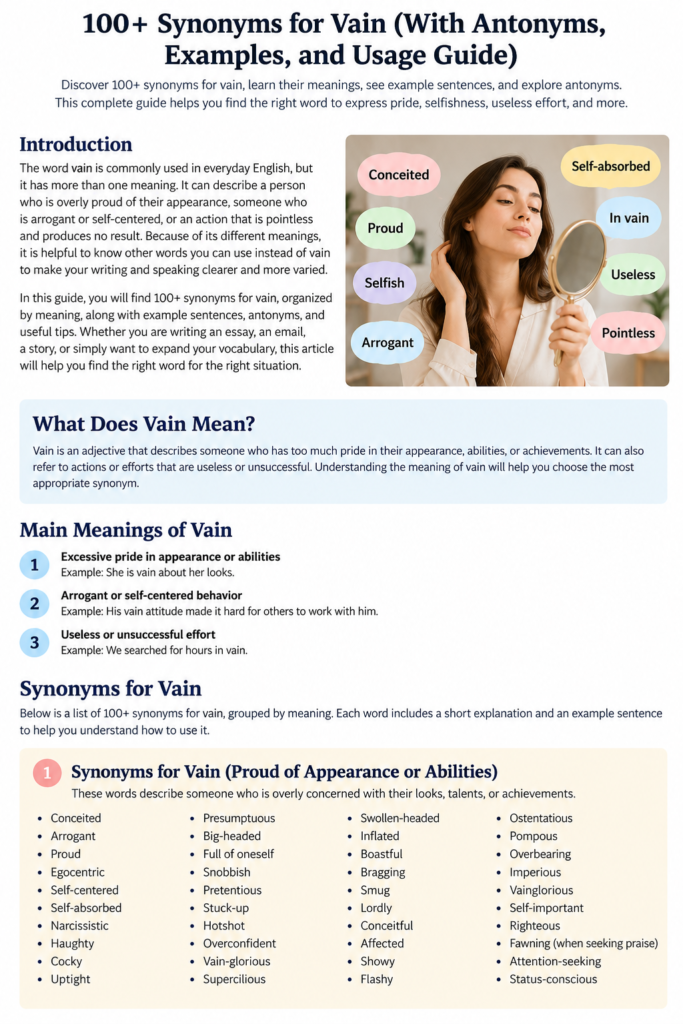
100+ Synonyms for Vain
The following alternatives are grouped by meaning. This is important because there is no single synonym that works naturally in every sentence containing “vain.”
Some entries are close synonyms, while others are useful alternatives only in particular contexts.
Synonyms for Vain When Describing Personality
These words are useful when “vain” means excessively proud, self-focused, or concerned with appearance or achievements.
1. Conceited
Having an excessively high opinion of yourself.
Example:
He became conceited after receiving several awards.
2. Arrogant
Having an exaggerated sense of superiority.
Example:
Her arrogant attitude made cooperation difficult.
3. Egotistical
Excessively focused on yourself and your own importance.
Example:
His egotistical behavior annoyed his coworkers.
4. Egotistic
Another adjective describing excessive self-interest or self-importance.
Example:
His egotistic comments dominated the conversation.
5. Narcissistic
Extremely focused on yourself, your appearance, or your importance.
Example:
The character is portrayed as narcissistic and obsessed with admiration.
6. Self-admiring
Showing excessive admiration for yourself.
Example:
His self-admiring comments quickly became irritating.
7. Self-important
Believing you are more important than you really are.
Example:
The self-important speaker refused to listen to anyone else.
8. Self-satisfied
Too pleased with yourself or your achievements.
Example:
He gave a self-satisfied smile after winning.
9. Smug
Too pleased with yourself, especially in a way that irritates other people.
Example:
She sounded smug after proving her point.
10. Boastful
Frequently talking proudly about yourself or your accomplishments.
Example:
His boastful stories became repetitive.
11. Vainglorious
Excessively proud of your achievements or abilities.
Example:
His vainglorious attitude made him difficult to work with.
12. Proud
Feeling strong satisfaction about yourself or something you have achieved. “Proud” is not always negative, so it is a softer alternative to “vain.”
Example:
She was proud of her appearance.
13. Haughty
Behaving as though you are better or more important than other people.
Example:
The haughty customer treated the staff disrespectfully.
14. Pompous
Trying to appear important, intelligent, or impressive.
Example:
His pompous manner made a simple discussion uncomfortable.
15. Pretentious
Trying to appear more important, sophisticated, or impressive than you really are.
Example:
The writer’s pretentious style distracted from the main idea.
16. Self-centered
Mainly concerned with yourself rather than other people.
Example:
His self-centered behavior frustrated his friends.
17. Self-absorbed
So focused on yourself that you pay little attention to others.
Example:
She was too self-absorbed to notice that her friend was upset.
18. Self-obsessed
Extremely focused on yourself, your appearance, or your interests.
Example:
The celebrity was portrayed as self-obsessed.
19. Self-loving
Showing excessive love or admiration for yourself.
Example:
His self-loving attitude was obvious from the way he spoke.
Also Read: Synonyms for Internalize: 80+ Alternatives With Meanings and Examples
20. Cocky
Overconfident in an irritating or disrespectful way.
Example:
His cocky attitude disappeared after he lost the match.
21. Stuck-up
Informal; behaving as though you are better than other people.
Example:
He seemed stuck-up when he refused to speak to the other guests.
22. Snobbish
Believing you are better because of wealth, status, education, taste, or social position.
Example:
Her snobbish comments offended the people around her.
23. Snooty
Informal; acting superior or unfriendly toward people considered less important.
Example:
The snooty customer complained about everything.
24. Uppity
Informal; behaving as though you deserve a higher position or status.
Example:
His uppity behavior irritated the rest of the group.
25. Superior
Acting as though you are better than others.
Example:
He used a superior tone during the discussion.
26. Disdainful
Showing that you believe someone or something is beneath your respect.
Example:
She gave him a disdainful look.
27. Imperious
Expecting other people to obey you and treating them as inferior.
Example:
The manager’s imperious manner discouraged questions.
28. Overbearing
Trying to control other people in an unpleasant or forceful way.
Example:
His overbearing personality made group decisions difficult.
29. Patronizing
Speaking or behaving as though you are more intelligent or important than someone else.
Example:
His patronizing explanation annoyed the experienced employee.
30. Condescending
Showing that you believe you are superior to someone.
Example:
Her condescending response made the new employee uncomfortable.
31. Swaggering
Showing excessive confidence in an arrogant or showy way.
Example:
He entered the room with a swaggering attitude.
32. Ostentatious
Displaying wealth, success, or status in an excessive way.
Example:
The family lived in an ostentatious mansion.
33. Flashy
Very noticeable and designed to attract attention.
Example:
He arrived in a flashy sports car.
34. Showy
Designed to attract attention or admiration.
Example:
She preferred showy jewelry.
35. Flamboyant
Very noticeable, dramatic, or extravagant in appearance or behavior.
Example:
His flamboyant personality attracted attention wherever he went.
36. Affected
Artificially trying to appear impressive, sophisticated, or fashionable.
Example:
His affected manner seemed unnatural.
37. Grandiose
Having an exaggerated sense of importance, ability, or status.
Example:
He had grandiose ideas about his future.
38. Inflated
Excessively high or exaggerated, especially when referring to someone’s opinion of themselves.
Example:
He had an inflated view of his abilities.
39. Immodest
Not modest; showing too much pride in yourself.
Example:
Her immodest claims surprised the audience.
40. Presumptuous
Too confident in a way that suggests you have more authority or importance than you actually do.
Example:
It was presumptuous of him to assume everyone would agree.
41. Self-regarding
Primarily concerned with yourself and your own interests.
Example:
The essay presents a self-regarding view of success.
42. Self-congratulatory
Giving yourself too much praise.
Example:
The report sounded self-congratulatory rather than objective.
43. Self-aggrandizing
Trying to make yourself appear more important or powerful.
Example:
The speech was full of self-aggrandizing claims.
44. Self-exalting
Praising or elevating yourself excessively.
Example:
His self-exalting statements weakened his argument.
45. Self-glorifying
Making yourself appear unusually admirable or important.
Example:
The autobiography sometimes feels self-glorifying.
46. Self-promoting
Drawing attention to yourself or your accomplishments.
Example:
His constant self-promoting became obvious on social media.
47. Glory-seeking
Seeking admiration, recognition, or fame.
Example:
The glory-seeking politician wanted credit for every achievement.
48. Attention-seeking
Behaving in ways intended to attract attention.
Example:
His attention-seeking behavior disrupted the meeting.
49. Status-conscious
Very concerned about social position, prestige, or appearance.
Example:
The status-conscious buyer cared more about the brand than the product.
50. Appearance-conscious
Very concerned about how you look.
Example:
She is extremely appearance-conscious before public events.
51. Image-conscious
Very concerned about how other people perceive you.
Example:
The company became increasingly image-conscious.
52. Preening
Behaving in a way that shows excessive pride in your appearance or achievements.
Example:
He spent the evening preening in front of the mirror.
53. Dandyish
Concerned with fashionable appearance and personal style.
Example:
His dandyish clothing attracted attention.
54. Puffed-up
Informal; excessively proud or self-important.
Example:
The puffed-up official refused to accept criticism.
55. Full of yourself
Informal; extremely pleased with yourself and your abilities.
Example:
He has become too full of himself since getting promoted.
56. Big-headed
Informal; too proud of yourself.
Example:
Winning the competition made him a little big-headed.
57. Swollen-headed
Informal; excessively proud because of success or praise.
Example:
The sudden fame made her swollen-headed.
58. High-and-mighty
Informal; acting as though you are superior to others.
Example:
He took a high-and-mighty attitude toward his coworkers.
59. Self-conceited
A less common expression for being excessively pleased with yourself.
Example:
His self-conceited attitude was difficult to tolerate.
60. Self-glorified
Describing someone who presents themselves as more admirable or important than they are.
Example:
The article read like a self-glorified account of his career.
Synonyms for Vain Meaning Unsuccessful or Without Result
When “vain” refers to an attempt, effort, hope, search, or action, words related to failure and lack of results are more appropriate.
61. Futile
Unable to produce a useful or successful result.
Example:
Further discussion would be futile.
62. Unsuccessful
Not achieving the desired outcome.
Example:
Their first attempt was unsuccessful.
63. Failed
Not achieving the intended result.
Example:
The rescue attempt failed.
64. Fruitless
Producing no useful result.
Example:
The investigation became a fruitless search for evidence.
65. Unfruitful
Failing to produce useful results.
Example:
The negotiations were unfruitful.
66. Unproductive
Not producing anything useful or effective.
Example:
The meeting was unproductive.
67. Ineffective
Not producing the intended effect.
Example:
The treatment proved ineffective.
68. Ineffectual
Unable to achieve the desired result.
Example:
The government’s response was ineffectual.
69. Pointless
Having no useful purpose or likely result.
Example:
Arguing about the past was pointless.
70. Useless
Having no practical use or benefit.
Example:
The broken device was useless.
71. Worthless
Having little or no value.
Example:
The damaged evidence was worthless.
72. Unavailing
Formal; failing to achieve the desired result.
Example:
Their repeated appeals were unavailing.
73. Unprofitable
Not producing a useful benefit or gain.
Example:
Continuing the project would be unprofitable.
74. Abortive
Ending unsuccessfully before completion.
Example:
The negotiations ended in an abortive attempt to reach an agreement.
75. Purposeless
Having no clear or useful purpose.
Example:
The exercise seemed purposeless.
76. Aimless
Without a clear goal or direction.
Example:
They spent an aimless afternoon searching for something to do.
77. Profitless
Producing no useful gain or benefit.
Example:
The discussion became a profitless argument.
78. Resultless
Producing no result. This is uncommon and should generally be replaced by “unsuccessful” or “fruitless” in everyday writing.
Example:
The resultless effort consumed valuable time.
79. Unachieved
Not accomplished or brought to completion.
Example:
The proposal remained an unachieved goal.
80. Unrealized
Not successfully achieved or fulfilled.
Example:
The plan remained an unrealized ambition.
81. Unfulfilled
Not completed or brought about.
Example:
Years passed with many unfulfilled promises.
82. Barren
Figuratively, producing little or nothing useful.
Example:
The negotiations produced a barren result.
83. Sterile
Figuratively, unable to produce useful ideas, results, or progress.
Example:
The debate became a sterile exchange of accusations.
84. Nugatory
Formal; having little or no practical value or effect.
Example:
The change was largely nugatory.
85. Bootless
Old-fashioned or literary; useless or unsuccessful.
Example:
Their efforts proved bootless.
86. Inconclusive
Failing to produce a definite result or answer.
Example:
The investigation was inconclusive.
87. Unworkable
Not practical or capable of succeeding.
Example:
The proposed solution was unworkable.
88. Impractical
Unlikely to work effectively in real circumstances.
Example:
Their plan was ambitious but impractical.
89. Inefficient
Failing to produce results efficiently.
Example:
The old system was inefficient.
90. Insufficient
Not enough to achieve the intended purpose.
Example:
The available evidence was insufficient.
91. Powerless
Unable to bring about the desired change.
Example:
The warning proved powerless to stop the conflict.
92. Idle
Not being used for a useful purpose; sometimes suitable when describing activity or effort.
Example:
They dismissed the proposal as idle speculation.
93. Empty
Lacking real substance, meaning, or effect.
Example:
His threats were empty.
94. Hollow
Lacking sincerity, substance, or meaningful effect.
Example:
The promise sounded hollow.
95. Meaningless
Having no useful meaning, purpose, or significance.
Also Read: 100 Synonyms of Foster: Meaning, Definition, Examples, and Better Alternatives
Example:
The gesture felt meaningless after the damage was done.
96. Senseless
Lacking a reasonable purpose or point.
Example:
The argument became a senseless waste of time.
97. Trivial
Too unimportant to matter in the situation.
Example:
They spent hours arguing over a trivial detail.
98. Insignificant
Too small or unimportant to have a meaningful effect.
Example:
The change was insignificant.
99. Inconsequential
Having little or no important effect.
Example:
The mistake was ultimately inconsequential.
100. Immaterial
Not relevant or important to the matter being discussed.
Example:
That detail is immaterial to the decision.
101. Negligible
So small that it has little practical importance.
Example:
The difference in cost was negligible.
102. Superfluous
Unnecessary because it adds nothing useful.
Example:
The final paragraph was superfluous.
103. Redundant
Unnecessary because something similar already exists or has already been said.
Example:
The additional explanation was redundant.
104. Unnecessary
Not needed for the intended purpose.
Example:
The extra step was unnecessary.
105. Expendable
Not essential and therefore able to be removed or sacrificed.
Example:
The unused equipment was considered expendable.
106. Irrelevant
Not connected to the purpose or issue at hand.
Example:
The argument introduced several irrelevant points.
107. Wasteful
Using time, money, effort, or resources without enough benefit.
Example:
The process was expensive and wasteful.
108. Vainly
The adverbial form of “vain,” meaning unsuccessfully or without achieving the intended result in the relevant context.
Example:
She vainly attempted to change his mind.
109. Unsuccessfully
Without success.
Example:
He unsuccessfully tried to contact the company.
110. Fruitlessly
Without producing a useful result.
Example:
They searched fruitlessly for the missing document.
111. Pointlessly
Without a useful purpose or result.
Example:
They argued pointlessly for several hours.
112. Futilely
In a futile or unsuccessful manner.
Example:
He futilely tried to open the locked door.
113. Ineffectively
Without producing the intended effect.
Example:
The team responded ineffectively to the problem.
114. Uselessly
Without useful purpose or effect.
Example:
They waited uselessly for a response that never came.
115. Unprofitably
Without producing a worthwhile benefit or gain.
Example:
The company continued to operate unprofitably.
Best Synonyms for Vain by Context
Choosing a synonym becomes easier when you first identify what “vain” means in the sentence.
| If “vain” means… | Best alternatives |
| Too proud of yourself | Conceited, egotistical, self-important |
| Too interested in appearance | Self-admiring, appearance-conscious, narcissistic |
| Believing you are better than others | Arrogant, haughty, superior |
| Too pleased with yourself | Smug, self-satisfied, cocky |
| Showing excessive wealth or status | Ostentatious, flashy, showy |
| Trying to look impressive | Pretentious, pompous, affected |
| Seeking attention | Attention-seeking, self-promoting |
| Unsuccessful | Unsuccessful, failed, fruitless |
| Producing no result | Futile, ineffective, ineffectual |
| Without a useful purpose | Pointless, purposeless, useless |
| Without value | Worthless, valueless, negligible |
| Without meaningful substance | Empty, hollow, meaningless |
| Not achieving a goal | Unsuccessful, unfulfilled, unrealized |
| “In vain” | Unsuccessfully, fruitlessly, without success |
Vain vs. Conceited
“Vain” and “conceited” are very close, but they are not identical in every context.
“Vain” often emphasizes excessive concern about appearance, attractiveness, achievements, or admiration.
“Conceited” focuses more strongly on having an overly high opinion of yourself.
Compare:
- She is vain about her appearance.
- He is conceited about his intelligence.
Both sentences suggest excessive self-regard, but the second places more emphasis on an exaggerated opinion of ability.
If you need a common synonym for “vain person,” “conceited” is usually one of the safest choices.
Vain vs. Arrogant
“Arrogant” usually suggests that someone believes they are superior to other people.
“Vain” does not always involve treating others as inferior.
For example:
She is vain about her hair.
This does not necessarily mean that she looks down on other people.
But:
He is arrogant toward his employees.
This clearly suggests a sense of superiority.
So, “arrogant” is a good synonym when the idea involves superiority, authority, or disrespect toward others.
Vain vs. Narcissistic
“Narcissistic” is often stronger than “vain.”
Someone can be vain because they enjoy looking attractive or receiving compliments. Calling that person “narcissistic” may suggest a much deeper and broader pattern of self-focus.
For everyday writing, “vain,” “conceited,” or “self-important” may be more appropriate when you simply mean excessive pride.
Vain vs. Selfish
“Selfish” is not an exact synonym for “vain.”
A selfish person mainly cares about their own interests and is unwilling to put the needs of others first.
A vain person is mainly concerned with appearance, achievements, admiration, or personal importance.
For example:
He was selfish and refused to share the money.
This does not mean he was vain.
Likewise:
She was vain about her appearance.
This does not necessarily mean she was selfish.
Therefore, “selfish” should not automatically be used as a synonym for “vain.”
Vain vs. Smug
“Smug” describes someone who is excessively pleased with themselves and often shows that satisfaction in an irritating way.
For example:
He looked smug after winning the argument.
“Vain” is broader. A vain person may constantly care about appearance or praise without necessarily behaving smugly.
“Smug” is therefore a useful synonym in situations involving obvious self-satisfaction.
Vain vs. Futile
These words belong to different senses of “vain.”
“Vain” can describe an unsuccessful effort:
They made a vain attempt to solve the problem.
“Futile” can often replace “vain” in this sentence:
They made a futile attempt to solve the problem.
However, you cannot normally replace “vain” with “futile” when talking about someone’s appearance.
Incorrect:
She is futile about her appearance.
Correct:
She is vain about her appearance.
This distinction is one of the most important things to understand when choosing a synonym for “vain.”
Another Word for “In Vain”
If you are searching for another word for “in vain,” the best alternatives depend on the sentence.
Useful choices include:
- unsuccessfully
- without success
- fruitlessly
- pointlessly
- futilely
- without result
- without achieving the goal
- without effect
- to no effect
- to no avail
- without accomplishing anything
- with no success
- with no useful result
- for nothing
- without a positive outcome
Examples
Original:
I tried in vain to contact her.
Alternatives:
I tried unsuccessfully to contact her.
I tried to contact her, but without success.
I tried repeatedly to contact her, but to no avail.
Original:
They searched in vain for the missing file.
Alternatives:
They searched unsuccessfully for the missing file.
They searched fruitlessly for the missing file.
They searched for the missing file but found nothing.
Synonyms for “In Vain” in Formal Writing
For professional, academic, or formal writing, these alternatives are usually clearer than simply repeating “in vain”:
- unsuccessfully
- without success
- without achieving the desired result
- without producing a result
- without effect
- to no avail
- without accomplishing the objective
- without achieving the intended outcome
- without producing meaningful progress
- fruitlessly
Example:
The researchers attempted to reproduce the result without success.
This may sound more precise in formal writing than:
The researchers attempted to reproduce the result in vain.
Antonyms for Vain
The opposite of “vain” depends on which meaning you have in mind.
Antonyms of Vain Meaning “Too Proud”
When “vain” means excessively proud or self-admiring, useful antonyms include:
- Humble
- Modest
- Unassuming
- Self-effacing
- Unpretentious
- Down-to-earth
- Reserved
- Measured
- Sincere
- Grounded
- Practical
- Unconcerned with appearance
- Modest-minded
- Humble-minded
- Self-critical
The strongest general antonyms are usually “humble” and “modest.”
Example
He is vain about his achievements.
Opposite:
He is humble about his achievements.
Antonyms of Vain Meaning “Unsuccessful”
When “vain” means unsuccessful or ineffective, the opposite can include:
Also Read: 100 Synonyms for Admirable: Meanings, Examples, and How to Use Them
- successful
- effective
- productive
- useful
- worthwhile
- fruitful
- beneficial
- valuable
- meaningful
- purposeful
- successful
- effective
- practical
- productive
- consequential
- significant
- profitable
- useful
- fruitful
Example
Their efforts were in vain.
Opposite:
Their efforts were successful.
Or:
Their efforts produced a useful result.
What Is the Opposite of “In Vain”?
The opposite of “in vain” is an expression that means an effort achieved its purpose.
Possible alternatives include:
- successfully
- with success
- effectively
- with the desired result
- with a positive outcome
- to good effect
- to good purpose
- with useful results
Example:
She tried in vain to fix the computer.
Opposite:
She successfully fixed the computer.
Common Questions About Vain Synonyms
What is the best synonym for vain?
There is no single best synonym because “vain” has different meanings.
For excessive pride, “conceited” is one of the closest everyday alternatives.
For an unsuccessful effort, “futile” is often a strong choice.
For someone who is overly pleased with themselves, “smug” or “self-satisfied” may be better.
What is another word for vain?
Depending on the meaning, another word for “vain” can be:
- conceited
- egotistical
- self-important
- arrogant
- self-admiring
- smug
- pretentious
- futile
- fruitless
- unsuccessful
- ineffective
- pointless
- useless
What is a synonym for vainly?
“Vainly” is an adverb. Depending on context, possible alternatives include:
- unsuccessfully
- fruitlessly
- futilely
- pointlessly
- ineffectively
- without success
- without result
- to no avail
Example:
He vainly tried to persuade them.
Better alternatives:
He unsuccessfully tried to persuade them.
He tried to persuade them, but without success.
What is the opposite of vain?
When “vain” describes a proud person, its strongest common antonyms are “humble,” “modest,” and “unassuming.”
When “vain” describes an unsuccessful effort, its opposites include “successful,” “effective,” “productive,” and “fruitful.”
Is “vain” the same as “arrogant”?
No. The words overlap, but “arrogant” emphasizes superiority over other people, while “vain” often emphasizes excessive concern with appearance, achievements, or admiration.
Is “vain” the same as “conceited”?
They are very similar when describing a person. “Conceited” strongly suggests an exaggerated opinion of yourself, while “vain” often emphasizes appearance, achievements, or the desire for admiration.
Is “selfish” a synonym for vain?
Not exactly. “Selfish” means mainly concerned with your own interests. “Vain” usually means excessively concerned with your appearance, achievements, or importance.
Is “smug” a synonym for vain?
It can be a close alternative in some situations. “Smug” specifically suggests excessive self-satisfaction, often combined with an irritating attitude.
Is “futile” a synonym for vain?
Only when “vain” means unsuccessful or unable to produce the desired result.
For example:
a vain attempt
can become:
a futile attempt
But “futile” cannot replace “vain” when “vain” describes someone’s appearance or self-admiration.
What is another word for useless?
Depending on the sentence, alternatives for “useless” include:
- futile
- pointless
- ineffective
- ineffectual
- worthless
- unhelpful
- unproductive
- fruitless
- unavailing
- purposeless
- impractical
- unnecessary
Not all of these are interchangeable in every sentence.
What is the synonym of envy?
“Envy” is a related but different word. Depending on the context, alternatives can include:
- jealousy
- resentment
- covetousness
- begrudging admiration
- jealousy-inspired desire
“Envious” means feeling envy. It should not automatically be used as a synonym for “vain.”
Are “skinny,” “shy,” “greedy,” or “unworthy” synonyms for vain?
No. These words describe different ideas.
- “Skinny” relates to being very thin.
- “Shy” describes someone uncomfortable with social attention or interaction.
- “Greedy” describes an excessive desire for money, food, possessions, or more than one’s fair share.
- “Unworthy” means not deserving something.
They may appear in related keyword searches, but they are not synonyms of “vain.”
What does “vain” mean in “take someone’s name in vain”?
This is a separate expression with its own usage. “Take someone’s name in vain” is an idiom and should not simply be replaced with “conceited” or “futile.” The expression can refer to speaking about someone disrespectfully, particularly when they are absent.
Quick Reference: Vain Synonyms and Antonyms
| Word or phrase | Meaning closest to “vain” | Example context |
| Conceited | Too proud of yourself | A vain person |
| Arrogant | Believing you are superior | A vain attitude |
| Egotistical | Excessively focused on yourself | Personality |
| Self-admiring | Excessively admiring yourself | Appearance |
| Self-important | Thinking you matter too much | Behavior |
| Smug | Too pleased with yourself | Attitude |
| Boastful | Talking proudly about yourself | Conversation |
| Haughty | Acting superior | Social behavior |
| Pompous | Trying to appear important | Speech |
| Pretentious | Trying to seem impressive | Style or behavior |
| Narcissistic | Extremely self-focused | Personality |
| Ostentatious | Excessively displaying wealth or status | Appearance |
| Cocky | Overconfident and irritating | Attitude |
| Self-centered | Focused mainly on yourself | Personality |
| Futile | Unable to produce results | An effort |
| Fruitless | Producing no useful result | Search or attempt |
| Unsuccessful | Not achieving the goal | Attempt |
| Ineffective | Not producing the intended effect | Method |
| Pointless | Without useful purpose | Action |
| Useless | Having no practical benefit | Object or action |
| Worthless | Having little or no value | Thing or result |
| Unavailing | Failing to achieve the goal | Formal writing |
| Unproductive | Producing little useful output | Work |
| Unworkable | Not capable of working | Plan |
| Meaningless | Without meaningful significance | Words or action |
| Empty | Without substance or effect | Promise |
| Hollow | Without sincerity or substance | Statement |
| Humble | Not excessively proud | Antonym |
| Modest | Not boastful or self-important | Antonym |
| Successful | Achieving the desired result | Antonym |
| Effective | Producing the intended result | Antonym |
| Productive | Producing useful results | Antonym |
How to Choose the Right Synonym for Vain
Before replacing “vain,” ask what the sentence is actually trying to say.
If the person cares too much about appearance
Use:
- vain
- self-admiring
- appearance-conscious
- image-conscious
- conceited
Example:
She is very vain about her appearance.
If the person thinks they are better than everyone else
Use:
- arrogant
- haughty
- superior
- condescending
- patronizing
Example:
His arrogant behavior upset the team.
If someone is excessively pleased with themselves
Use:
- smug
- self-satisfied
- cocky
- self-important
Example:
He gave a smug smile.
If someone constantly talks about achievements
Use:
- boastful
- self-promoting
- self-congratulatory
- vainglorious
Example:
His boastful stories became tiresome.
If an effort fails
Use:
- unsuccessful
- futile
- fruitless
- ineffective
- unavailing
Example:
Their efforts were futile.
If something has no purpose
Use:
- pointless
- purposeless
- useless
- unnecessary
Example:
Continuing the argument was pointless.
If something has no substance or meaning
Use:
- empty
- hollow
- meaningless
- insubstantial
Example:
The politician’s promise sounded hollow.
Final Takeaway
The word “vain” has two major everyday meanings, so the best synonym depends on context.
When “vain” describes a person’s excessive pride or concern with appearance, strong alternatives include “conceited,” “egotistical,” “self-admiring,” “self-important,” “arrogant,” “smug,” “boastful,” and “narcissistic.”
When “vain” describes an unsuccessful effort, useful alternatives include “futile,” “fruitless,” “unsuccessful,” “ineffective,” “unavailing,” “pointless,” and “unproductive.”
The expression “in vain” generally means “unsuccessfully” or “without achieving the desired result,” while “vainly” is its related adverbial form.
The most important rule is simple: do not choose a synonym just because it looks similar in a thesaurus. Choose the word that preserves the exact meaning of the sentence.
For a vain person, “conceited” may be the best choice. For an unsuccessful effort, “futile” may be better. For excessive self-satisfaction, “smug” may be more precise. For a failed search, “fruitless” may sound more natural.
Good vocabulary is not about using the most complicated word. It is about choosing the word that says exactly what you mean.