Synonyms for Fairness: 100 Meanings, Examples, and the Right Word for Every Context
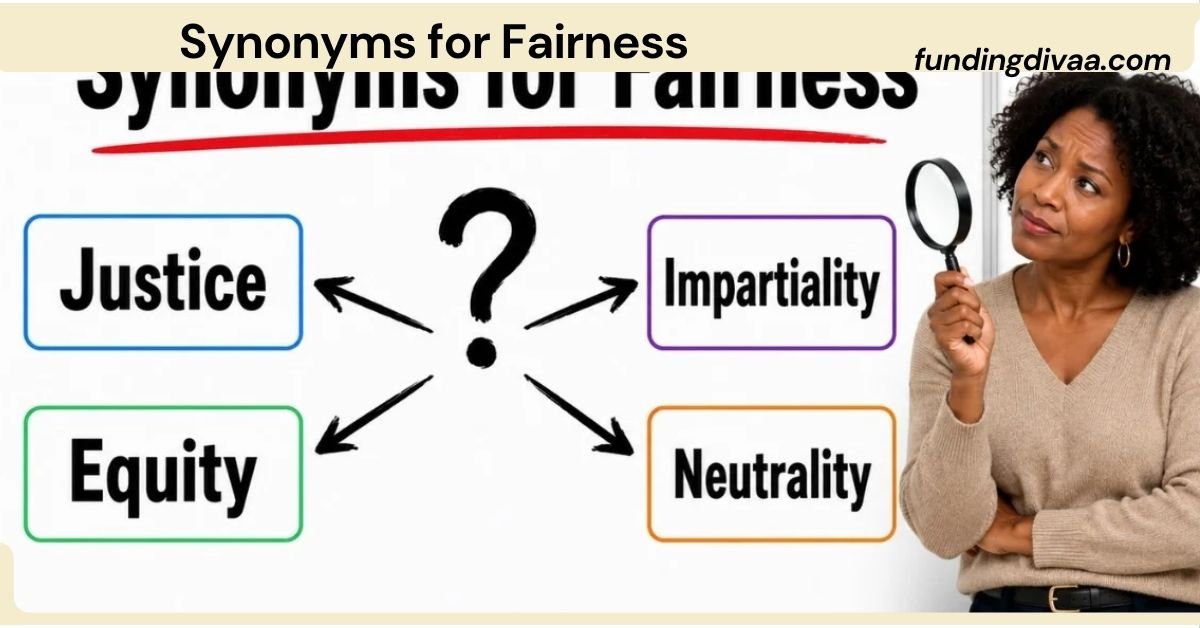
Looking for another word for fairness? The right synonym depends on the context. Words such as justice, equity, equality, impartiality, and evenhandedness can express different aspects of fair treatment. In this guide, you’ll find useful synonyms for fairness, simple meanings, examples, and tips for choosing the best word for your sentence.
.
What is fairness?
Fairness is the idea of treating people in a just, reasonable, and unbiased way. It can involve giving people equal opportunities, applying rules consistently, respecting their rights, or considering their individual circumstances before making a decision.
A simple definition of fairness is:
Fairness means treating people in a way that is reasonable, just, and free from improper favoritism.
The best synonym for fairness depends on what you mean. Justice is a strong choice when you are talking about rights or wrongdoing. Impartiality is better when the main idea is avoiding bias. Equity focuses on fair treatment that takes different needs or circumstances into account. Equality emphasizes equal status, rights, or opportunities.
So, if you are searching for another word for fairness, there is no single answer that works in every sentence.
Quick answer: What is another word for fairness?
Some of the most useful synonyms for fairness are:
- Justice
- Equity
- Equality
- Impartiality
- Objectivity
- Evenhandedness
- Fair-mindedness
- Reasonableness
- Equitableness
- Neutrality
- Justness
- Unbiasedness
- Balance
- Consistency
- Non-discrimination
- Equal treatment
- Due process
- Integrity
- Decency
- Proportionality
For most general situations, justice, equity, impartiality, and evenhandedness are among the closest alternatives.
However, these words are not interchangeable in every situation. Choosing the right word means identifying the particular kind of fairness you want to express.
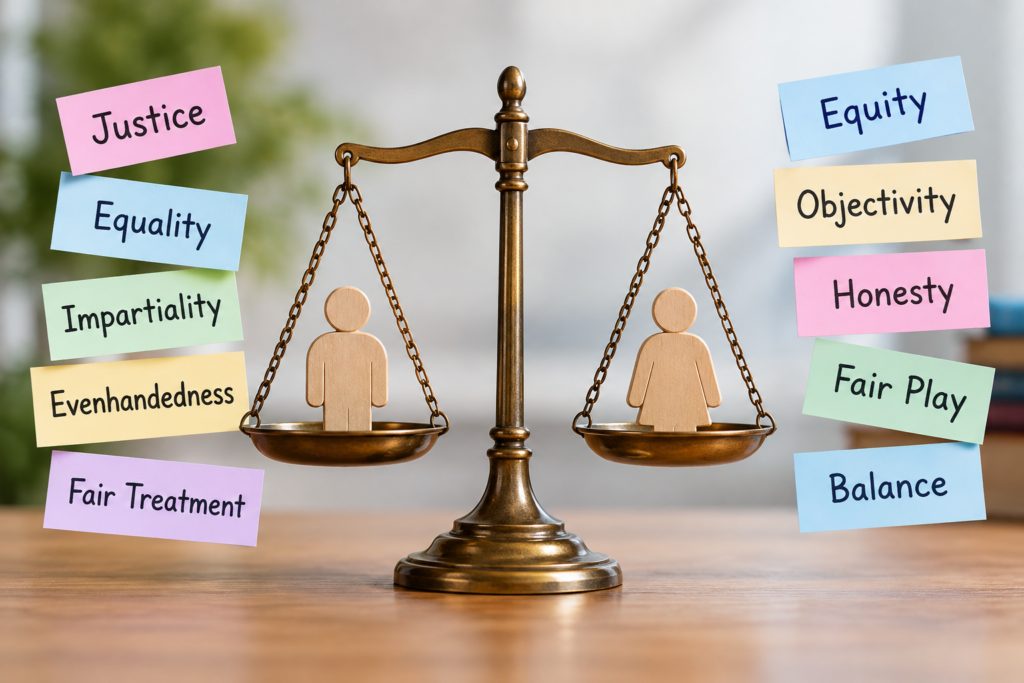
100 synonyms and related words for fairness
The following list includes close synonyms, context-specific alternatives, and closely related terms. Some are stronger matches than others, so the explanation beside each word shows when it works best.
1. Justice
Meaning: Fair treatment based on what is right or deserved.
Example: The victims wanted justice after the wrongful decision.
Justice is one of the closest general answers to “another word for fairness.” It is especially useful in discussions of law, rights, wrongdoing, and moral responsibility.
2. Equity
Meaning: Fair treatment that takes people’s different needs or circumstances into account.
Example: The program was designed to improve equity in access to education.
Equity is often used when fairness does not mean giving everyone exactly the same thing.
Also Read: 100 Synonyms for Admirable: Meanings, Examples, and How to Use Them
3. Equality
Meaning: Equal rights, status, opportunities, or treatment.
Example: The policy promotes equality in the workplace.
Equality is related to fairness, but the two words are not always identical.
4. Impartiality
Meaning: The quality of judging without favoritism or bias.
Example: The referee was praised for her impartiality.
Use this word when fairness comes from remaining neutral between competing sides.
5. Objectivity
Meaning: Making judgments based on facts rather than personal feelings or preferences.
Example: The reviewer approached the complaint with objectivity.
6. Evenhandedness
Meaning: Treating different people or sides in a balanced and fair way.
Example: His evenhandedness helped settle the dispute.
7. Fair-mindedness
Meaning: A willingness to consider different people, opinions, or arguments fairly.
Example: Her fair-mindedness made her a trusted manager.
8. Reasonableness
Meaning: The quality of being sensible, moderate, and fair.
Example: The committee appreciated the reasonableness of his proposal.
9. Equitableness
Meaning: The quality of being fair and appropriate to everyone involved.
Example: Employees welcomed the equitableness of the new arrangement.
This is a formal and less common word, so “fairness” or “equity” will usually sound more natural.
10. Neutrality
Meaning: Not supporting one side over another.
Example: The mediator maintained neutrality throughout the discussion.
11. Justness
Meaning: The quality of being morally right or fair.
Example: The justness of the ruling was debated for years.
12. Unbiasedness
Meaning: Freedom from personal preference or prejudice.
Example: The selection process was designed to ensure unbiasedness.
“Impartiality” or “lack of bias” is usually more natural in everyday writing.
13. Balance
Meaning: Fair consideration of different sides, interests, or viewpoints.
Example: The article provides a balanced account of the disagreement.
14. Consistency
Meaning: Applying the same standards or rules reliably.
Example: Consistency in discipline can make workplace decisions seem fairer.
Consistency is not a direct synonym for fairness, but it is often an important part of perceived fair treatment.
15. Non-discrimination
Meaning: Treatment without unjust discrimination against a person or group.
Example: The hiring policy emphasizes non-discrimination.
16. Equal treatment
Meaning: Applying the same standards to people in comparable circumstances.
Example: Employees expect equal treatment from their supervisors.
17. Due process
Meaning: Fair treatment through established legal procedures.
Example: The defendant argued that she had been denied due process.
This term is particularly useful in legal contexts.
18. Integrity
Meaning: Strong commitment to honest and ethical principles.
Example: His integrity influenced the way he handled the complaint.
Integrity is related to fairness but is broader than it.
19. Decency
Meaning: Respectful and morally acceptable behavior.
Example: Basic decency requires people to treat one another with respect.
20. Proportionality
Meaning: A reasonable relationship between an action, response, penalty, or benefit and the circumstances.
Example: The board considered whether the punishment was proportionate to the mistake.
21. Merit
Meaning: The quality or achievement that makes someone deserving of recognition or reward.
Example: The promotion was based on merit rather than personal connections.
22. Merit-based treatment
Meaning: Treatment or rewards based on ability, achievement, or qualifications.
Example: The organization promised merit-based hiring.
23. Meritocracy
Meaning: A system in which advancement is intended to depend on ability and achievement.
Example: The company described its promotion system as a meritocracy.
Meritocracy describes a system, not fairness itself.
24. Fair play
Meaning: Honest and respectful behavior according to accepted rules.
Example: Good sportsmanship depends on fair play.
25. Sportsmanship
Meaning: Fair, respectful behavior in sports or competition.
Example: Her sportsmanship was more impressive than the final score.
26. Fair treatment
Meaning: Treatment that is reasonable, just, and free from unfair preference.
Example: Every employee deserves fair treatment.
27. Equitable treatment
Meaning: Treatment that is fair and appropriate to the circumstances.
Example: The organization wants to provide equitable treatment to all applicants.
28. Equal opportunity
Meaning: A situation in which people have the same basic opportunity to compete, participate, or succeed.
Example: The scholarship aims to provide equal opportunity to qualified students.
29. Equality of opportunity
Meaning: The principle that people should have fair access to opportunities.
Example: Equality of opportunity is important in education and employment.
30. Nonpartisanship
Meaning: Not favoring a particular political party or side.
Example: The commission promised nonpartisanship during the investigation.
31. Independence
Meaning: Freedom from inappropriate outside influence.
Example: An independent reviewer may provide a more trustworthy assessment.
32. Detachment
Meaning: Emotional distance that allows someone to judge a matter without becoming personally involved.
Example: Professional detachment helped the manager evaluate both complaints.
33. Disinterestedness
Meaning: Lack of personal interest in the outcome.
Example: Her disinterestedness made her a suitable person to review the case.
Do not confuse “disinterested” with “uninterested.” Disinterested can mean free from personal interest, while uninterested usually means not interested.
34. Open-mindedness
Meaning: Willingness to consider different opinions or possibilities.
Example: His open-mindedness helped the group find a solution.
35. Judiciousness
Meaning: The ability to make sensible and carefully considered decisions.
Example: Her judiciousness prevented an overly harsh response.
36. Prudence
Meaning: Care and good judgment when making decisions.
Example: The manager showed prudence when reviewing the evidence.
37. Reasonableness
Meaning: Sensible and appropriate judgment or behavior.
Example: The court considered the reasonableness of the request.
38. Moderation
Meaning: Avoiding excessive or extreme action.
Example: The manager responded with moderation rather than imposing an excessive penalty.
39. Temperance
Meaning: Self-control and avoidance of extremes.
Example: Temperance helped the committee reach a balanced decision.
40. Propriety
Meaning: Behavior that is considered proper, appropriate, or acceptable.
Example: The investigation examined the propriety of the decision.
41. Rectitude
Meaning: Strong moral correctness.
Example: The official was respected for his rectitude.
42. Probity
Meaning: Complete honesty and strong moral character.
Example: The position requires professional competence and probity.
43. Uprightness
Meaning: Honest and morally correct behavior.
Example: Her uprightness earned the trust of her colleagues.
44. Ethical conduct
Meaning: Behavior that follows accepted moral principles.
Example: Ethical conduct is essential when handling confidential decisions.
45. Morality
Meaning: Principles about right and wrong behavior.
Example: The debate raised important questions of morality.
46. Ethicality
Meaning: The quality of being ethically acceptable.
Example: Researchers questioned the ethicality of the procedure.
This is a formal term and is less common than “ethical behavior.”
47. Lawfulness
Meaning: Conformity with the law.
Example: The court examined the lawfulness of the search.
Lawfulness and fairness overlap in some legal situations, but something can be lawful without everyone considering it fair.
48. Legitimacy
Meaning: The quality of being accepted as valid, proper, or justified.
Example: Transparency helped strengthen the legitimacy of the election.
49. Accountability
Meaning: Responsibility for actions, decisions, and their consequences.
Example: Public accountability can discourage unfair decision-making.
50. Transparency
Meaning: Openness that makes decisions, rules, or processes easier to understand.
Example: Greater transparency made the selection process easier to trust.
Also Read: Synonyms for Compassion: 80+ Words With Meanings, Examples, and Differences
51. Inclusiveness
Meaning: Making sure people have a meaningful opportunity to participate.
Example: Inclusiveness helped ensure that different viewpoints were heard.
52. Accessibility
Meaning: The quality of being available or usable by people without unnecessary barriers.
Example: Accessibility can be an important part of fair public services.
53. Reciprocity
Meaning: A balanced exchange in which people respond appropriately to one another.
Example: Reciprocity helped create a healthier partnership.
54. Balance of interests
Meaning: Fair consideration of competing needs or concerns.
Example: The court sought a balance of interests between the two parties.
55. Fair-minded judgment
Meaning: A decision made after honestly considering different sides.
Example: The committee reached a fair-minded judgment after hearing both candidates.
56. Impartial judgment
Meaning: A decision made without favoring one side.
Example: The dispute requires an impartial judgment.
57. Unprejudiced treatment
Meaning: Treatment that is not influenced by unfair assumptions or prejudice.
Example: Every applicant deserves unprejudiced treatment.
58. Bias-free treatment
Meaning: Treatment that avoids inappropriate personal or group-based bias.
Example: The new process is intended to provide bias-free treatment.
59. Equal consideration
Meaning: Giving comparable people, claims, or viewpoints appropriate consideration.
Example: Both candidates received equal consideration.
60. Equal standing
Meaning: Having the same basic status or position in a particular context.
Example: The rules give all participants equal standing.
61. Equal access
Meaning: The same basic ability to use or reach a resource, service, or opportunity.
Example: The policy seeks to provide equal access to training.
62. Equal rights
Meaning: The same fundamental rights under a particular system.
Example: The movement called for equal rights under the law.
63. Equal opportunity
Meaning: A fair chance to participate or succeed.
Example: The program gives qualified applicants an equal opportunity.
64. Fair allocation
Meaning: A reasonable distribution of resources, responsibilities, or benefits.
Example: The committee debated the fairest allocation of funding.
65. Fair distribution
Meaning: A distribution considered reasonable or just.
Example: The goal was a fair distribution of available resources.
66. Just allocation
Meaning: Distribution based on principles of justice.
Example: The board considered a just allocation of the limited funds.
67. Reasonable share
Meaning: An amount that is considered appropriate or fair.
Example: Everyone should contribute a reasonable share of the work.
68. Fair share
Meaning: The amount someone reasonably deserves or should contribute.
Example: Each team member completed a fair share of the project.
69. Justifiable treatment
Meaning: Treatment that can reasonably be defended as appropriate.
Example: The company needed a clear reason for the change to show that the treatment was justifiable.
70. Proper treatment
Meaning: Treatment that is appropriate and respectful.
Example: Customers expect proper treatment when making a complaint.
71. Fair dealing
Meaning: Honest and reasonable conduct in a transaction or relationship.
Example: Fair dealing is important in business relationships.
72. Good faith
Meaning: Honest intention and sincere conduct.
Example: Both parties entered the agreement in good faith.
Good faith is closely connected with fairness in many legal and business contexts, although it is not a direct synonym.
73. Good judgment
Meaning: The ability to make sensible decisions.
Example: Good judgment was needed to resolve the disagreement.
74. Sound judgment
Meaning: Reliable and sensible decision-making.
Example: The manager used sound judgment when reviewing the complaint.
75. Sensibility
Meaning: Practical understanding of what is reasonable or appropriate.
Example: The decision showed practical sensibility.
76. Moderateness
Meaning: The quality of avoiding extremes.
Example: The moderateness of the proposed response made it easier to accept.
77. Fairness of treatment
Meaning: The degree to which someone is treated reasonably and justly.
Example: The survey measured employees’ perceptions of fairness of treatment.
78. Justice-mindedness
Meaning: A strong concern for just treatment.
Example: Her justice-mindedness influenced how she approached workplace disputes.
79. Sense of justice
Meaning: A strong personal concern for what is right and fair.
Example: His sense of justice made him speak up when he saw the mistake.
80. Sense of fairness
Meaning: An awareness of whether treatment or behavior seems fair.
Example: Children often develop a strong sense of fairness at an early age.
81. Fairness of process
Meaning: The degree to which the method used to reach a decision is fair.
Example: The appeal focused on the fairness of the process.
82. Procedural fairness
Meaning: Fairness in the procedures used to make or review a decision.
Example: The organization introduced new rules to improve procedural fairness.
83. Substantive fairness
Meaning: Fairness in the actual result or substance of a decision.
Example: The review considered both procedural fairness and the fairness of the final outcome.
84. Social justice
Meaning: Fairness in the way rights, opportunities, resources, and responsibilities are distributed in society.
Example: The organization works on issues related to social justice.
85. Economic justice
Meaning: Fairness in economic opportunities, resources, and treatment.
Example: The campaign focused on economic justice.
86. Distributive justice
Meaning: Fairness concerning the distribution of benefits, burdens, resources, or opportunities.
Example: The policy raised questions about distributive justice.
87. Restorative justice
Meaning: An approach that focuses on repairing harm and addressing the effects of wrongdoing.
Example: The program uses restorative justice to help affected communities.
88. Egalitarianism
Meaning: A belief in social or political equality.
Example: Egalitarianism emphasizes equal status among people.
89. Egalitarian treatment
Meaning: Treatment based on the principle that people should have equal status.
Example: The organization promotes egalitarian treatment.
90. Anti-bias
Meaning: Intended to reduce or prevent unfair bias.
Example: The company introduced anti-bias training.
91. Anti-discrimination
Meaning: Intended to prevent unfair discrimination.
Example: The workplace follows anti-discrimination policies.
92. Unprejudiced judgment
Meaning: A decision made without allowing prejudice to influence it.
Example: A reviewer should provide an unprejudiced judgment.
93. Neutral judgment
Meaning: A judgment that does not favor either side.
Example: The mediator offered a neutral judgment after hearing both parties.
94. Balanced judgment
Meaning: A decision that takes relevant sides and evidence into account.
Example: The editor made a balanced judgment after reviewing the full report.
95. Fair-mindedness
Meaning: The habit of considering people and arguments without unfair bias.
Example: Fair-mindedness is valuable when disagreements involve strong emotions.
96. Equitable distribution
Meaning: A distribution that is fair according to relevant circumstances.
Example: The committee wanted an equitable distribution of funding.
97. Just treatment
Meaning: Treatment that is morally or legally fair.
Example: Every person deserves just treatment.
98. Fair consideration
Meaning: Honest and appropriate attention given to a person, claim, or idea.
Example: All applications received fair consideration.
99. Appropriate treatment
Meaning: Treatment suited to the circumstances and consistent with reasonable standards.
Example: The policy should allow for appropriate treatment of unusual cases.
100. A level playing field
Meaning: A situation in which people have a reasonably equal chance to compete or succeed.
Example: Transparent rules can help create a level playing field for small businesses.
This is an idiomatic expression rather than a direct synonym, but it is a useful alternative when talking about equal opportunity.
The closest synonym for fairness
If you need one general synonym, justice is often the strongest choice.
However, the best word changes according to context:
| If you mean… | Best word |
| Fair treatment in general | Justice |
| Fair treatment based on circumstances | Equity |
| Equal rights or opportunities | Equality |
| No favoritism | Impartiality |
| Decisions based on facts | Objectivity |
| Treating both sides fairly | Evenhandedness |
| Considering different viewpoints | Fair-mindedness |
| Sensible and reasonable treatment | Reasonableness |
| Following fair procedures | Due process |
| Fair distribution | Equity |
| Fairness in punishment | Proportionality |
| Fair competition | Fair play |
| Avoiding discrimination | Non-discrimination |
| Honest ethical conduct | Integrity |
| Openness in decision-making | Transparency |
| Applying rules consistently | Consistency |
Fairness vs. justice
Fairness and justice are closely related, and both can describe fair treatment. However, justice often carries a stronger moral, legal, or social meaning.
For example:
- “The teacher showed fairness when grading the papers.”
- “The victims demanded justice.”
The first sentence concerns everyday treatment. The second suggests a larger question of rights, wrongdoing, or what people deserve.
Justice can therefore be a powerful synonym for fairness, but it is not always the most natural replacement.
Fairness vs. equity
Equity is one of the most important words to understand when looking for a fairness synonym.
Fairness is the broad idea of reasonable and just treatment.
Equity often focuses on making treatment fair by considering differences in people’s circumstances or needs. Cambridge similarly defines equity in the fairness sense around treating people fairly according to their needs.
For example, imagine two employees need different forms of support to perform the same job successfully. Giving both employees identical support may be equal, while giving each person the support they actually need may be considered equitable.
That is why “fairness” and “equality” should not automatically be treated as exact synonyms.
Fairness vs. equality
Equality generally focuses on giving people the same rights, status, opportunities, or treatment.
Fairness is broader.
Consider this simple example:
Three students are taking the same exam. One student has a documented need for an approved accommodation.
Giving every student exactly the same conditions might look equal. Providing an approved accommodation can be viewed as fair because the goal is to remove an irrelevant barrier.
So:
- Equality asks, “Are people receiving the same thing?”
- Equity asks, “Are people receiving what they reasonably need?”
- Fairness asks, “Is the overall treatment just and reasonable?”
The exact answer depends on the situation.
Fairness vs. impartiality
Impartiality is narrower than fairness.
If a judge treats both sides without favoring either one, the judge is being impartial. Cambridge describes impartiality as judging without supporting one side in a dispute.
For example:
- “The referee showed impartiality.”
- “The referee made a fair decision.”
Both sentences work, but the first specifically emphasizes the absence of favoritism.
Fairness vs. objectivity
Objectivity means relying on facts and evidence rather than personal feelings.
A person can be objective without necessarily making a fair decision if the rules themselves are unreasonable. Likewise, someone can care deeply about fairness while still allowing personal feelings to influence a judgment.
Use objectivity when the main idea is evidence-based judgment.
Use fairness when the main idea is reasonable and just treatment.
Fairness in different contexts
Fairness in school
In education, fairness can involve grading consistently, giving students reasonable opportunities to demonstrate their knowledge, applying classroom rules consistently, and avoiding favoritism.
Useful alternatives include:
- Equity
- Equal treatment
- Impartiality
- Equality of opportunity
- Consistency
- Objectivity
Example:
The teacher’s impartiality helped students trust the grading process.
Fairness in the workplace
Workplace fairness can involve hiring, pay, promotions, workload, discipline, evaluations, and access to opportunities.
Useful words include:
- Equity
- Equality
- Impartiality
- Merit
- Consistency
- Transparency
- Equal opportunity
- Non-discrimination
Example:
Employees were concerned about the transparency of the promotion process.
Fairness in law
Legal discussions often require more precise terms than simply “fairness.”
Useful expressions include:
- Justice
- Due process
- Equality before the law
- Impartiality
- Proportionality
- Non-discrimination
- Lawfulness
- Procedural fairness
Example:
The appeal raised concerns about procedural fairness.
Fairness in sports
In sports, fairness usually involves following the rules, treating competitors consistently, and avoiding cheating or favoritism.
Useful alternatives include:
- Fair play
- Sportsmanship
- Evenhandedness
- Impartiality
- Neutrality
- Equal treatment
Example:
The referee’s evenhandedness earned the respect of both teams.
Fairness in business
Business fairness can relate to prices, contracts, negotiations, competition, employee treatment, and customer service.
Useful terms include:
- Fair dealing
- Equity
- Transparency
- Reasonableness
- Good faith
- Equal treatment
- Proportionality
Example:
Customers questioned whether the new pricing system was equitable.
Synonyms for “fair treatment”
If your exact phrase is fair treatment, these are useful alternatives:
- Just treatment
- Equitable treatment
- Equal treatment
- Impartial treatment
- Unbiased treatment
- Non-discriminatory treatment
- Reasonable treatment
- Appropriate treatment
- Evenhanded treatment
- Fair dealing
The best choice depends on what aspect of treatment matters most.
For example, “equal treatment” stresses sameness, while “equitable treatment” can recognize different circumstances.
Synonyms for “a fair decision”
If you want another way to say a fair decision, try:
- Just decision
- Equitable decision
- Impartial decision
- Objective decision
- Reasonable decision
- Balanced decision
- Well-considered decision
- Proportionate decision
- Unbiased decision
- Fair-minded decision
Example:
The committee reached a well-considered decision after reviewing all the evidence.
Also Read: 100 Synonyms of Aware: Meanings, Examples, and How to Choose the Right Word
Synonyms for “a sense of fairness”
A sense of fairness is the feeling or belief that people should be treated justly.
Possible alternatives include:
- Sense of justice
- Moral judgment
- Ethical awareness
- Concern for justice
- Concern for equal treatment
- Commitment to fairness
- Fair-mindedness
- Justice-mindedness
Example:
Her strong sense of justice motivated her to challenge the decision.
What is the opposite of fairness?
The most direct antonym of fairness is unfairness.
Other opposites include:
- Injustice
- Inequity
- Inequality
- Bias
- Favoritism
- Partiality
- Discrimination
- Prejudice
- Unreasonableness
- Unjust treatment
- Unfair treatment
- Inconsistency
- Imbalance
- Corruption
- Nepotism
The correct antonym depends on the type of unfairness involved.
For example, bias means an unfair preference, while injustice is a broader term for unfair treatment or lack of justice. Inequity specifically refers to unfair inequality. Cambridge lists injustice as the opposite of justice and inequality as the opposite of equality.
What is another word for “fair”?
“Fair” can have several meanings, so its synonyms change with context.
When fair means just or reasonable:
- Just
- Equitable
- Reasonable
- Impartial
- Unbiased
- Evenhanded
- Objective
- Balanced
- Right
- Proper
When fair means acceptable or adequate:
- Reasonable
- Acceptable
- Decent
- Satisfactory
- Adequate
- Moderate
For example:
“That is a fair price.”
Here, “reasonable” may work better than “just.”
But:
“The judge gave a fair decision.”
Here, “impartial,” “just,” or “reasonable” may be more appropriate.
The word “fair” has several meanings, so replacing it mechanically with a single synonym can change the meaning of a sentence.
What does “in all fairness” mean?
In all fairness means that you are considering all relevant facts before making a judgment.
For example:
In all fairness, the manager gave us very little time to finish the project.
The phrase acknowledges something positive or relevant about a person or situation before giving criticism.
It is similar to:
- To be fair
- To give someone credit
- Considering all the facts
- In fairness to someone
- To be reasonable about it
Cambridge defines “in all fairness” as considering everything that affects a situation so that a fair judgment can be made.
What does “in fairness to” mean?
In fairness to someone means that you want to acknowledge something in that person’s favor before making a judgment.
Example:
In fairness to Maria, she warned everyone about the problem before it happened.
It can also introduce a fact that makes criticism less one-sided:
In fairness to the company, the policy was clearly explained before employees agreed to it.
Is “fairness” a word?
Yes. Fairness is a standard English noun.
It commonly refers to the quality of treating people equally or in a way that is right or reasonable.
It can also have an older meaning related to beauty, although that use is much less common in modern everyday English.
Fairness meaning in simple English
In very simple English:
Fairness means treating people properly and reasonably without unfair favoritism.
For example:
A teacher shows fairness by applying the same classroom rules consistently while considering legitimate individual circumstances.
Fairness meaning in Urdu
A common Urdu translation of fairness is:
انصاف (Insaaf) — justice or fair treatment.
Depending on the context, other Urdu words can also fit, such as:
- مساوات (Musawat) — equality
- برابری (Barabari) — equality or equal treatment
- منصفانہ سلوک — fair treatment
- غیر جانبداری — impartiality or neutrality
The best translation depends on the sentence. For example, fairness in a legal context may be closer to انصاف, while fairness meaning equal treatment may be better expressed through مساوات or برابری.
Common mistakes when choosing a fairness synonym
1. Treating every synonym as identical
Words can overlap in meaning without being interchangeable.
For example:
The judge showed impartiality.
This specifically emphasizes freedom from bias.
The judge showed fairness.
This is broader and can include the result, process, treatment, and reasoning.
2. Using equality when you mean equity
Equality usually emphasizes the same rights or treatment. Equity can account for different needs or circumstances.
Choose carefully based on your intended meaning.
3. Using justice in every sentence
Justice is a powerful synonym, but it can sound too formal or morally strong for an everyday situation.
Instead of:
“I want justice because my brother got the larger slice of cake.”
A natural sentence would usually be:
“I want a fair share.”
4. Using objectivity when you mean kindness or equal treatment
Objectivity is about how a judgment is made. It does not automatically mean that the outcome is fair.
5. Using “unbiasedness” when a simpler phrase works
“Unbiasedness” is understandable, but “lack of bias,” “impartiality,” or “being unbiased” often sounds more natural.
How to choose the right synonym for fairness
Ask yourself what kind of fairness you mean.
Are you talking about rights or wrongdoing?
Use justice.
Are you talking about different needs or circumstances?
Use equity.
Are you talking about equal status or opportunity?
Use equality.
Are you talking about avoiding favoritism?
Use impartiality.
Are you talking about facts rather than emotions?
Use objectivity.
Are you talking about giving both sides equal consideration?
Use evenhandedness or balance.
Are you talking about rules and legal procedures?
Use due process or procedural fairness.
Are you talking about competition?
Use fair play or a level playing field.
Are you talking about honest business conduct?
Use fair dealing or good faith.
This approach is much more useful than memorizing a long list of words without understanding their differences.
Frequently asked questions about fairness
What is the best synonym for fairness?
There is no single best synonym for every situation. Justice is a strong general choice, while equity, impartiality, equality, and evenhandedness are better when you need a more specific meaning.
What is a formal word for fairness?
Useful formal alternatives include equity, impartiality, justice, objectivity, justness, proportionality, and procedural fairness.
What is another word for fair treatment?
Common alternatives include just treatment, equitable treatment, equal treatment, impartial treatment, unbiased treatment, and non-discriminatory treatment.
What is a synonym for fairness in an essay?
For academic or formal writing, consider equity, impartiality, justice, objectivity, proportionality, equality, or reasonableness. Choose the word that matches the specific point you are making.
What is the synonym of fairness in a workplace?
Depending on the context, useful words include equity, equality, impartiality, equal opportunity, consistency, transparency, and non-discrimination.
What word describes someone who treats everyone fairly?
Good choices include impartial, unbiased, fair-minded, evenhanded, objective, and equitable.
For example:
She is an impartial manager who listens to both sides.
What is the opposite of fairness?
The most direct opposite is unfairness. Other possibilities include injustice, inequity, bias, favoritism, partiality, discrimination, and prejudice, depending on the situation.
What is the difference between fairness and justice?
Fairness is a broad idea of reasonable and just treatment. Justice often has a stronger moral, legal, or social meaning.
What is the difference between fairness and equality?
Equality focuses on equal rights, status, or treatment. Fairness is broader and asks whether the overall treatment is reasonable and just.
What is the difference between fairness and equity?
Fairness is the general principle of just treatment. Equity often focuses on achieving fair treatment by recognizing differences in people’s circumstances or needs.
Can “fairness” mean “equality”?
Sometimes, but not always. Fairness can involve equality, but a fair outcome does not necessarily require everyone to receive exactly the same thing.
What does “in all fairness” mean?
It means considering all relevant facts before making a judgment. It is often used to acknowledge something positive or reasonable about a person or situation before criticizing it.
Is “fair-mindedness” a synonym for fairness?
It is a closely related word. Fair-mindedness describes a person’s willingness to consider different views or people fairly, while fairness is the broader quality of fair treatment.
What is a simple sentence using fairness?
The teacher showed fairness by giving every student a reasonable chance to explain the situation.
What is a simple synonym for fairness?
For basic English, justice or fair treatment are easy choices. Depending on the sentence, equality or impartiality may also work.
What is a crossword clue for fairness?
If you are solving a crossword puzzle, the answer depends on the number of letters and the exact clue. Common possibilities for a clue meaning “fairness” include equity, justice, equality, or impartiality.
A crossword answer cannot be determined reliably from the clue alone without the letter count or crossing letters.
Final thoughts
Fairness is a broad concept, which is why it has so many related words. The right synonym depends on what you want to emphasize.
Use justice for what is right or deserved. Use equity when different circumstances matter. Choose equality when the focus is equal rights or opportunities. Use impartiality when you want to emphasize freedom from bias, and objectivity when decisions should be based on facts rather than personal feelings.
For everyday situations, simple expressions such as fair treatment, equal treatment, fair play, fair share, and a level playing field may sound more natural than formal vocabulary.
The most effective way to improve your writing is not to replace every occurrence of “fairness” with a more complicated word. Instead, choose the word that communicates the exact idea you mean.
That small distinction can make essays, workplace writing, reports, conversations, and everyday English much clearer and more precise.