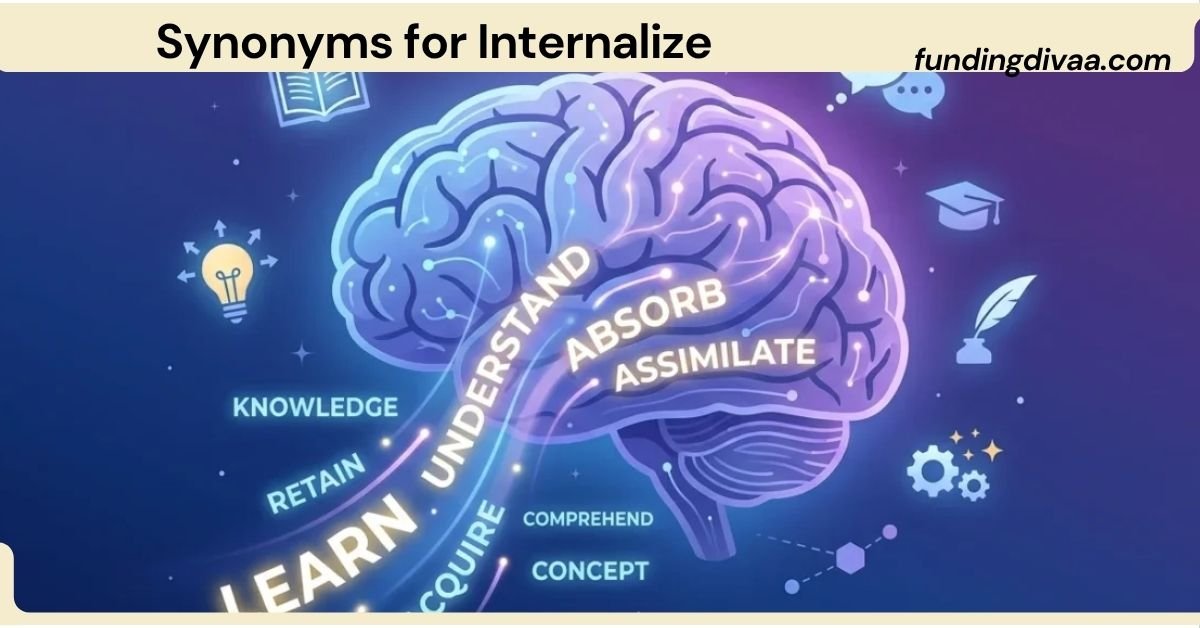
Synonyms for Internalize: 80+ Alternatives With Meanings and Examples
Finding the right synonyms for internalize can make your writing clearer and more precise. Internalize means to deeply absorb an idea, belief, lesson, or feeling so it becomes part of your thinking or behavior. Depending on the context, words such as absorb, understand, adopt, embrace, assimilate, and integrate may work as alternatives. This guide explains the meaning of internalize and provides useful synonyms with simple examples.
What Does Internalize Mean?
To internalize means to take an idea, lesson, belief, value, feeling, or experience and make it part of your own thinking, understanding, or behavior.
In simple words, when you internalize something, you do more than simply hear or remember it. You take it in deeply enough that it can influence the way you think, feel, or act.
For example:
- A student may internalize a grammar rule after using it correctly many times.
- A child may internalize values learned from family.
- An employee may internalize a company’s standards and follow them naturally.
- A person may internalize criticism and begin to believe negative things about themselves.
The best synonym depends on what you are trying to describe. For learning, words such as absorb, grasp, comprehend, and assimilate may work well. For beliefs, accept, embrace, adopt, and take to heart may be better. For habits, words such as ingrain, establish, develop, and cultivate can sometimes express the idea more naturally.
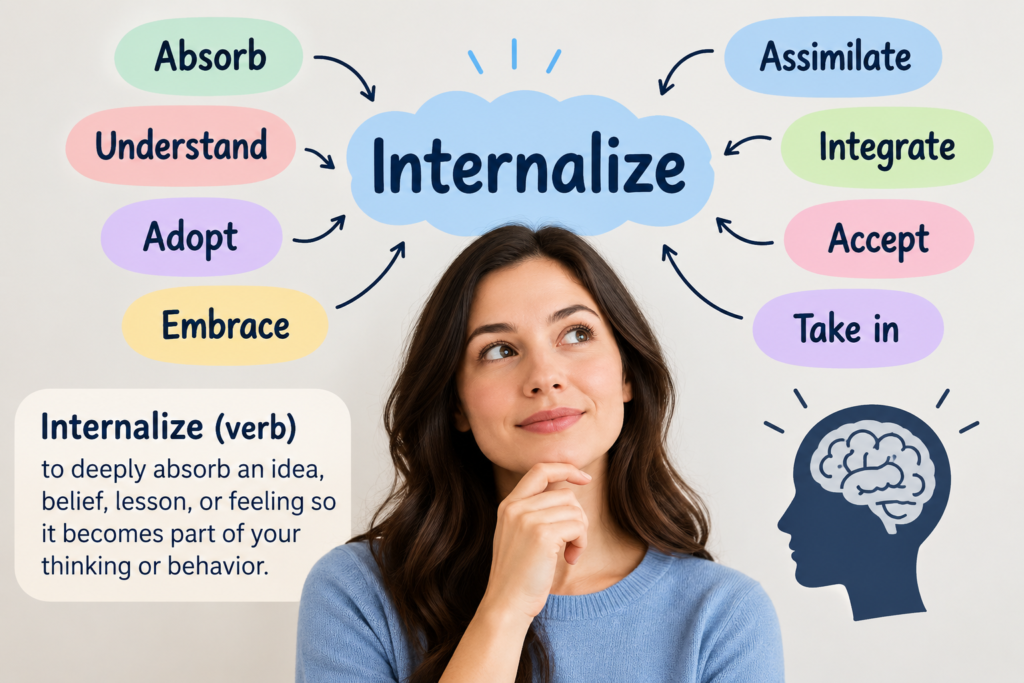
This guide explains the meaning of internalize and provides a large selection of useful alternatives, including synonyms for internalized, internalizing, and internalization.
Quick Answer: Synonyms for Internalize
Some of the closest and most useful synonyms for internalize are:
absorb, assimilate, adopt, accept, embrace, understand, comprehend, grasp, incorporate, integrate, learn, retain, process, digest, take in, take to heart, make one’s own, familiarize yourself with, become accustomed to, master, apply, practice, reinforce, ingrain, embed, instill, cultivate, develop, acquire, recognize, appreciate, reflect on, consider, personalize, and assimilate.
However, these words are not always interchangeable. Internalize usually carries the idea of something becoming part of a person’s own thinking, beliefs, feelings, habits, or behavior.
The Core Meaning of Internalize
The verb internalize describes a movement from something external to something personal.
You may hear information from a teacher, receive advice from a parent, experience criticism from another person, or observe a social rule. At first, that information exists outside you. If you internalize it, it becomes part of your own understanding or behavior.
Compare these examples:
- “She heard the advice.”
She received the information. - “She understood the advice.”
She grasped what it meant. - “She internalized the advice.”
The advice became part of the way she thinks or acts.
This distinction is important when choosing an internalize synonym.
Internalize Definition in Simple English
The simplest internalize definition is:
To absorb something so deeply that it becomes part of your thoughts, beliefs, feelings, knowledge, habits, or behavior.
The word can be used in several areas, including education, personal development, psychology, communication, workplace training, and everyday conversation.
Internalize in a sentence
Here are several original internalize examples:
- Students need time to internalize new concepts.
- She internalized the lesson and changed the way she approached the problem.
- Children can internalize attitudes they observe in adults.
- He practiced the technique until he had internalized the basic movements.
- She did not simply remember the advice; she internalized it.
80+ Synonyms for Internalize
Not every word below is a perfect dictionary substitute. Some are close synonyms, while others are useful alternatives in particular contexts. The distinction matters because internalize can refer to knowledge, beliefs, emotions, habits, or behavior.
1. Absorb
To take in information, knowledge, or an experience deeply.
Example: The students absorbed the main ideas during the workshop.
2. Assimilate
To take in and understand new information so that it becomes part of existing knowledge.
Example: It took him several weeks to assimilate the new material.
3. Adopt
To accept an idea, belief, method, or behavior and begin using it.
Example: The team adopted a more practical approach to problem-solving.
4. Understand
To grasp the meaning or importance of something.
Example: She understood the lesson after working through several examples.
5. Comprehend
To understand something, especially information that may be complex.
Example: The students eventually comprehended the difficult theory.
6. Grasp
To understand an idea clearly.
Example: He quickly grasped the basic principle.
7. Learn
To gain knowledge or a skill through study or experience.
Example: Children learn social behaviors by observing people around them.
8. Incorporate
To make something part of a larger system, plan, or approach.
Example: She incorporated the feedback into her next draft.
9. Integrate
To combine new information or ideas with what already exists.
Example: He integrated the new information into his existing knowledge.
10. Accept
To receive an idea, fact, belief, or situation as valid or real.
Example: She eventually accepted the importance of changing her approach.
11. Embrace
To accept an idea, change, or belief willingly and positively.
Example: The team embraced the new way of working.
12. Process
To think about information or an experience and make sense of it.
Example: Give her some time to process what happened.
13. Digest
To consider and understand information carefully.
Example: He needed a few minutes to digest the information.
14. Retain
To keep information in your memory.
Example: Regular review helps students retain what they learn.
15. Memorize
To commit information to memory.
Example: She memorized the vocabulary before the exam.
Memorize is related to internalize, but it is not an exact synonym. Memorization can happen without genuine understanding or personal acceptance.
16. Acquire
To gain knowledge, skills, habits, or information.
Example: She acquired valuable communication skills through practice.
17. Master
To become highly skilled or knowledgeable in something.
Example: He mastered the technique after months of practice.
18. Familiarize
To become knowledgeable about something.
Example: Employees should familiarize themselves with the new procedures.
19. Practice
To repeat an activity until it becomes more natural or skillful.
Example: Repeated practice helped her make the technique automatic.
20. Apply
To put learned knowledge or principles into practical use.
Example: He applied the lessons from the course to his daily work.
21. Reinforce
To strengthen an idea, belief, skill, or piece of knowledge.
Example: The exercises reinforced the concepts introduced in class.
22. Ingrain
To establish something deeply and firmly.
Example: Years of practice ingrained the habit of checking her work.
23. Embed
To establish something firmly within a person’s thinking, system, or behavior.
Example: The training embedded safety awareness into the team’s daily routine.
24. Instill
To gradually introduce an idea, value, quality, or belief into someone’s mind.
Also Read: 100 Synonyms of Aware: Meanings, Examples, and How to Choose the Right Word
Example: Parents often try to instill confidence in their children.
25. Cultivate
To deliberately develop a quality, habit, attitude, or skill over time.
Example: Reading regularly can cultivate a strong interest in learning.
26. Develop
To gradually build a skill, habit, understanding, or attitude.
Example: She developed a better understanding of the subject through practice.
27. Form
To develop an idea, opinion, belief, or habit.
Example: Young people form opinions from many different experiences.
28. Establish
To make something stable or firmly developed.
Example: The routine helped establish good study habits.
29. Build
To gradually develop knowledge, confidence, or understanding.
Example: Each lesson helped build his understanding of the topic.
30. Strengthen
To make a belief, skill, habit, or understanding stronger.
Example: Discussion strengthened her understanding of the issue.
31. Learn by Heart
To memorize something completely.
Example: The students learned the short poem by heart.
This is useful when internalize is being used to mean remembering something extremely well, but it does not necessarily imply personal understanding.
32. Take In
To receive and understand information.
Example: She took in the important points during the presentation.
33. Take to Heart
To accept something seriously and allow it to influence your thoughts or behavior.
Example: He took his mentor’s advice to heart.
This can be a particularly good alternative when discussing advice, criticism, or personal lessons.
34. Make Your Own
To understand or accept an idea in a personal way.
Example: Over time, she made the principles her own.
35. Make Part of Yourself
To accept something so deeply that it becomes part of your identity or behavior.
Example: He made the team’s values part of his everyday approach.
36. Become Accustomed To
To become familiar and comfortable with something through repeated experience.
Example: She became accustomed to the new routine after several weeks.
37. Adapt To
To adjust your behavior or thinking to new conditions.
Example: The new employee adapted to the company’s expectations quickly.
38. Acclimate To
To become comfortable with a new environment, situation, or routine.
Example: It took the students some time to acclimate to the new system.
39. Recognize
To identify or become aware of the importance or truth of something.
Example: He recognized the value of regular practice.
40. Realize
To become aware of something or understand it clearly.
Example: She realized that her earlier assumption was incorrect.
41. Appreciate
To understand the value, importance, or meaning of something.
Example: After more experience, he appreciated the value of careful planning.
42. Acknowledge
To recognize or accept something as true or important.
Example: She acknowledged the need for a different approach.
43. Believe
To accept something as true or hold it as a personal belief.
Example: He came to believe that patience was essential.
44. Trust
To accept something as reliable or worthy of confidence.
Example: Over time, she learned to trust her own judgment.
45. Accept as True
To come to regard an idea or statement as true.
Example: He eventually accepted the explanation as true.
46. Reflect On
To think carefully about an experience, idea, or event.
Example: She reflected on the feedback before making a decision.
47. Consider
To think carefully about an idea or possibility.
Example: He considered the criticism before changing his approach.
48. Contemplate
To think about something deeply and carefully.
Example: She spent the evening contemplating what she had learned.
49. Examine
To study something closely in order to understand it.
Example: The students examined the evidence before reaching a conclusion.
50. Explore
To investigate an idea or experience in greater depth.
Example: The course encouraged students to explore different perspectives.
51. Interpret
To determine or explain the meaning of something.
Example: Readers may interpret the message in different ways.
52. Conceptualize
To form an idea or concept mentally.
Example: The designer conceptualized the project before creating the first draft.
53. Perceive
To become aware of or understand something through observation or interpretation.
Example: People may perceive the same event differently.
54. Internalize
To make an idea, belief, lesson, feeling, or experience part of yourself.
Example: She internalized the lesson and used it in future situations.
55. Personalize
To make something personally meaningful or connected to your own experience.
Example: He personalized the lesson by relating it to his own goals.
56. Individualize
To adapt something to a particular person or situation.
Example: The teacher individualizes instruction according to each student’s needs.
57. Embody
To express an idea, value, or quality through actions or behavior.
Example: Her actions embodied the values she talked about.
58. Reflect
To think carefully about an experience or idea.
Example: He reflected on the mistake and learned from it.
59. Learn From
To gain knowledge or understanding from an experience.
Example: She learned from the mistake rather than repeating it.
60. Draw a Lesson From
To gain a useful understanding from an event or experience.
Example: He drew a lesson from the failed project.
61. Gain Insight Into
To develop a deeper understanding of something.
Example: The discussion helped her gain insight into the problem.
62. Understand Deeply
To develop a strong and meaningful understanding.
Example: Students need opportunities to understand deeply rather than simply memorize facts.
63. Become Familiar With
To gain knowledge of something through exposure or experience.
Example: New employees become familiar with company policies during training.
Also Read: 100 Synonyms for Lucrative With Meanings and Examples
64. Take On
To accept a role, attitude, responsibility, or characteristic.
Example: Over time, he took on the team’s professional standards.
65. Absorb Into
To take something into an existing way of thinking or living.
Example: She absorbed the new ideas into her approach to teaching.
66. Integrate Into
To make something a functional part of an existing system or routine.
Example: He integrated the new study method into his schedule.
67. Fold Into
To combine something with an existing idea, plan, or system.
Example: The editor folded the new suggestions into the final plan.
68. Adopt as One’s Own
To accept an idea or principle and treat it as personally meaningful.
Example: She adopted the principle as her own.
69. Internalize a Lesson
To learn a lesson so thoroughly that it affects future behavior.
Example: After making the same mistake twice, he finally internalized the lesson.
70. Absorb a Lesson
To take in the meaning of a lesson and understand its importance.
Example: The experience helped the team absorb an important lesson.
71. Learn a Lesson
To gain understanding from an experience.
Example: She learned a lesson from the unsuccessful project.
72. Carry Forward
To take an idea, lesson, or principle from one situation into another.
Example: He carried the lessons from his first job forward into his new career.
73. Put Into Practice
To turn an idea or principle into actual behavior.
Example: She put the training into practice at work.
74. Live By
To follow a belief, principle, or value consistently.
Example: He tries to live by the values he learned from his family.
75. Act On
To use information or advice as a basis for action.
Example: She acted on the feedback and improved the report.
76. Follow
To behave according to a rule, principle, or recommendation.
Example: The employees followed the new safety procedures.
77. Conform To
To behave according to an accepted standard or expectation.
Example: New procedures required workers to conform to updated safety standards.
78. Incorporate Into
To make new information or ideas part of an existing approach.
Example: The writer incorporated the research findings into the article.
79. Internalize Emotionally
To take an emotional experience or message deeply into your feelings and self-understanding.
Example: She internalized the rejection and began doubting herself.
80. Process Emotionally
To think through and work through an emotional experience.
Example: He needed time to process the disappointment.
81. Take Personally
To interpret something as directly connected to yourself, often emotionally.
Example: Try not to take constructive criticism personally.
82. Carry Within
To continue holding an experience, belief, or feeling internally.
Example: She carried the memory within her for many years.
83. Store
To retain information for later use.
Example: The brain stores information in different ways.
84. Retain Internally
To keep information or an experience within one’s own memory or understanding.
Example: Writing notes can help students retain information internally.
85. Absorb and Apply
To understand information and then use it in practice.
Example: Good training helps employees absorb and apply new procedures.
86. Integrate and Apply
To combine new knowledge with existing understanding and use it effectively.
Example: The course teaches students to integrate and apply what they learn.
Best Synonyms for Internalize by Context
There is no single perfect synonym for internalize. The best choice changes according to the situation.
When Internalize Means “Learn”
Use:
- absorb
- assimilate
- comprehend
- grasp
- understand
- learn
- acquire
- retain
- master
- take in
- digest
Example:
Instead of:
Students must internalize the new concepts.
You could write:
Students must absorb the new concepts.
Or:
Students must understand and apply the new concepts.
The second version can be clearer when the goal is practical understanding.
When Internalize Means “Accept a Belief”
Use:
- accept
- embrace
- adopt
- believe
- acknowledge
- take to heart
- make your own
- live by
Example:
She internalized the importance of honesty.
Possible alternatives include:
She embraced the importance of honesty.
She adopted honesty as a personal principle.
She came to believe that honesty was essential.
Each alternative has a slightly different meaning.
When Internalize Means “Develop a Habit”
Use:
- ingrain
- establish
- develop
- cultivate
- practice
- reinforce
- build
- become accustomed to
- adapt to
Example:
He internalized the habit of checking his work.
A natural alternative would be:
He developed the habit of checking his work.
Or:
Regular practice ingrained the habit of checking his work.
When Internalize Means “Understand Deeply”
Use:
- comprehend
- grasp
- absorb
- assimilate
- process
- digest
- understand deeply
- gain insight into
- reflect on
Example:
She internalized the lesson.
Could become:
She fully understood the lesson and applied it to future situations.
This is often clearer than replacing internalize with a single word.
Synonyms for Internalizing
Internalizing is the -ing form of internalize. It describes the process of making something part of your own thoughts, feelings, beliefs, or behavior.
Useful alternatives include:
- absorbing
- learning
- assimilating
- understanding
- processing
- accepting
- embracing
- adopting
- incorporating
- integrating
- practicing
- retaining
- reflecting on
- taking in
- taking to heart
- becoming accustomed to
- developing
- cultivating
- ingraining
- applying
Internalizing Meaning
The meaning of internalizing changes slightly according to context.
In education, it can mean gaining a strong understanding of information.
In personal development, it can mean making a lesson or value part of your behavior.
In emotional contexts, internalizing can mean taking an experience or feeling deeply into yourself.
For example:
Internalizing the lesson helped her avoid making the same mistake again.
Synonyms for Internalized
Internalized is the past tense or past participle of internalize.
Depending on the sentence, possible alternatives include:
- absorbed
- learned
- understood
- assimilated
- adopted
- accepted
- embraced
- incorporated
- integrated
- retained
- processed
- ingrained
- embedded
- developed
- mastered
- taken to heart
- made one’s own
- put into practice
Internalized Meaning
When something is internalized, it has generally moved beyond simple exposure or awareness and has become part of someone’s thinking, beliefs, knowledge, feelings, or behavior.
For example:
She internalized the criticism.
This may mean that she took the criticism deeply and allowed it to affect how she viewed herself.
That is different from:
She understood the criticism.
Understanding only tells us that she grasped the message. Internalizing suggests a deeper personal effect.
Internalizing Emotions and Feelings
Internalize is commonly used with emotions, especially when discussing negative experiences.
For example:
- internalize criticism
- internalize rejection
- internalize shame
- internalize fear
- internalize anger
- internalize disappointment
- internalize negative messages
In these situations, alternatives depend heavily on the intended meaning.
If someone thinks carefully about an emotion, “process” may be appropriate.
If someone accepts a negative belief about themselves, “take to heart” may work.
If an experience becomes deeply established in their thinking, “absorb” or “ingrain” may fit.
For example:
He internalized the criticism.
Could become:
He took the criticism deeply to heart.
Or:
He allowed the criticism to shape the way he viewed himself.
The best wording depends on the exact meaning you want to communicate.
Internalization in Psychology
In psychology-related writing, internalization generally refers to the process through which external experiences, standards, beliefs, attitudes, or messages become part of a person’s internal world.
For example, a person may gradually internalize:
- family expectations
- social standards
- personal values
- criticism
- beliefs
- behavioral rules
- cultural messages
The term should be used carefully because “internalize” does not automatically mean that an experience is harmful. A person can internalize positive values, useful knowledge, healthy habits, or negative beliefs.
For example:
A child may internalize the value of kindness.
This describes a positive process.
By contrast:
A person may internalize repeated negative comments.
Here, internalize describes how external messages can become part of a person’s self-perception.
Internalize vs. Absorb
These words are closely related but not identical.
Absorb usually means taking in information, knowledge, or experience.
Internalize suggests that what was taken in becomes part of your own thinking, beliefs, habits, or behavior.
Compare:
She absorbed the information.
She took in and understood the information.
She internalized the principle.
The principle became part of how she thinks or acts.
Internalize vs. Understand
Understand means to grasp the meaning of something.
Internalize goes further in many contexts.
Someone can understand a rule without consistently following it.
For example:
He understood the importance of exercise.
This means he recognized its importance.
He internalized the importance of exercise.
This suggests that the belief became part of his thinking and may influence his behavior.
Internalize vs. Memorize
Memorize means to commit information to memory.
Internalize can involve memory, but it usually implies deeper understanding, acceptance, or integration.
A student may memorize a definition without understanding it.
A student who internalizes a concept can often explain it, recognize it in new situations, and use it appropriately.
Therefore, memorize is sometimes related to internalize, but it is not a universal replacement.
Internalize vs. Adopt
Adopt means to accept and begin using an idea, method, policy, or behavior.
Internalize emphasizes a deeper personal integration.
For example:
The company adopted a new policy.
This means the company officially accepted the policy.
The employees internalized the new policy.
This suggests that employees understood and incorporated its principles into their behavior.
Internalize vs. Incorporate
Incorporate means to include something as part of a larger whole.
Internalize focuses more on what happens within a person’s understanding or behavior.
For example:
The writer incorporated the editor’s suggestions into the article.
The suggestions became part of the article.
The writer internalized the editor’s advice.
The advice became part of the writer’s own approach or understanding.
Internalize vs. Process
Process means to think through information, events, or emotions.
Internalize suggests that the result becomes part of the person’s internal understanding, beliefs, or behavior.
Someone can process an experience without necessarily internalizing its message.
This makes “process” a useful related term, but not a perfect synonym.
What Is the Opposite of Internalize?
The opposite of internalize depends on the context.
Possible opposites include:
- externalize
- express
- reject
- dismiss
- disregard
- ignore
- release
- separate
- detach
- distance yourself from
- keep at a surface level
Externalize
Externalize is often the clearest conceptual opposite when something is brought from inside to the outside.
For example:
She internalized her feelings.
versus:
She externalized her feelings by talking openly about them.
However, there is no single opposite that works in every sentence.
If internalize means “accept,” the opposite may be “reject.”
If it means “retain,” the opposite may be “forget” or “discard.”
If it means “keep feelings inside,” the opposite may be “express.”
Internalize Synonym and Antonym at a Glance
| Word | Relationship to Internalize | Common Context |
| Absorb | Close synonym | Knowledge and information |
| Assimilate | Close synonym | Learning and ideas |
| Adopt | Contextual alternative | Ideas and behaviors |
| Understand | Related alternative | Knowledge |
| Embrace | Contextual alternative | Beliefs and changes |
| Incorporate | Contextual alternative | Ideas and systems |
| Integrate | Contextual alternative | Knowledge and practices |
| Ingrain | Contextual alternative | Habits and beliefs |
| Process | Related alternative | Information and emotions |
| Memorize | Narrower alternative | Memory |
| Externalize | Common conceptual opposite | Thoughts and feelings |
| Reject | Opposite in some contexts | Beliefs and ideas |
| Express | Opposite in some emotional contexts | Feelings |
| Disregard | Opposite in some contexts | Advice or information |
How to Choose the Right Synonym for Internalize
Before replacing internalize, ask what exactly is being made part of the person.
For knowledge
Choose:
absorb, understand, comprehend, grasp, assimilate, learn, retain
For beliefs
Choose:
accept, embrace, adopt, believe, acknowledge, take to heart
For habits
Choose:
develop, cultivate, establish, practice, ingrain, reinforce
For emotions
Choose:
process, take to heart, absorb, carry within, take personally
For formal writing
Choose:
assimilate, incorporate, integrate, adopt, comprehend, process, reinforce
For simple everyday English
Choose:
learn, understand, accept, take in, get used to, make your own
This approach is better than choosing a synonym based only on a thesaurus because two words can be related while still producing different meanings.
Also Read: 100 Synonyms for Admirable: Meanings, Examples, and How to Use Them
Internalize in Different Types of Writing
Academic Writing
In academic writing, internalize can describe how learners develop knowledge, principles, or concepts.
Example:
Repeated application can help learners internalize theoretical concepts.
Depending on the intended meaning, alternatives include assimilate, comprehend, integrate, or apply.
Professional Writing
In workplace writing, internalize can describe learning standards, procedures, or organizational values.
Example:
New employees need opportunities to understand and apply the organization’s procedures.
Here, “understand and apply” may be clearer than internalize.
Personal Writing
In personal writing, internalize can describe lessons, experiences, beliefs, or emotions.
Example:
She internalized the experience and became more careful in future situations.
Possible alternatives include reflected on, learned from, took to heart, or processed.
Everyday Conversation
In casual speech, simpler words are often better.
Instead of:
You need to internalize this lesson.
You might say:
You need to learn this lesson.
Or:
You need to really understand this.
Or:
You need to take this advice to heart.
Common Mistakes When Using Internalize
Using internalize when “remember” is enough
If you only mean remembering information, remember or memorize may be more precise.
Treating every synonym as interchangeable
Absorb, adopt, understand, memorize, and embrace have different meanings. Always consider the context.
Using internalize when you mean “express”
Internalize can suggest keeping something within oneself. If the intended meaning is communicating a thought or feeling outwardly, express may be more accurate.
Using “internalize” for every kind of learning
Learning, understanding, memorizing, applying, and internalizing are different stages or processes. A person can learn something without fully internalizing it.
Frequently Asked Questions
What does internalize mean?
Internalize means to absorb an idea, belief, lesson, feeling, or experience so deeply that it becomes part of your own thinking, understanding, behavior, or beliefs.
What is another word for internalize?
Common alternatives include absorb, assimilate, understand, adopt, embrace, incorporate, integrate, comprehend, grasp, process, and take to heart. The best choice depends on the context.
What is the simplest synonym for internalize?
For everyday English, “understand,” “learn,” “absorb,” or “take in” can work in some contexts. “Accept” may be appropriate when talking about beliefs.
What does it mean to internalize something?
To internalize something means to take it into your own mind or emotional world and allow it to become part of your understanding, beliefs, habits, or behavior.
What is the difference between internalize and understand?
Understand means to know what something means. Internalize usually suggests a deeper process in which that knowledge, belief, or lesson becomes part of how someone thinks or behaves.
What is the difference between internalize and memorize?
Memorize means storing information in memory. Internalize generally suggests deeper understanding, acceptance, or integration. A person can memorize something without truly internalizing it.
What does internalized mean?
Internalized means that something has been taken into a person’s own thoughts, beliefs, feelings, knowledge, habits, or behavior.
What is an internalized synonym?
Depending on the sentence, internalized can be replaced with absorbed, learned, understood, adopted, accepted, embraced, integrated, assimilated, processed, ingrained, or taken to heart.
What does internalizing mean?
Internalizing means the process of making an idea, experience, belief, lesson, or feeling part of your internal understanding or behavior.
What is another word for internalizing?
Possible alternatives include absorbing, learning, assimilating, understanding, processing, accepting, adopting, embracing, incorporating, integrating, and taking in.
What does internalise mean?
Internalise is the British spelling of internalize. It has the same basic meaning: to absorb or accept something so that it becomes part of your thoughts, beliefs, feelings, or behavior.
What is the opposite of internalize?
There is no single opposite in every context. Externalize can be an opposite when discussing thoughts or feelings. Reject, dismiss, disregard, or express may work in other contexts.
Can you internalize feelings?
Yes. Internalize can describe taking emotions or emotional experiences deeply into yourself. For example, someone may internalize criticism and allow it to affect their self-image.
Is “absorb” a synonym for internalize?
Absorb is a close synonym in many learning-related contexts. However, internalize often suggests a deeper personal effect, while absorb can simply mean taking in information.
Is “adopt” a synonym for internalize?
Adopt can be a useful synonym when you are talking about accepting an idea, method, belief, or behavior. It does not fit every use of internalize.
Is “memorize” a synonym for internalize?
Not exactly. Memorize focuses on storing information in memory, while internalize often includes deeper understanding, acceptance, or integration.
What is another word for internalized feelings?
Depending on the meaning, you might say feelings that were absorbed, deeply felt, carried within, taken to heart, or emotionally processed. The best expression depends on whether the focus is on experience, acceptance, or emotional impact.
What is the internalization meaning in psychology?
In psychology-related contexts, internalization generally refers to external experiences, beliefs, standards, or messages becoming part of a person’s internal thoughts, attitudes, values, or behavior.
Final Takeaway
The best synonym for internalize depends on what you want to communicate.
For knowledge, consider absorb, assimilate, comprehend, grasp, understand, learn, or retain.
For beliefs and values, consider accept, adopt, embrace, believe, acknowledge, or take to heart.
For habits and behavior, consider develop, cultivate, establish, practice, reinforce, or ingrain.
For emotions and experiences, consider process, reflect on, absorb, take personally, or carry within.
For formal writing, assimilate, integrate, incorporate, comprehend, and process can be useful when their meanings match the sentence.
Remember that a good synonym does not simply have to look similar to internalize. It needs to preserve the meaning you actually want. In many cases, a short phrase such as “take to heart,” “put into practice,” or “make part of your thinking” communicates the idea more accurately than a single-word replacement.
Whether you are looking for an internalize synonym for an essay, a professional document, everyday conversation, or a vocabulary exercise, start with the context and then choose the word that expresses the intended meaning most precisely.