100+ Synonyms of Coexist: Meaning, Definition, Examples, and Related Words
Have you ever wondered how people with different beliefs can live in the same community, how different animal species share a habitat, or how two opposite feelings can exist at the same time? The word coexist describes these situations.
To coexist means to exist, live, or remain present alongside another person or thing. It often describes different people, ideas, cultures, or living organisms that share a place or situation. They do not always need to agree, cooperate, or have a close relationship.
Learning synonyms of coexist can make your English more natural and expressive. Instead of repeating the same word, you can choose alternatives such as exist together, live alongside, share a space, or coexist peacefully, depending on what you want to say.
This guide explains the coexist meaning in simple English, provides more than 100 related words and expressions, and explores coexistence synonyms, antonyms, sentence examples, relationship meanings, spelling variations, and common questions.
What Is the Meaning of Coexist?
The definition of coexist is to exist or be present at the same time as another person, thing, condition, or idea. It can also mean living in the same place without necessarily interfering with one another.
In simple terms, coexist means to exist together.
For example, two families can coexist in the same apartment building. Several animal species can coexist in a forest. People can also hold different opinions while continuing to participate in the same discussion.
The meaning of coexist changes slightly depending on the situation.
Coexist meaning in everyday English
In everyday conversation, coexist usually refers to people or things that share space or circumstances.
Examples:
- Different personalities can coexist in one family.
- Small businesses coexist with large companies in the same town.
- Traditional customs coexist with modern lifestyles.
- Cats and dogs can coexist in a home when they become comfortable around each other.
Coexist meaning in relationships
The phrase “coexist in a relationship” describes how two people share their lives while maintaining their individual identities, interests, and opinions.
For example, two partners may enjoy different hobbies but still have a healthy relationship. They do not need to like the same activities to coexist successfully.
Coexisting in a relationship can involve respecting personal boundaries, communicating clearly, and accepting reasonable differences. However, coexistence does not automatically mean that a relationship is happy or free from problems.
Coexist meaning in science and nature
In ecology, coexist describes different species living in the same environment. These species may compete for resources, depend on one another, or occupy different parts of the same habitat.
For example, several bird species may coexist in a wetland because they feed in different areas or eat different foods.
In research, coexist can also describe conditions or processes that are present at the same time.
Coexist meaning in society
In a social setting, coexistence refers to different individuals or groups sharing a community despite differences in language, culture, values, or beliefs.
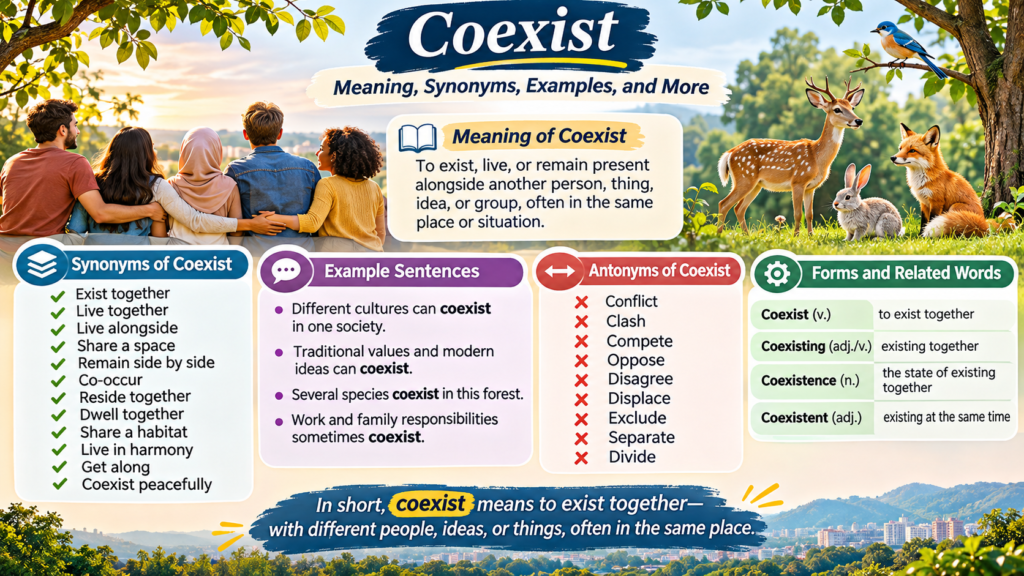
Peaceful coexistence often involves respect, communication, and rules that help people share public spaces without unnecessary conflict.
Quick Answer: What Is Another Word for Coexist?
If you are searching for a coexist synonym, the most suitable choice depends on your sentence.
Common alternatives include:
- Exist together
- Live together
- Live alongside
- Share a space
- Remain side by side
- Occupy the same environment
- Be present simultaneously
- Continue alongside
- Co-occur
- Reside together
- Dwell together
- Share a habitat
- Live in harmony
- Get along
- Coexist peacefully
Exist together is a strong general alternative. Live together works well for people sharing a home, while co-occur is useful for describing events or conditions that happen together.
Remember that synonyms are not always interchangeable. For example, collaborate means to work together, while coexist simply means to exist together. Two organizations can coexist without collaborating on any project.
Also Read: 250+ Synonyms of Wellness: Meanings, Examples, and Words Related to Health
110 Synonyms of Coexist With Meanings and Examples
Below are 110 synonyms and related expressions for coexist. The list includes direct alternatives, phrases for peaceful relationships, expressions for shared environments, and words used in formal or scientific writing.
Some entries are close synonyms, while others are useful only in specific contexts. Choose the expression that best preserves the meaning of your sentence.
1. Direct synonyms for coexist
These expressions describe two or more things existing together or sharing the same place.
- Exist together — to be present at the same time. Example: Different traditions exist together in the community.
- Live together — to share a home or living environment. Example: The two families live together in one house.
- Live alongside — to continue living near or with others. Example: People and wildlife live alongside each other in the region.
- Dwell together — to live in the same place. Example: Several communities dwelled together for generations.
- Reside together — to live in a shared location. Example: The relatives reside together during the winter.
- Share a space — to occupy the same place. Example: Independent businesses share a space in the building.
- Share an environment — to exist within the same surroundings. Example: Different plants share an environment.
- Exist side by side — to continue existing without necessarily merging. Example: Traditional and modern practices exist side by side.
- Remain together — to continue being together. Example: The groups remained together during the transition.
- Stay side by side — to remain alongside one another. Example: The old and new buildings stay side by side.
- Occupy the same area — to be located in a common space. Example: Several bird species occupy the same area.
- Be present together — to occur or be available at the same time. Example: Different emotions can be present together.
- Co-occur — to occur together, often in research or technical writing. Example: These conditions may co-occur.
- Continue to exist together — to remain present at the same time. Example: Both systems continue to exist together.
- Share the same habitat — to live in the same natural environment. Example: Frogs and insects share the same habitat.
- Occupy a common environment — to exist in the same surroundings. Example: Several species occupy a common environment.
- Be found together — to occur in the same place or situation. Example: These minerals are often found together.
- Live in proximity — to live near one another. Example: The communities live in proximity to the river.
- Remain side by side — to continue existing alongside something else. Example: The two methods remain side by side.
- Coexist peacefully — to exist together without serious conflict. Example: Different groups coexist peacefully in the town.
2. Synonyms related to peace and harmony
These alternatives work when coexistence involves calm relationships, respect, or an absence of serious conflict.
- Live in harmony — to maintain a peaceful relationship. Example: The residents try to live in harmony.
- Get along — to have a friendly or manageable relationship. Example: The roommates get along despite their differences.
- Live peacefully — to share a place without frequent conflict. Example: The neighbors live peacefully.
- Maintain peace — to prevent or reduce conflict. Example: Both sides worked to maintain peace.
- Harmonize — to fit together in a balanced way. Example: The building harmonizes with its surroundings.
- Be in harmony — to have a balanced relationship. Example: Their plans are in harmony with local needs.
- Respect differences — to recognize others’ right to differ. Example: The students respect differences in opinion.
- Accept differences — to allow different beliefs or preferences. Example: The team accepts differences in working styles.
- Show mutual respect — to treat each other considerately. Example: The groups show mutual respect during discussions.
- Avoid conflict — to prevent disputes from developing. Example: Clear communication helps the neighbors avoid conflict.
- Maintain peaceful relations — to keep interactions calm. Example: The countries maintain peaceful relations.
- Live without hostility — to share an environment without open hatred. Example: The communities learned to live without hostility.
- Make room for differences — to allow different views or needs. Example: A good classroom makes room for differences.
- Find common ground — to discover shared interests. Example: The two sides found common ground.
- Reach an understanding — to develop a mutual understanding. Example: The neighbors reached an understanding.
- Keep the peace — to prevent arguments or disturbances. Example: Open communication helps keep the peace.
- Maintain a truce — to sustain an agreement to stop fighting. Example: The groups maintained a temporary truce.
- Live with mutual understanding — to recognize one another’s perspectives. Example: The partners aim to live with mutual understanding.
- Practice peaceful coexistence — to share a place or society without violence. Example: The program promotes peaceful coexistence.
- Live and let live — to allow others to live according to their preferences. Example: Their approach is simple: live and let live.
3. Synonyms related to cooperation
These words are appropriate when people or organizations actively help one another. They are related to coexist but generally imply more interaction.
- Cooperate — to act together toward a shared outcome. Example: The departments cooperate on environmental projects.
- Collaborate — to work jointly on a task. Example: The researchers collaborate on a study.
- Work together — to contribute toward a common goal. Example: Local groups work together to improve the park.
- Coordinate — to organize activities so they fit together. Example: The teams coordinate their schedules.
- Combine efforts — to contribute work or resources jointly. Example: The organizations combine efforts to help families.
- Join forces — to unite efforts for a shared purpose. Example: Two charities joined forces for a campaign.
- Partner — to work with another person or organization. Example: The schools partner on community projects.
- Team up — to form a working partnership. Example: The volunteers teamed up to clean the beach.
- Support one another — to provide mutual help. Example: The members support one another.
- Assist each other — to give help in return. Example: The neighboring farms assist each other during harvest.
- Collaborate closely — to work together with regular communication. Example: Designers collaborate closely with engineers.
- Coordinate efforts — to organize separate actions toward one goal. Example: The agencies coordinate efforts during emergencies.
- Share responsibilities — to divide duties among participants. Example: The household members share responsibilities.
- Act collectively — to take action as a group. Example: The residents act collectively to protect the forest.
- Pool resources — to combine available money, equipment, or skills. Example: The businesses pool resources for advertising.
- Build a partnership — to establish a cooperative relationship. Example: The institutions build a partnership around research.
- Work in tandem — to operate together in a coordinated manner. Example: The two systems work in tandem.
- Operate jointly — to manage or perform something together. Example: The organizations operate jointly in the region.
- Contribute together — to make combined contributions. Example: The volunteers contribute together to the project.
- Unite around a goal — to organize around a shared purpose. Example: The community united around a goal of safer streets.
4. Synonyms related to connection and association
These expressions emphasize links between people, ideas, systems, or events.
- Associate — to have a connection with someone or something. Example: The organizations associate through a shared initiative.
- Connect — to form or have a link. Example: The ideas connect through a common theme.
- Relate — to have a meaningful relationship. Example: The two concepts relate to each other.
- Interact — to communicate with or influence one another. Example: Different species interact within an ecosystem.
- Correspond — to match or be consistent with something. Example: The findings correspond with earlier observations.
- Overlap — to share an area, period, or feature. Example: The two projects overlap in several areas.
- Intersect — to cross or meet at a point. Example: Their professional interests intersect.
- Link — to connect one thing with another. Example: The report links social and economic factors.
- Be related — to share a connection. Example: The two issues are related.
- Be associated — to be connected in some way. Example: These patterns are associated in the dataset.
- Run parallel — to continue along separate but simultaneous paths. Example: The two initiatives run parallel.
- Develop alongside — to grow or change while something else does the same. Example: Digital tools develop alongside traditional services.
- Share similarities — to have common features. Example: The two approaches share similarities.
- Be interconnected — to be linked as parts of a larger system. Example: The systems are interconnected.
- Be interrelated — to relate to or influence one another. Example: The issues are interrelated.
- Maintain a connection — to keep a relationship or link. Example: The communities maintain a connection through annual events.
- Be compatible — to work or exist together without major conflict. Example: Their schedules are compatible.
- Fit together — to work as matching or complementary parts. Example: The proposals fit together well.
- Complement — to add something useful to another thing. Example: The two approaches complement each other.
- Coexist in parallel — to continue alongside something without necessarily merging. Example: The services coexist in parallel.
5. Synonyms related to continuity
Use these expressions when you want to emphasize that different things remain present over time.
- Persist alongside — to continue existing while something else remains. Example: Traditional beliefs persist alongside new ideas.
- Continue alongside — to remain present as something else develops. Example: Paper records continue alongside digital files.
- Endure together — to last through a difficult period together. Example: The communities endured together through the crisis.
- Remain in place — to continue occupying a position or role. Example: Both systems remain in place during the transition.
- Continue in parallel — to keep progressing along separate paths. Example: The programs continue in parallel.
- Survive alongside — to remain alive or functional while something else exists. Example: Small shops survive alongside large retailers.
- Carry on together — to continue an activity or shared situation. Example: The partners carried on together after the setback.
- Last side by side — to continue existing alongside another thing. Example: The customs lasted side by side.
- Remain concurrent — to continue occurring during the same period. Example: The processes remain concurrent.
- Continue simultaneously — to keep happening at the same time. Example: Both investigations continue simultaneously.
- Persist together — to remain present at the same time. Example: The two patterns persist together.
- Stay in existence — to continue existing. Example: Several local traditions stay in existence.
- Remain active together — to continue functioning at the same time. Example: Both networks remain active together.
- Operate side by side — to continue functioning in the same setting. Example: The payment systems operate side by side.
- Co-occur over time — to appear together across a period. Example: The two trends co-occur over time.
6. Synonyms related to acceptance and adjustment
These expressions describe ways that people or systems make it possible to share space or circumstances.
- Tolerate — to allow something without necessarily approving of it. Example: The neighbors tolerate each other’s different routines.
- Accept — to recognize or allow a difference. Example: The team accepts different viewpoints.
- Accommodate — to adjust arrangements to meet different needs. Example: The workplace accommodates different schedules.
- Adapt — to change in response to a situation. Example: The species adapt to changes in their habitat.
- Adjust — to make a change so something works better. Example: The roommates adjust their routines.
- Respect — to recognize the value or rights of others. Example: The groups respect each other’s traditions.
- Make allowances for — to consider differences or limitations. Example: The manager makes allowances for different working styles.
- Find a balance — to manage different needs or interests. Example: The family finds a balance between work and home life.
- Compromise — to reach an agreement through concessions. Example: The roommates compromise over shared spaces.
- Reconcile — to resolve differences or make opposing ideas compatible. Example: The team reconciled competing priorities.
- Acclimate — to become accustomed to a new environment. Example: New residents acclimate to life in the community.
- Integrate — to bring elements into a larger system. Example: The school integrates technology into lessons.
- Assimilate — to become absorbed into a group or culture. Example: Some newcomers assimilate into the wider community.
- Make space for — to allow another person, idea, or activity to exist. Example: The policy makes space for different needs.
- Allow differences to remain — to accept that not everything must become the same. Example: The agreement allows differences to remain.
These 110 alternatives provide a broad vocabulary for different situations. Some are close synonyms, while others describe actions or qualities that support coexistence. Always consider the meaning of the full sentence before replacing one word with another.
Coexist vs. Similar Words: Important Differences
A thesaurus for coexist may list many related terms, but understanding their differences is more useful than memorizing a long list.
| Word | Main meaning | Example |
| Coexist | Exist together | Different beliefs coexist in society. |
| Collaborate | Work jointly toward a goal | The writers collaborate on a book. |
| Cooperate | Help one another | The neighbors cooperate on local projects. |
| Tolerate | Allow something without necessarily approving | She tolerates different opinions. |
| Harmonize | Fit together in a balanced way | The colors harmonize beautifully. |
| Share | Use or experience something together | The children share a room. |
| Integrate | Bring something into a larger system | The school integrates technology into lessons. |
| Overlap | Share part of an area, period, or feature | Their responsibilities overlap. |
| Co-occur | Happen or appear together | The two patterns co-occur in the data. |
| Reconcile | Resolve differences | They reconciled their competing priorities. |
| Interact | Communicate with or influence one another | The species interact in several ways. |
| Persist | Continue to exist | Older customs persist in modern society. |
Coexist vs. collaborate
Coexist means to exist together. Collaborate means to work together toward a shared goal.
Example: Two businesses may coexist in the same neighborhood without collaborating on a project.
Coexist vs. tolerate
Coexist describes a shared state. Tolerate describes allowing something that may be unwelcome or different from your preferences.
Example: People with opposing views may coexist in one community, while tolerating different opinions may help them avoid unnecessary conflict.
Coexist vs. harmonize
Coexist does not require agreement or balance. Harmonize suggests that different elements fit together well.
Example: Traditional and modern buildings can coexist in a city, but they harmonize when their designs complement each other.
Also Read: 100 Synonyms for Consolation: Meanings, Examples, and Related Words
Coexist vs. live together
Live together often refers to people or animals sharing a home. Coexist has a broader meaning and also applies to ideas, conditions, and systems.
Example: Roommates live together in an apartment, while different opinions coexist during a discussion.
Coexistence Meaning and Synonyms
Coexistence is the noun form of coexist. The meaning of coexistence is the state of two or more people, things, or ideas existing together.
The word is often used in discussions of society, relationships, nature, and competing ideas.
Examples:
- Peaceful coexistence among communities can support social stability.
- Different plant species coexist in the same habitat.
- Old and new technologies coexist in modern workplaces.
- Hope and uncertainty can coexist during major life changes.
- Different viewpoints can coexist within an open discussion.
What is another word for coexistence?
The best coexistence synonym depends on the context.
| Synonym or related expression | Suitable context |
| Shared existence | General discussions |
| Co-occurrence | Events or conditions that happen together |
| Co-presence | People or things present together |
| Peaceful living | Communities and relationships |
| Living side by side | People, groups, or species |
| Harmony | Balanced or peaceful relationships |
| Co-habitation | Sharing a living space or habitat |
| Compatibility | Things that can function together |
| Concurrent existence | Formal or technical writing |
| Parallel existence | Separate things continuing alongside one another |
| Shared environment | Ecology and social settings |
| Mutual existence | General or theoretical discussions |
These words are related rather than universally interchangeable. For example, compatibility describes whether things can function together, while coexistence describes their presence together.
Coexisting Meaning: What Does Coexisting Mean?
Coexisting is the present participle of coexist. It can also serve as an adjective to describe people, things, or conditions that exist together.
Examples:
- Coexisting communities may have different customs.
- The coexisting systems perform different functions.
- Several species are coexisting in the protected habitat.
- Different concerns can be coexisting factors in a decision.
If you are searching for the definition of coexisting, the simple meaning is existing or living together.
Coexisting does not necessarily mean cooperating, agreeing, or maintaining a peaceful relationship. Those meanings depend on the surrounding sentence.
Coexist or Co-Exist: Which Spelling Is Correct?
Coexist is the standard closed spelling in modern American English. Co-exist is also encountered, but the unhyphenated version is generally preferable for consistent writing.
The common forms are:
- Coexist: the base verb.
- Coexists: the present-tense form used with he, she, or it.
- Coexisted: the simple past tense.
- Coexisting: the present participle or adjective.
- Coexistence: the noun.
- Coexistent: an adjective meaning existing together.
Examples:
- Different species coexist in the forest.
- Several cultures coexisted in the region.
- The coexisting systems serve different purposes.
- The two conditions are coexistent.
Co-existence is a recognized alternative spelling, but coexistence is generally preferred in standard American English.
Common spelling mistakes
Searches sometimes contain variations such as coexistance, coexsist, coexsistence, coedist, and co existance.
The standard spellings are:
| Incorrect or nonstandard form | Preferred form |
| Coexistance | Coexistence |
| Coexsist | Coexist |
| Coexsistence | Coexistence |
| Co exist | Coexist |
| Co existance | Coexistence |
| Coedist | Coexist |
| Co existing | Coexisting |
The spaced form co exist meaning is generally a search variation rather than standard spelling. When writing an article, use coexist and coexistence consistently.
The phrase c o e x i s t is simply the word spelled out with spaces between its letters. It is not a separate English word.
Coexist Antonyms: What Is the Opposite of Coexist?
There is no single antonym that works in every context. The opposite depends on whether coexist describes shared space, simultaneous existence, or a peaceful relationship.
Common contrasting words include:
- Conflict — to be in opposition.
- Clash — to be incompatible or come into direct opposition.
- Compete — to seek the same limited resource or advantage.
- Oppose — to act against something.
- Disagree — to hold different opinions.
- Displace — to take the place of something else.
- Exclude — to prevent someone or something from being included.
- Separate — to keep things apart.
- Divide — to split into different groups or parts.
- Invalidate — to make an argument or claim ineffective or unsound.
These are context-dependent opposites, not exact antonyms in every sentence.
For example, two businesses can coexist while competing with each other. Competition does not automatically prevent coexistence.
How to Use Coexist in a Sentence
Coexist is suitable for everyday conversations, school assignments, professional writing, and scientific discussions.
Simple sentences with coexist
- People with different beliefs can coexist peacefully.
- Several species coexist in this habitat.
- Traditional values and modern ideas can coexist.
- Work and family responsibilities sometimes coexist.
- Different opinions can coexist without a final agreement.
- The two systems coexist within the same organization.
- Hope and fear can coexist during uncertain times.
- Small businesses coexist with large retailers in the area.
- Several languages coexist in the region.
- Humans and wildlife must coexist in shared landscapes.
Coexist in formal writing
In formal writing, coexist can describe simultaneous conditions, different viewpoints, or separate systems that remain present together.
Examples:
- The findings suggest that the two processes can coexist under certain conditions.
- Different policy approaches may coexist within the same framework.
- Economic growth and environmental protection can coexist when suitable safeguards are in place.
- The study examines how competing explanations coexist within the literature.
Common sentence patterns
The following structures help you use the word naturally:
Coexist with: Different traditions coexist with modern practices.
Coexist alongside: Local shops coexist alongside national chains.
Coexist in: Several species coexist in this ecosystem.
Coexist peacefully: The groups coexist peacefully.
Allow something to coexist: The approach allows different methods to coexist.
Use the pattern that matches your intended meaning.
Coexist in Spanish: Translation and Meaning
The Spanish translation of coexist is coexistir. The noun coexistence translates to coexistencia.
| English | Spanish |
| Coexist | Coexistir |
| Coexistence | Coexistencia |
| Coexist peacefully | Coexistir pacíficamente |
| Live together | Vivir juntos |
| Exist together | Existir juntos |
For example, “Different cultures can coexist” translates to “Diferentes culturas pueden coexistir.”
The best translation depends on the sentence. Coexistir works well for different cultures or ideas existing together, while vivir juntos is often more natural when talking about people sharing a home.
Practical Tips for Choosing the Right Coexist Synonym
Finding another word for coexist is easy when you first identify what you want to communicate.
1. Decide whether you mean existence or interaction
If two things are simply present together, use exist together or coexist.
If they actively help each other, cooperate or collaborate may be more accurate.
2. Consider whether peace is important
Use live in harmony, live peacefully, or maintain peaceful relations when the sentence emphasizes a lack of conflict.
Use coexist when you only need to describe the shared state.
3. Match the word to the subject
For people, live together or get along may sound natural.
For animals, share a habitat may be more precise.
For ideas, exist side by side is often suitable.
For scientific findings, co-occur may be appropriate when two conditions appear together.
4. Avoid changing the meaning
Words such as unite, merge, and combine suggest that separate things come together more actively. Coexist does not require things to become one group or system.
For example, two businesses may coexist in a shopping center without merging into one company.
Also Read: 100+ Synonyms of Vanity: Meaning, Examples, and Opposites
5. Read the complete sentence aloud
If the replacement changes the intended meaning, choose another expression.
“Different views coexist” means different opinions remain present together. “Different views agree” suggests that the opinions are in agreement, which may not be true.
Frequently Asked Questions About Coexist
1. What does coexist mean in simple English?
Coexist means to live or exist alongside another person or thing at the same time. It can describe people, groups, ideas, or species that share a place or situation.
2. What is the closest synonym for coexist?
Exist together is one of the closest general synonyms. Depending on the context, live alongside, share a space, and co-occur may also work.
3. What does coexisting mean?
Coexisting means existing or living together. It is the present participle of coexist and can also function as an adjective.
4. What is another word for coexist peacefully?
Possible alternatives include live in harmony, live peacefully, maintain peaceful relations, and get along. The best choice depends on whether you mean peaceful living or a friendly relationship.
5. What is the noun form of coexist?
The noun form is coexistence. It refers to the condition of different people or things existing together.
6. What is the adjective form of coexist?
Coexistent is an adjective meaning existing together. Coexisting is also commonly used as an adjective.
7. Can coexist describe negative situations?
Yes. Coexist does not automatically mean that a situation is good or peaceful.
For example, conflict and cooperation can coexist within the same organization. Both conditions may be present at the same time.
8. Can two opposite ideas coexist?
Yes. Opposing ideas can coexist when both remain present in a discussion or person’s thinking.
For example, someone may feel excited about a new opportunity while also feeling nervous about the changes it will bring.
9. Is coexist the same as compromise?
No. Coexist means to exist together, while compromise involves making concessions to reach an agreement. People can coexist without reaching a compromise.
10. Is cohabitate a synonym for coexist?
Sometimes, but the meanings are not identical. Cohabitate refers more specifically to sharing a living space or habitat. Coexist also applies to ideas, conditions, and systems.
11. What is the difference between coexist and co-occur?
Coexist emphasizes the continued presence of things together, while co-occur emphasizes that events, features, or conditions happen or appear together. Co-occur is especially useful in research and technical writing.
12. How do you pronounce coexist?
Coexist is commonly pronounced koh-ig-ZIST, with the main stress on the final syllable.
13. What is the past tense of coexist?
The simple past tense is coexisted.
Example: Several communities coexisted in the region for many years.
14. Is coexistance a correct spelling?
No. Coexistance is a common misspelling. The correct noun is coexistence.
Similarly, coexsist and coexsistence are misspellings of coexist and coexistence.
15. How many synonyms of coexist are there?
There is no fixed number. Thesauruses provide direct alternatives as well as related phrases that fit specific contexts. The important point is to choose an expression that preserves the intended meaning.
16. What does co-exist mean in a relationship?
Co-exist in a relationship means sharing life or space while maintaining individual identities and respecting reasonable differences. The standard spelling is coexist.
17. What is a synonym for coexistence in English?
Possible alternatives include shared existence, co-occurrence, co-presence, peaceful living, and parallel existence. Each expression has a slightly different use.
18. What does coexist mean in Spanish?
Coexist means coexistir in Spanish, while coexistence means coexistencia. The translation may vary with the sentence and context.
Conclusion
Coexist means to live or exist together, either in the same place or during the same period. It can describe people sharing a community, animals occupying one habitat, ideas remaining present together, or systems operating side by side.
The best synonym depends on the situation. Exist together is a useful general alternative, while live alongside, get along, harmonize, share a habitat, and co-occur are appropriate in specific contexts.
Understanding the differences between coexistence, cooperation, tolerance, and harmony helps you choose more accurate words for conversations, essays, professional documents, and everyday writing.
Instead of memorizing every alternative, focus on how each word changes the meaning of a sentence. This approach will strengthen your vocabulary, improve your writing, and help you communicate more naturally in English.