
100 Synonyms for Consolation: Meanings, Examples, and Related Words
When someone experiences disappointment, grief, failure, or emotional pain, the right words can make a difficult moment easier. A thoughtful message, a reassuring conversation, or a caring presence can help someone feel less alone. The word consolation describes the comfort or relief a person receives during such times.
However, consolation does not always mean removing sadness completely. Sometimes, it means helping someone cope with a difficult situation, regain hope, or find a small source of peace.
Learning synonyms for consolation can improve your vocabulary and help you communicate more clearly. Whether you are writing an essay, preparing a condolence message, improving your English, or looking for another word for consolation in everyday conversation, understanding the differences between related words is important.
This guide explains the most useful consolation synonyms, provides simple definitions and original examples, explores antonyms, and answers common vocabulary questions.
What Is a Synonym for Consolation?
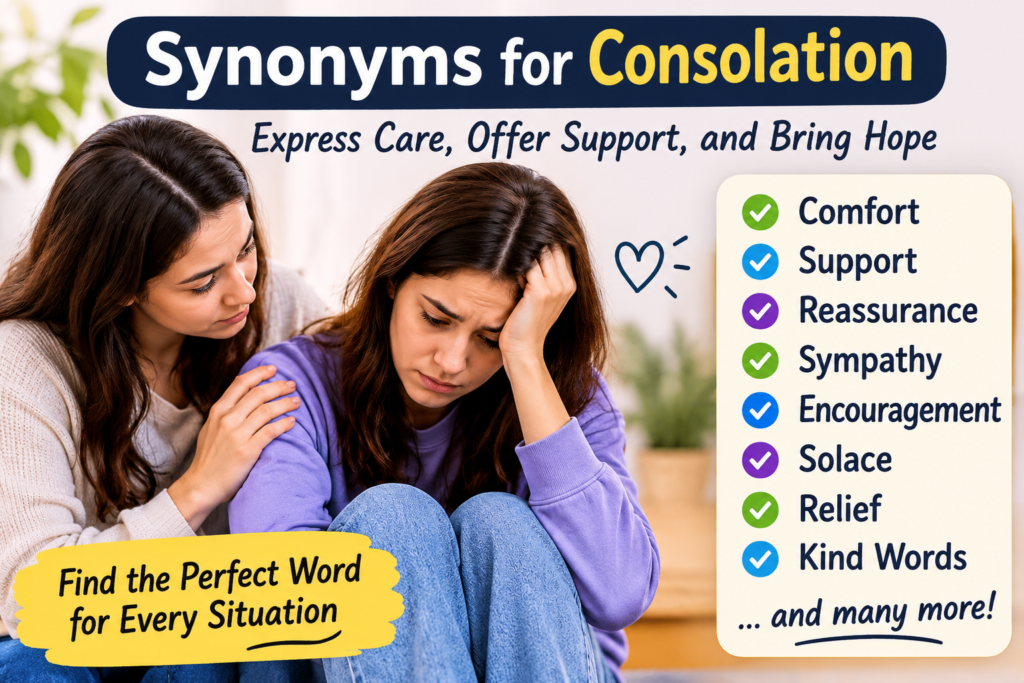
The most common synonym for consolation is comfort. Other useful alternatives include solace, reassurance, sympathy, encouragement, support, relief, compassion, and commiseration.
The best word depends on the situation. Comfort usually means reducing sadness or distress, while reassurance helps someone feel less worried. Sympathy expresses concern for another person’s suffering, and encouragement helps someone regain confidence or hope.
For example:
- Comfort: Her friend offered comfort after the disappointing news.
- Solace: He found solace in reading his favorite books.
- Reassurance: The teacher gave the student reassurance before the exam.
- Sympathy: We expressed our sympathy to the grieving family.
- Encouragement: Her coach offered encouragement after the loss.
These words are closely related, but they are not interchangeable in every sentence.
100 Synonyms for Consolation With Meanings and Examples
The following list includes direct synonyms, close alternatives, and useful expressions associated with emotional comfort. Some words describe the act of consoling someone, while others describe the feeling, response, or source of comfort.
1. Direct Synonyms and Closely Related Words
These words are especially useful when you need another word for consolation in general writing.
1. Comfort
Meaning: Relief from sadness, pain, or worry.
Example: Her sister’s comforting words brought her comfort after a difficult day.
2. Solace
Meaning: Comfort during grief, disappointment, or hardship.
Example: He found solace in the quiet beauty of the garden.
3. Consolation
Meaning: Something that makes a difficult experience easier to bear.
Example: The kind message was a small consolation after his rejection.
4. Relief
Meaning: A reduction in pain, worry, stress, or distress.
Example: Talking about her worries brought her some relief.
5. Reassurance
Meaning: Words or actions that reduce fear and uncertainty.
Example: The doctor’s explanation provided reassurance before the procedure.
6. Support
Meaning: Help that enables someone to cope with a difficult situation.
Example: Her friends offered support after she lost her job.
7. Sympathy
Meaning: Concern for someone experiencing sadness or hardship.
Example: We expressed our sympathy after hearing about his loss.
8. Encouragement
Meaning: Words or actions that inspire confidence and hope.
Example: A little encouragement helped Maya try again.
9. Compassion
Meaning: Concern for another person’s suffering, often accompanied by a desire to help.
Example: The volunteer treated every struggling family with compassion.
10. Empathy
Meaning: The ability to understand or share another person’s feelings.
Example: His empathy helped his friend feel understood.
11. Commiseration
Meaning: An expression of sympathy for another person’s disappointment or difficulty.
Example: Her colleagues offered commiseration after the project failed.
12. Kindness
Meaning: Thoughtful, considerate behavior toward another person.
Example: A simple act of kindness made the lonely visitor feel welcome.
13. Solicitousness
Meaning: Careful concern for another person’s comfort or well-being.
Example: Her solicitousness helped the nervous guest feel at ease.
14. Tenderness
Meaning: Gentle affection and sensitivity toward someone’s feelings.
Example: He spoke with tenderness when comforting his younger brother.
Also Read: 100+ Synonyms of Vanity: Meaning, Examples, and Opposites
15. Consoling
Meaning: Providing comfort to someone who is upset.
Example: She offered a consoling message after the disappointing result.
2. Words That Describe Emotional Support
These alternatives are useful when consolation comes from a person who listens, cares, or helps someone through a challenging time.
16. Care
Meaning: Concern for another person’s well-being.
Example: His family showed care during his recovery.
17. Understanding
Meaning: Awareness of another person’s feelings or circumstances.
Example: Her manager showed understanding when she explained her difficulties.
18. Companionship
Meaning: The comfort of having someone with you.
Example: The elderly man appreciated the companionship of his neighbors.
19. Solidarity
Meaning: Unity and mutual support during a difficult experience.
Example: The community showed solidarity with families affected by the disaster.
20. Fellowship
Meaning: A feeling of friendship and shared connection.
Example: The support group offered fellowship to people facing similar challenges.
21. Assistance
Meaning: Practical help provided to someone who needs it.
Example: The organization provided assistance to families after the storm.
22. Aid
Meaning: Help or resources offered to someone in difficulty.
Example: Emergency aid brought relief to the affected residents.
23. Encouragement
Meaning: Support that strengthens confidence or determination.
Example: Her teacher’s encouragement helped her continue studying.
24. Advocacy
Meaning: Active support for someone’s needs, interests, or rights.
Example: His counselor provided advocacy when he struggled to access services.
25. Attentiveness
Meaning: Giving careful attention to another person’s needs.
Example: The nurse’s attentiveness helped the patient feel cared for.
26. Consideration
Meaning: Thoughtful awareness of another person’s feelings.
Example: Her consideration made the difficult conversation easier.
27. Nurturing
Meaning: Providing care that helps someone feel safe and develop.
Example: A nurturing environment helped the child regain confidence.
28. Camaraderie
Meaning: Friendship and trust among people who share an experience.
Example: The teammates’ camaraderie helped them cope with defeat.
29. Receptiveness
Meaning: Willingness to listen to and understand another person’s concerns.
Example: His receptiveness encouraged her to speak honestly.
30. Supportiveness
Meaning: The quality of being helpful, caring, and encouraging.
Example: Her supportiveness made the workplace feel welcoming.
3. Words That Express Hope and Confidence
Consolation sometimes helps people believe that their situation can improve. The following words are especially suitable for messages after failure, rejection, or uncertainty.
31. Hope
Meaning: A feeling that something better may happen.
Example: Her family’s support gave her hope after the setback.
32. Optimism
Meaning: A tendency to expect positive possibilities.
Example: His optimism helped the team move forward after losing the competition.
33. Confidence
Meaning: A belief in one’s abilities or the likelihood of a good outcome.
Example: The coach’s advice restored her confidence.
34. Motivation
Meaning: The desire or willingness to take action.
Example: Positive feedback gave him the motivation to continue.
35. Inspiration
Meaning: Something that encourages new ideas, courage, or effort.
Example: Her grandmother’s story became a source of inspiration.
36. Uplift
Meaning: An improvement in someone’s mood or spirits.
Example: A cheerful phone call gave her spirits an unexpected uplift.
37. Cheer
Meaning: Happiness or encouragement that improves someone’s mood.
Example: His friends brought some cheer to an otherwise difficult afternoon.
38. Reassuringness
Meaning: The quality of making someone feel less anxious or uncertain.
Example: The reassuringness of her calm voice helped the children relax.
39. Affirmation
Meaning: A statement that recognizes someone’s worth, feelings, or abilities.
Example: His teacher’s affirmation helped him believe in his potential.
40. Validation
Meaning: Recognition that someone’s feelings or experiences are understandable.
Example: She felt relief when her friend offered validation instead of criticism.
4. Words That Describe Calm and Emotional Ease
Use these terms when consolation helps reduce tension, settle fears, or create a feeling of peace.
41. Calm
Meaning: A peaceful state without strong agitation.
Example: Her friend’s calm presence helped her think clearly.
42. Tranquility
Meaning: A state of peace and freedom from disturbance.
Example: He found tranquility while walking beside the lake.
43. Serenity
Meaning: A quiet, peaceful state of mind.
Example: The peaceful surroundings brought her a sense of serenity.
44. Peace
Meaning: Freedom from conflict, disturbance, or emotional turmoil.
Example: After their conversation, she finally felt some peace.
45. Ease
Meaning: Freedom from difficulty, discomfort, or tension.
Example: His explanation put her mind at ease.
46. Soothing
Meaning: Having a calming or comforting effect.
Example: The soothing sound of rain helped him relax.
47. Repose
Meaning: A state of rest or peaceful relaxation.
Example: After weeks of stress, she welcomed a moment of repose.
48. Relaxation
Meaning: The release of tension or stress.
Example: Listening to gentle music brought relaxation after work.
49. Composure
Meaning: The ability to remain calm and in control of one’s emotions.
Example: Her friend’s advice helped her regain her composure.
50. Equanimity
Meaning: Mental calmness, especially during difficult circumstances.
Example: He faced the unexpected setback with remarkable equanimity.
5. Words That Describe Healing and Recovery
Some forms of consolation help people process painful experiences or begin to recover emotionally.
51. Healing
Meaning: The process of recovering from emotional or physical pain.
Example: Honest conversations became part of her emotional healing.
52. Restoration
Meaning: The process of bringing back a previous sense of strength or well-being.
Example: Time away from work helped with the restoration of his confidence.
53. Recovery
Meaning: The process of returning to a better condition after hardship.
Example: Her friends supported her recovery after a painful breakup.
54. Renewal
Meaning: The return of energy, hope, or a fresh outlook.
Example: The new opportunity brought a feeling of renewal.
55. Mending
Meaning: The process of repairing something damaged, including a relationship.
Example: Their sincere apology helped begin the mending of their friendship.
56. Reconciliation
Meaning: The restoration of a friendly relationship after disagreement.
Example: Their honest discussion opened the door to reconciliation.
57. Catharsis
Meaning: The release of strong or painful emotions.
Example: Writing about her grief gave her a sense of catharsis.
58. Release
Meaning: Freedom from an emotional burden or tension.
Example: Talking openly brought a welcome release from pent-up frustration.
59. Respite
Meaning: A short period of rest or relief from something difficult.
Example: The weekend offered a respite from the pressure of work.
60. Restoration of hope
Meaning: The return of belief that circumstances may improve.
Example: The unexpected offer brought a restoration of hope after months of rejection.
Also Read: Synonyms of Loud: 200+ Words for Different Sounds and Situations
6. Words for Sympathy, Grief, and Mourning
These terms are particularly helpful when someone has experienced a death, serious loss, or deeply disappointing event.
61. Condolence
Meaning: An expression of sympathy, especially after someone’s death.
Example: We sent a condolence message to the family.
62. Condolences
Meaning: Expressions of sympathy offered to someone who is grieving.
Example: Please accept our sincere condolences during this difficult time.
63. Commiserating
Meaning: Sharing or expressing sympathy about another person’s trouble.
Example: We spent the afternoon commiserating about our disappointing results.
64. Pity
Meaning: Sorrow or concern for someone else’s suffering; it can sometimes sound condescending.
Example: She wanted understanding and support rather than pity.
65. Grief support
Meaning: Emotional or practical help for someone experiencing loss.
Example: The local center offered grief support to bereaved families.
66. Mourning
Meaning: The process of expressing or experiencing grief after a loss.
Example: Her relatives gave her time and space for mourning.
67. Compassionate listening
Meaning: Listening carefully and kindly to someone who is suffering.
Example: Compassionate listening helped him talk about his loss.
68. Shared sorrow
Meaning: Sadness experienced or acknowledged together with others.
Example: The gathering became a moment of shared sorrow and remembrance.
69. Remembrance
Meaning: The act of remembering someone or something important, often with affection.
Example: They found comfort in the remembrance of happier times.
70. Solidarity in grief
Meaning: A shared sense of support among people experiencing loss.
Example: Their solidarity in grief helped the family feel less isolated.
7. Words for Encouraging Someone After Disappointment
Consolation can also come from helping someone accept an outcome, learn from it, and move forward.
71. Acceptance
Meaning: Recognizing a situation as it is, even when it is difficult.
Example: Gradually, she reached acceptance of the decision.
72. Perspective
Meaning: A way of understanding a situation in a broader context.
Example: His mentor helped him gain perspective after the failed interview.
73. Patience
Meaning: The ability to tolerate delay or difficulty without becoming overly upset.
Example: She showed patience while her friend worked through the disappointment.
74. Resilience
Meaning: The ability to adapt and recover after difficulties.
Example: His resilience helped him rebuild his confidence.
75. Perseverance
Meaning: Continuing to work toward a goal despite obstacles.
Example: Encouragement strengthened her perseverance after repeated setbacks.
76. Fortitude
Meaning: Courage and mental strength during hardship.
Example: Her fortitude inspired the people around her.
77. Determination
Meaning: A strong commitment to continuing despite challenges.
Example: The support she received strengthened her determination.
78. Empowerment
Meaning: Helping someone feel capable of making decisions or taking action.
Example: The workshop provided empowerment through practical skills and guidance.
79. Reframing
Meaning: Looking at a difficult situation from a different perspective.
Example: Reframing the rejection as a learning opportunity helped him move forward.
80. Renewed confidence
Meaning: A restored belief in one’s abilities after doubt or failure.
Example: Completing a smaller task gave her renewed confidence.
8. Expressions and Less Common Alternatives
The final 20 entries include useful expressions and context-specific words. Some are not exact dictionary synonyms, but they can communicate a similar idea in the right situation.
81. Reassurance
Meaning: Words or actions that make someone feel more secure.
Example: A quick message from her family provided reassurance.
82. Emotional support
Meaning: Care and understanding that help someone manage difficult feelings.
Example: He relied on emotional support while adjusting to a major life change.
83. Moral support
Meaning: Encouragement or companionship without necessarily providing practical assistance.
Example: Her brother came to the competition to offer moral support.
84. A listening ear
Meaning: Someone who is willing to listen without judgment.
Example: When she felt overwhelmed, her friend offered a listening ear.
85. A shoulder to cry on
Meaning: A person who provides comfort during sadness.
Example: After the breakup, she needed a shoulder to cry on.
86. Words of comfort
Meaning: Statements intended to reduce sadness or distress.
Example: His message included a few thoughtful words of comfort.
87. Words of encouragement
Meaning: Statements that help someone feel hopeful or capable.
Example: Her mentor shared words of encouragement before the presentation.
88. A comforting presence
Meaning: Being near someone in a way that makes them feel supported.
Example: His quiet presence was more helpful than advice.
89. A silver lining
Meaning: A positive aspect of an otherwise difficult situation.
Example: Losing the competition was disappointing, but meeting new teammates was a silver lining.
90. A bright spot
Meaning: A small positive experience during a difficult period.
Example: Her daily conversations with friends became a bright spot in a stressful week.
91. A source of comfort
Meaning: A person, activity, or thing that provides emotional relief.
Example: Her favorite childhood book remained a source of comfort.
92. A glimmer of hope
Meaning: A small sign that a situation may improve.
Example: The second interview gave him a glimmer of hope.
93. A sense of security
Meaning: A feeling of safety and confidence.
Example: Knowing that help was available gave her a sense of security.
94. Peace of mind
Meaning: A feeling of being free from worry.
Example: Checking the details in advance gave him peace of mind.
95. Emotional relief
Meaning: A reduction in emotional pressure, sadness, or anxiety.
Example: Sharing her concerns brought emotional relief.
96. A morale boost
Meaning: Something that improves confidence, enthusiasm, or group spirit.
Example: The team’s unexpected victory provided a morale boost.
97. A soothing influence
Meaning: A person or thing that helps reduce agitation.
Example: Her grandmother was a soothing influence during family disagreements.
98. Reprieve
Meaning: A temporary break from something unpleasant or difficult.
Example: The good news provided a brief reprieve from their worries.
99. Consoling gesture
Meaning: An action that expresses care or provides comfort.
Example: Bringing dinner was a consoling gesture during a stressful week.
100. Emotional refuge
Meaning: A person, place, or activity where someone feels emotionally safe.
Example: The community center became an emotional refuge during a difficult period.
The Best Consolation Synonyms for Different Situations
Not every alternative fits every context. The most natural word depends on what the person is experiencing and how you want to express support.
| Situation | Best word or expression | Example |
| Someone feels sad | Comfort | I hope these words bring you comfort. |
| Someone is grieving | Solace | May you find solace in your memories. |
| Someone feels anxious | Reassurance | She needed reassurance before the meeting. |
| Someone has experienced a loss | Condolences | Please accept my sincere condolences. |
| Someone has failed | Encouragement | He offered encouragement after the exam. |
| Someone feels alone | Companionship | Her companionship helped him through the week. |
| Someone feels overwhelmed | Relief | Finishing the task brought relief. |
| Someone needs to feel understood | Empathy | She responded with empathy rather than judgment. |
| Someone faces a long struggle | Resilience | His resilience helped him keep going. |
| Someone needs a break | Respite | The holiday provided a respite from stress. |
What Is the Difference Between Consolation, Comfort, Solace, and Sympathy?
These words overlap in meaning, but each emphasizes a different part of the experience.
Consolation vs. Comfort
Comfort is a broad term for reducing distress or making someone feel better. Consolation is often associated with disappointment, loss, or an outcome that cannot easily be changed.
Example of comfort: The warm blanket brought comfort on the cold night.
Example of consolation: The runner took consolation in finishing the race despite not winning.
Consolation vs. Solace
Solace often describes a source of peace or comfort during prolonged sadness or hardship. Consolation can refer to either the comfort itself or something positive that makes a disappointing outcome easier to accept.
Example of solace: She found solace in gardening after a difficult year.
Example of consolation: The scholarship was a consolation after he missed out on his first-choice program.
Consolation vs. Sympathy
Sympathy is concern for another person’s suffering. Consolation is the comfort offered or received in response to sadness or disappointment.
Example of sympathy: We felt sympathy for the family after their loss.
Example of consolation: Our visit brought the family some consolation.
Consolation vs. Reassurance
Reassurance helps reduce fear, doubt, or uncertainty. Consolation usually addresses sadness, disappointment, or loss.
Example of reassurance: The mechanic reassured her that the repair was minor.
Example of consolation: Her friends offered consolation after she was rejected for the position.
Consolation vs. Encouragement
Encouragement helps someone feel motivated or confident enough to continue. Consolation helps someone cope with a painful experience.
Example of encouragement: His teacher encouraged him to apply again.
Example of consolation: His teacher consoled him after the rejection.
What Is the Difference Between Consolation and a Consolation Prize?
A consolation prize is a reward given to someone who does not win the main prize or competition. It offers a small positive outcome after disappointment.
For example: Although Lena did not win the art contest, she received a consolation prize for her creativity.
Related expressions include:
- Runner-up prize
- Participation award
- Secondary prize
- Small reward
- Recognition award
These expressions are not exact synonyms in every context. A participation award recognizes involvement, while a runner-up prize generally recognizes a high placement.
A consolation prize can be a literal object or award. In everyday conversation, consolation can also be something intangible, such as learning a useful lesson, receiving support, or finding a new opportunity.
Consolation Synonyms and Antonyms
An antonym is a word with an opposite or contrasting meaning. Because consolation refers to comfort during distress, its antonyms often describe emotional pain, worry, or the absence of support.
Common Antonyms of Consolation
| Antonym or contrasting term | Meaning | Example |
| Distress | Severe worry or emotional suffering | The uncertainty caused distress. |
| Anguish | Intense mental or emotional pain | She felt anguish after the loss. |
| Sorrow | A feeling of sadness | He struggled with sorrow after saying goodbye. |
| Despair | A loss of hope | Repeated failures led to despair. |
| Grief | Deep sadness, especially after a loss | The family experienced grief. |
| Discomfort | A feeling of unease | The disagreement caused discomfort. |
| Aggravation | An increase in irritation or difficulty | The delay added to his aggravation. |
| Discouragement | A loss of confidence or motivation | The rejection caused discouragement. |
| Disappointment | Sadness when expectations are not met | The canceled event brought disappointment. |
| Turmoil | A state of confusion or emotional disturbance | The sudden change created turmoil. |
These are contextual antonyms rather than exact opposites in every situation. For example, grief is not the direct opposite of consolation; it is a feeling that consolation may help ease.
Synonyms for Consolation in Sentences
Understanding how words work in context makes them easier to use correctly.
Here are additional examples for everyday communication and writing.
- Her friends offered comfort when she felt overwhelmed.
- He found solace in the memories of his childhood.
- The team’s kind response brought consolation after the defeat.
- A little reassurance helped her overcome her nervousness.
- His sister offered sympathy after the disappointing news.
- The counselor provided emotional support during a stressful period.
- Her words of encouragement gave him the confidence to try again.
- The family showed compassion toward their grieving neighbor.
- The unexpected refund brought some relief.
- Their companionship helped her feel less isolated.
- A peaceful walk gave him a brief respite from his worries.
- The teacher’s understanding made the student feel accepted.
- She offered condolences to her colleague after the bereavement.
- The good news provided a glimmer of hope.
- His calm explanation gave everyone peace of mind.
Synonyms for Comforting
The word comforting describes something that provides comfort or reduces distress. Its best synonym depends on whether you are describing words, a person, an action, or an experience.
Useful synonyms for comforting include:
- Soothing: The soothing music helped her relax.
- Reassuring: His reassuring response eased her concerns.
- Consoling: She offered a consoling message after the rejection.
- Calming: The calming environment reduced his anxiety.
- Heartening: The heartening news restored their confidence.
- Encouraging: Her encouraging words helped him continue.
- Supportive: His supportive attitude made the conversation easier.
- Uplifting: The uplifting story gave the audience hope.
- Restful: The quiet room provided a restful environment.
- Appeasing: The manager took an appeasing approach to reduce tension.
Note that appeasing generally means trying to calm someone or reduce anger, often by accommodating demands. It is not always a natural substitute for comforting.
Synonyms for Reassure
To reassure someone is to help them feel less worried, frightened, or uncertain.
Common synonyms and related expressions include:
- Comfort
- Encourage
- Calm
- Reassure
- Soothe
- Encourage confidence
- Put at ease
- Allay fears
- Set someone’s mind at rest
- Restore confidence
Examples:
- The doctor reassured the patient about the treatment plan.
- Her friend helped put her at ease before the interview.
- The manager’s explanation allayed the team’s fears.
- His honest response set her mind at rest.
- The teacher encouraged confidence in students who were struggling.
The phrase put at ease is especially useful in everyday English, while allay fears is more formal.
Synonyms for Sympathy and Commiserate
Sympathy involves concern for another person’s difficulty. To commiserate means to express sympathy or share feelings about a difficult experience, often a disappointment.
Synonyms for Sympathy
- Compassion
- Empathy
- Concern
- Understanding
- Pity
- Kindness
- Condolence
- Fellow feeling
- Shared concern
- Commiseration
Example: Her coworkers expressed sympathy when she explained what had happened.
Synonyms for Commiserate
- Sympathize
- Share someone’s disappointment
- Express concern
- Offer condolences
- Show compassion
- Share someone’s sorrow
- Feel for someone
Example: We commiserated with our friend after his team lost the final.
An important distinction is that sympathize emphasizes understanding or sharing concern, while commiserate often suggests discussing a shared disappointment or hardship.
Synonyms for Relief and Relieving
Relief is the feeling of reduced pain, stress, worry, or difficulty. Relieving describes something that produces this effect.
Synonyms for Relief
- Ease
- Comfort
- Respite
- Release
- Reprieve
- Reassurance
- Relaxation
- Liberation
- Alleviation
- Emotional release
Example: The final confirmation brought a sense of relief.
Synonyms for Relieving
- Soothing
- Calming
- Comforting
- Reassuring
- Relaxing
- Alleviating
- Easing
- Liberating
- Restorative
- Stress-reducing
Example: The conversation was relieving because she could finally explain her concerns.
The words relief and consolation overlap, but they are not identical. Relief often follows the reduction of a burden, whereas consolation focuses more specifically on comfort during sadness or disappointment.
Synonyms for Get Over It
The phrase get over it usually means to recover emotionally from an upsetting event, accept a disappointment, or stop being troubled by something.
However, it can sound dismissive when spoken to someone who is grieving or struggling. Gentler alternatives are usually better when offering consolation.
Also Read: Synonyms of Counter: 150+ Alternatives, Definitions, Examples, and Related Words
Useful alternatives include:
- Recover from it
- Move forward
- Come to terms with it
- Make peace with it
- Work through it
- Heal from it
- Put it behind you
- Adjust to the situation
- Find acceptance
- Regain your confidence
Examples:
Instead of saying, “Just get over it,” try, “Take the time you need to work through it.”
Instead of saying, “You need to get over the rejection,” try, “I know this is disappointing, but you can learn from the experience and try again when you’re ready.”
Instead of saying, “Get over the argument,” try, “I hope you can work through the disagreement when you feel ready.”
The goal is to express understanding without suggesting that another person’s feelings are unimportant.
Synonyms for Grievances
A grievance is a complaint or feeling of unfair treatment. It is related to emotional distress, but it is not a direct synonym for consolation.
Useful synonyms for grievance include:
- Complaint
- Objection
- Grievance
- Resentment
- Protest
- Concern
- Dispute
- Dissatisfaction
- Discontent
- Allegation
Example: The employee raised a formal complaint about the unfair policy.
If someone has grievances, consolation may help them feel heard, but resolving the underlying complaint may require an explanation, an apology, or corrective action.
Synonyms for Catharsis
Catharsis is the release of strong emotions, often resulting in a feeling of relief. It can be related to consolation, but the words describe different experiences.
Related terms include:
- Emotional release
- Release
- Purging of emotions
- Unburdening
- Expression of feelings
- Emotional unloading
- Relief
- Letting go
- Emotional expression
Example: Writing in her journal gave her a sense of emotional release.
Catharsis describes the release itself, while consolation describes comfort offered or received during a difficult experience.
Synonyms for Hopeful
A hopeful person believes that something positive may happen. Hope can be an important part of consolation because it helps people imagine a better future.
Useful synonyms for hopeful include:
- Optimistic
- Positive
- Encouraged
- Confident
- Promising
- Expectant
- Upbeat
- Reassured
- Buoyant
- Forward-looking
Example: After receiving helpful feedback, he felt optimistic about his next application.
These words have slightly different meanings. Promising often describes a situation or opportunity, while optimistic usually describes an attitude or outlook.
Synonyms for Soothing
Soothing describes something that reduces tension, irritation, fear, or discomfort.
Common alternatives include:
- Calming
- Comforting
- Reassuring
- Relaxing
- Pacifying
- Sedating
- Tranquilizing
- Gentle
- Restful
- Appeasing
Example: Her soothing voice helped the frightened child settle down.
Some words require care. Pacifying and appeasing often imply reducing anger or conflict, while comforting and reassuring are generally more appropriate for emotional consolation.
How to Choose the Right Synonym for Consolation
Choosing a suitable synonym involves more than finding a word with a similar dictionary definition. Consider the person’s feelings, the situation, and the tone you want to communicate.
1. Consider the Type of Distress
If someone is grieving, solace, comfort, and condolences may be appropriate. If someone is anxious, reassurance may be more suitable. If someone has experienced failure, encouragement may help.
2. Match the Formality
For everyday conversations, use simple terms such as comfort, support, and kindness.
For formal writing, terms such as solace, commiseration, and consolation may fit better.
For a professional email, phrases such as “I understand this is disappointing” or “Please let me know how I can support you” sound natural and respectful.
3. Avoid Making Assumptions
Not everyone wants advice when they feel upset. Some people need someone to listen, while others appreciate practical help.
Instead of immediately telling someone what to do, consider asking, “Would you like to talk about it, or would you prefer some time to yourself?”
4. Use the Word That Matches Your Meaning
Compare these examples:
- “Her words comforted me.” This emphasizes reduced sadness.
- “Her words reassured me.” This emphasizes reduced fear or uncertainty.
- “Her words encouraged me.” This emphasizes renewed motivation.
- “Her words consoled me.” This emphasizes comfort during disappointment or distress.
- “Her words inspired me.” This emphasizes renewed motivation or a fresh perspective.
These distinctions make your writing more precise and natural.
Common Mistakes When Using Consolation Synonyms
Even closely related words cannot always replace one another.
Using Sympathy When You Mean Comfort
Sympathy expresses concern for someone’s suffering. Comfort describes what helps reduce that suffering.
Less precise: Her sympathy made the child feel better.
More specific: Her comforting words helped the child feel better.
The first sentence can still be correct, but the second makes the action clearer.
Using Reassurance When You Mean Relief
Reassurance involves reducing uncertainty or worry through words or actions. Relief describes the resulting reduction in distress.
Example: The manager’s reassurance helped the employee relax.
Example: The employee felt relief after receiving the manager’s confirmation.
Confusing Consolation With Celebration
Consolation is associated with coping with disappointment or sadness. Celebration expresses happiness about an achievement or event.
Example: The runner received consolation after losing the race.
Example: The winner celebrated the victory.
Treating Every Related Phrase as an Exact Synonym
Expressions such as a silver lining, a shoulder to cry on, and peace of mind can communicate consolation in particular contexts. However, they do not always fit where the noun consolation would appear.
For example, “She found consolation in music” is natural. “She found a shoulder to cry on in music” is not natural unless the phrase is being used figuratively in a creative context.
Frequently Asked Questions
1. What is the closest synonym for consolation?
Comfort is usually the closest everyday synonym. Solace is another strong choice, especially when discussing grief, sadness, or prolonged hardship.
2. What is the plural of consolation?
The plural is consolations. It refers to multiple sources or instances of comfort.
Example: Despite the disappointment, she found small consolations in the support of her friends.
3. Is consolation a noun or a verb?
Consolation is a noun. The related verb is console, which means to comfort someone who is upset.
Example: Her friend offered consolation.
Example: Her friend tried to console her.
4. Is solace more formal than comfort?
Solace often sounds more literary or formal than comfort. It is frequently used in discussions of grief, reflection, and emotional hardship, while comfort works in a wider range of everyday situations.
5. What is a good synonym for consolation in an essay?
Comfort, solace, reassurance, sympathy, and encouragement are useful choices. Select the word that accurately expresses your intended meaning rather than replacing consolation simply to avoid repetition.
6. What does it mean to take consolation in something?
It means finding a positive or comforting aspect of a disappointing or difficult situation.
Example: Although she missed the scholarship, she took consolation in knowing that she had performed well in the interview.
7. What is the difference between consolation and condolences?
Consolation refers broadly to comfort during sadness or disappointment. Condolences are expressions of sympathy, especially those offered after a death.
8. Can consolation be used for something other than sadness?
Yes. Consolation can refer to comfort after losing a competition, missing an opportunity, receiving disappointing news, or facing an outcome that cannot be changed.
9. What is a consolation prize?
A consolation prize is a reward offered to someone who does not win the main competition or award. It provides recognition or a small positive outcome after disappointment.
10. What is the best way to console someone without sounding insensitive?
Acknowledge their feelings, listen without judgment, and avoid rushing them to feel better. Simple expressions such as “I’m sorry you’re going through this” or “I’m here if you want to talk” can communicate genuine care.
11. Is pity the same as consolation?
No. Pity is a feeling of sorrow or concern for another person’s suffering. Consolation is comfort that helps someone cope with that suffering. Pity may sometimes sound patronizing, so sympathy or compassion can be more appropriate.
12. Can I use consolation in a professional email?
Yes. For example: “I understand that the outcome is disappointing, and I appreciate the effort you invested in the project.” In professional settings, respectful acknowledgment and practical support are often more natural than overly emotional language.
Conclusion
Consolation describes the comfort that helps people cope with sadness, loss, worry, and disappointment. Although comfort is its most common synonym, other words such as solace, reassurance, sympathy, encouragement, compassion, and relief express different aspects of the experience.
The most effective synonym depends on what someone is feeling and what kind of support they need. Use solace when describing comfort during hardship, reassurance when reducing uncertainty, sympathy when acknowledging suffering, and encouragement when helping someone regain confidence.
Learning these distinctions will strengthen your vocabulary, improve your writing, and help you communicate with greater clarity and sensitivity. The best word is not necessarily the most complicated one; it is the word that expresses your meaning naturally and respectfully.