100+ Synonyms of Vanity: Meaning, Examples, and Opposites
Vanity is a word used to describe excessive pride in yourself, your appearance, your abilities, or your achievements. It can also refer to a strong desire for attention, praise, or admiration from other people. Understanding the meaning of vanity and its synonyms can help you choose more accurate words when speaking, writing, or describing someone’s behavior.
For example, a person who constantly talks about their expensive clothes may be described as vain. Someone who believes they are better than everyone else may be called arrogant. A person who regularly praises their own achievements may be described as boastful.
Although these behaviors can be related to vanity, the words used to describe them are not always interchangeable. Some emphasize self-admiration, while others suggest pride, superiority, showing off, or an exaggerated sense of importance.
This guide explains what vanity means, lists more than 100 related words with definitions and examples, explores its antonyms, and answers common questions about the word.
What Is Vanity? Meaning and Definition
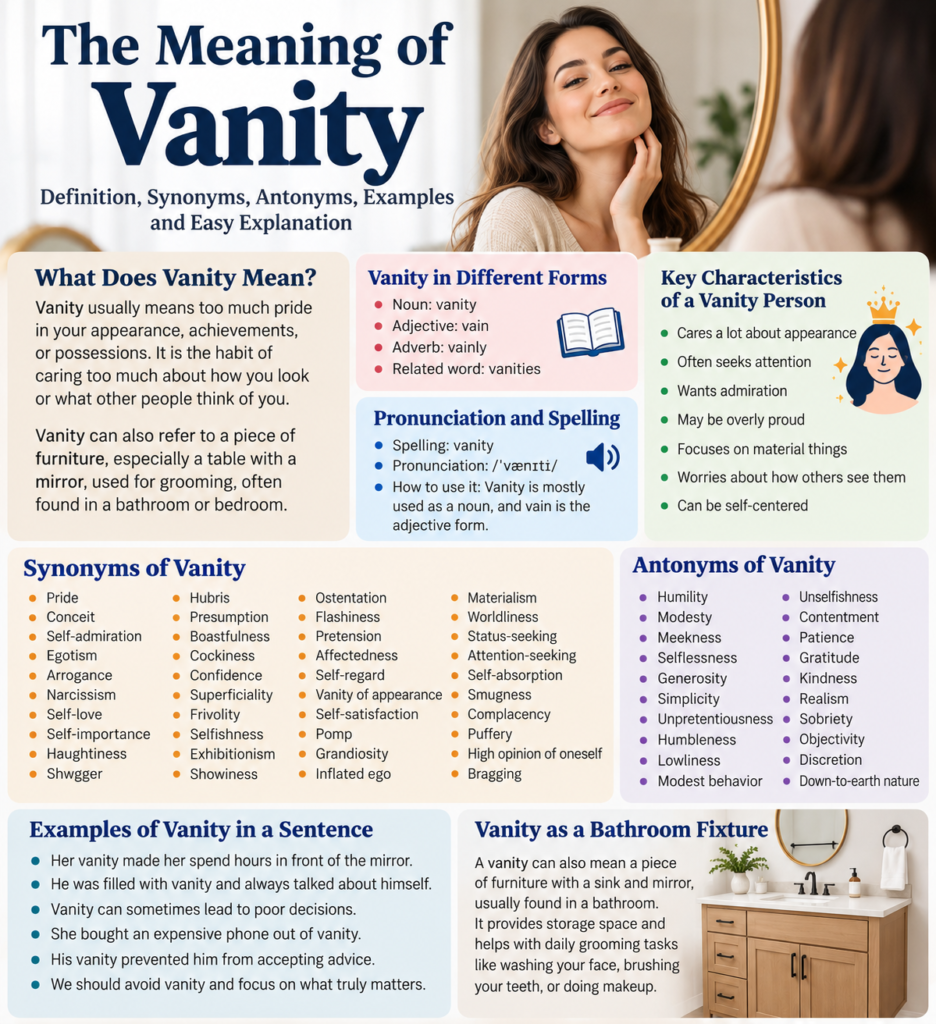
Vanity is excessive pride in your appearance, abilities, possessions, achievements, or personal importance. It often involves caring too much about how other people see you or wanting them to admire you.
The word usually has a negative meaning when it describes a personality trait. It suggests that someone’s attention to their image or importance has become excessive.
Vanity meaning in simple English
In simple English, vanity means thinking too highly of yourself or caring too much about looking impressive in the eyes of others.
For example:
- A person who spends every conversation talking about their beauty may show vanity.
- Someone who expects praise for every small achievement may be vain.
- A manager who believes that nobody else is intelligent enough to make decisions may display vanity and arrogance.
Vanity does not always involve physical appearance. It can also concern intelligence, wealth, education, popularity, professional success, or social status.
What does the word vanity mean in different contexts?
The meaning of vanity can change slightly depending on how it is used.
1. Vanity as excessive self-admiration
This meaning describes someone who thinks too highly of their appearance or personal qualities.
Example: His vanity made him believe that everyone admired his appearance.
2. Vanity as excessive pride
Vanity can describe someone who is overly proud of achievements, abilities, or status.
Example: Her vanity grew after she received public recognition for her work.
3. Vanity as a desire for attention
The word can describe a strong need for compliments, approval, or admiration.
Example: He accepted the award mainly to satisfy his vanity.
4. Vanity as something futile or pointless
In formal, literary, or religious contexts, vanity can also mean emptiness, worthlessness, or the temporary nature of worldly success.
Example: The novel explores the vanity of chasing wealth without finding personal happiness.
This last meaning is important because not every use of vanity refers to an arrogant person. In some sentences, it describes an effort or ambition that has little lasting value.
Also Read: 200+ Synonyms for Devious: Meaning, Definition, Examples, and Antonyms
Best Synonyms of Vanity
The best synonym for vanity depends on the meaning you want to express. Conceit is a close general alternative when vanity means an excessively high opinion of yourself. Arrogance emphasizes superiority over other people, while narcissism emphasizes excessive self-focus and admiration.
Here are useful alternatives organized by meaning.
Synonyms related to excessive pride
- Conceit — An excessively high opinion of yourself. Example: His conceit made him reject helpful advice.
- Arrogance — The belief that you are better or more important than others. Example: Her arrogance damaged relationships with her coworkers.
- Egotism — Excessive focus on your own importance and achievements. Example: His egotism made every discussion about him.
- Vainglory — Excessive pride in personal success or accomplishments. Example: The leader’s vainglory mattered more to him than public service.
- Haughtiness — A proud attitude that treats others as inferior. Example: Her haughtiness made new employees uncomfortable.
- Hubris — Excessive pride or confidence that can lead to mistakes or failure. Example: The athlete’s hubris prevented him from preparing properly.
- Pompousness — An exaggerated display of importance or dignity. Example: His pompousness made a simple meeting unnecessarily formal.
- Self-conceit — An inflated opinion of your own abilities or qualities. Example: Self-conceit stopped him from recognizing his weaknesses.
- Superciliousness — A superior attitude that suggests contempt for others. Example: The critic’s superciliousness offended the audience.
- Smugness — Excessive satisfaction with yourself, often displayed in an irritating way. Example: His smugness disappeared when the results were announced.
- Overconfidence — More confidence than a situation justifies. Example: Overconfidence caused the team to underestimate its competitors.
- Cockiness — An overly confident, often annoying attitude. Example: His cockiness made the victory especially satisfying for his opponents.
- Presumption — Unjustified confidence or an excessive willingness to assume importance or privilege. Example: Her presumption surprised people who barely knew her.
- Self-importance — An exaggerated belief in your own value or status. Example: His self-importance made him expect special treatment.
- Pridefulness — A tendency toward excessive pride. Example: Pridefulness made it difficult for her to accept criticism.
- Superiority — A belief or attitude that you are better than other people. Example: He spoke with an unpleasant sense of superiority.
- Grandiosity — An exaggerated sense of personal importance, power, or ability. Example: His grandiosity appeared in his unrealistic promises.
- Vaunting — Excessive boasting or display of one’s achievements. Example: The speech relied on vaunting rather than useful information.
- Self-satisfaction — Pleasure in your own qualities or accomplishments, sometimes excessive. Example: His self-satisfaction kept him from improving.
- Vainness — The quality of being excessively concerned with your appearance or importance. Example: Her vainness became obvious whenever attention shifted away from her.
Synonyms related to self-admiration
- Self-admiration — Excessive appreciation of your own appearance or qualities. Example: His constant mirror checks suggested strong self-admiration.
- Self-regard — The opinion you have of your own worth; in excess, it can suggest vanity. Example: Her excessive self-regard made teamwork difficult.
- Self-love — Affection or appreciation for yourself, which may be healthy or excessive depending on context. Example: Healthy self-love differs from vanity because it does not require constant praise.
- Self-worship — Extreme admiration of yourself. Example: The character’s self-worship left little room for humility.
- Self-glorification — Presenting yourself as unusually admirable or important. Example: His memoir became an exercise in self-glorification.
- Self-exaltation — Raising your own status or praising yourself excessively. Example: The speech focused on self-exaltation instead of shared success.
- Self-praise — Speaking favorably about your own qualities or achievements. Example: Her presentation included too much self-praise.
- Self-adulation — Excessive admiration of yourself. Example: His self-adulation made genuine feedback difficult to accept.
- Self-celebration — Focusing excessively on your own success or importance. Example: The announcement sounded more like self-celebration than gratitude.
- Self-congratulation — Praising yourself for something you have done. Example: His self-congratulation began before the project was complete.
- Self-esteem — Your sense of personal worth; it is not inherently a synonym for vanity. Example: Strong self-esteem helped her accept both praise and criticism.
- Self-assurance — Confidence in yourself and your abilities. Example: Her self-assurance came from years of practice.
- Self-confidence — Belief in your own abilities. Example: His self-confidence helped him speak clearly during the interview.
- Self-satisfaction with appearance — Excessive pleasure in how you look. Example: Her concern with appearance sometimes developed into self-satisfaction.
- Self-obsession — An excessive preoccupation with yourself. Example: His self-obsession made him ignore his friends’ concerns.
Synonyms related to boasting and showing off
- Boastfulness — A habit of talking proudly about yourself. Example: Her boastfulness turned every conversation into a contest.
- Boasting — Making proud statements about your achievements or possessions. Example: His boasting about his salary annoyed his colleagues.
- Bragging — Talking too much about what you have done or own. Example: Constant bragging made the celebration uncomfortable.
- Braggadocio — Boastful talk, especially when it exaggerates courage or ability. Example: His braggadocio disappeared when he faced a real challenge.
- Vaunting — Making an exaggerated display of your own qualities or achievements. Example: The politician’s vaunting distracted from the issue.
- Grandstanding — Acting or speaking mainly to attract attention or admiration. Example: The manager’s grandstanding wasted time during the meeting.
- Self-aggrandizement — Trying to increase your own status or importance. Example: Critics viewed the announcement as self-aggrandizement.
- Self-promotion — Drawing attention to your achievements or abilities; it can be reasonable or excessive. Example: Professional self-promotion becomes vanity when honesty gives way to exaggeration.
- Swagger — An exaggerated display of confidence or importance. Example: He entered the room with a swagger that demanded attention.
- Showboating — Performing or behaving in a way designed to attract attention. Example: The player was criticized for showboating after every point.
- Bluster — Loud, forceful talk intended to impress or intimidate. Example: His bluster concealed his lack of preparation.
- Bravado — A bold or confident display that may hide fear or uncertainty. Example: His bravado faded when he had to answer questions.
- Ostentation — A showy display of wealth, status, or luxury. Example: The mansion’s ostentation impressed some guests and annoyed others.
- Flashiness — A conspicuous style intended to attract attention. Example: The outfit’s flashiness drew attention away from the speaker.
- Showiness — The quality of being designed to attract attention. Example: The design favored showiness over practicality.
- Self-advertisement — Promoting yourself to gain attention or recognition. Example: The interview felt like self-advertisement rather than a discussion of the work.
- Image-consciousness — Strong concern about how other people perceive you. Example: His image-consciousness influenced every public decision.
- Attention-seeking — Behavior intended to attract notice or approval. Example: Her attention-seeking behavior interrupted the discussion.
- Name-dropping — Mentioning famous or influential people to impress others. Example: His name-dropping made the conversation feel forced.
- Peacocking — An attention-grabbing display intended to make someone appear impressive or attractive. Example: His peacocking at the party seemed designed to win attention.
Synonyms related to self-centeredness
- Self-centeredness — Focusing mainly on your own needs, feelings, or interests. Example: His self-centeredness made it difficult to plan as a group.
- Self-absorption — Being deeply occupied with your own thoughts and concerns. Example: Her self-absorption left little time for other people’s problems.
- Egocentrism — Seeing situations mainly from your own point of view. Example: Egocentrism made compromise difficult.
- Egoism — Giving excessive importance to your own interests. Example: His egoism affected every major decision.
- Selfishness — Caring more about your own needs than other people’s needs. Example: Her selfishness became clear when she refused to share credit.
- Self-involvement — Being excessively occupied with your own affairs. Example: His self-involvement prevented him from noticing the team’s difficulties.
- Self-preoccupation — Spending too much attention on your own concerns. Example: Self-preoccupation made her less aware of the people around her.
- Self-obsession — An unusually strong focus on yourself. Example: His self-obsession affected his friendships.
- Me-first attitude — A habit of putting your own wants before everyone else’s. Example: His me-first attitude caused repeated arguments.
- Self-interest — Concern for your own benefit; it is not necessarily negative. Example: Her decision served her self-interest without harming anyone.
- Self-serving behavior — Actions mainly intended to benefit yourself. Example: His self-serving behavior damaged the team’s trust.
- Narcissism — Excessive self-focus and a strong need for admiration in everyday usage. Example: The character’s narcissism made him dependent on compliments.
- Narcissistic pride — Pride centered on an inflated view of yourself. Example: His narcissistic pride made disagreement feel like a personal attack.
- Egocentricity — The quality of focusing excessively on your own perspective. Example: Egocentricity prevented her from understanding the other side.
- Self-absorption in appearance — Excessive attention to how you look. Example: His self-absorption in appearance left him constantly checking photographs.
Also Read: 150+ Synonyms of Impression With Meanings, Examples & Antonyms
Synonyms related to pretension and social superiority
- Pretentiousness — Trying to seem more important, cultured, or impressive than you are. Example: The speech’s pretentiousness made its message less effective.
- Pretension — A claim or display of importance, knowledge, or sophistication that may be exaggerated. Example: The restaurant had elegance without pretension.
- Affectation — Artificial behavior or style adopted to impress others. Example: Her exaggerated accent sounded like an affectation.
- Snobbery — Treating people as inferior because of their background, tastes, or status. Example: His snobbery showed when he mocked inexpensive clothing.
- Elitism — The belief that a select group is superior or deserves special influence. Example: Critics accused the club of elitism.
- Uppishness — An attitude suggesting that you consider yourself socially superior. Example: His sudden uppishness surprised his old friends.
- Pomp — An impressive or elaborate display of dignity or status. Example: The ceremony’s pomp overshadowed its purpose.
- Pomposity — Behavior that makes someone seem excessively important or dignified. Example: The speaker’s pomposity distracted the audience.
- Imperiousness — An overbearing manner that expects obedience. Example: Her imperiousness made collaboration difficult.
- Supercilious pride — Pride expressed through a dismissive or superior attitude. Example: His supercilious pride made him dismiss reasonable suggestions.
- Condescension — Speaking or behaving as if others are less intelligent or capable. Example: His condescension offended the new employees.
- Haughtiness of manner — A proud manner that treats others as inferior. Example: Her haughtiness of manner discouraged questions.
- Snobbishness — Behavior that expresses a sense of social or cultural superiority. Example: His snobbishness was obvious when he judged people’s hobbies.
- Social pretension — Trying to appear more important or socially prominent than you are. Example: The event was filled with social pretension.
- Grand airs — An exaggerated manner that suggests high status or importance. Example: He put on grand airs after receiving a promotion.
Synonyms related to appearance, wealth, and status
- Vanity about appearance — Excessive concern with physical attractiveness. Example: Her vanity about appearance made her anxious about every photograph.
- Personal vanity — Excessive pride in your own qualities or image. Example: Personal vanity influenced his choice of clothes.
- Fashion vanity — Excessive concern with looking fashionable or impressive. Example: Fashion vanity led him to value labels over comfort.
- Materialism — Placing excessive importance on money and possessions; not identical to vanity. Example: Her materialism made expensive brands seem essential to happiness.
- Ostentatiousness — The quality of making a showy display of wealth or status. Example: The room’s ostentatiousness made it feel overwhelming.
- Extravagance — Spending or behaving beyond what is necessary or reasonable. Example: His extravagance attracted attention but created financial problems.
- Display — A public presentation of something, sometimes intended to impress. Example: The display of expensive gifts seemed designed to provoke admiration.
- Flash — A showy or attention-grabbing style. Example: The car’s flash mattered more to him than its reliability.
- Swank — Stylish display or behavior associated with luxury and sophistication. Example: The club’s swank appealed to guests who valued status.
- Ostentatious pride — Pride expressed through an obvious display of possessions or achievements. Example: His ostentatious pride was clear in the way he displayed every award.
- Status-seeking — Trying to gain social importance or recognition. Example: Her status-seeking influenced the groups she joined.
- Status consciousness — Strong awareness of social rank and prestige. Example: Status consciousness shaped his choice of neighborhood.
- Image obsession — Excessive concern with maintaining a desired public image. Example: Image obsession prevented the celebrity from speaking openly.
- Vanity of wealth — Excessive pride in money or possessions. Example: The story explores the vanity of wealth without generosity.
- Luxury-seeking — A strong desire for expensive or prestigious goods; it is not automatically vanity. Example: His luxury-seeking became a way to impress his friends.
- Conspicuous consumption — Buying or displaying expensive items to signal wealth or status. Example: The family’s conspicuous consumption attracted attention in the small town.
- Status display — Using possessions, behavior, or symbols to communicate social standing. Example: The car became a status display rather than a practical purchase.
Synonyms related to futility and emptiness
These words fit a different meaning of vanity: the idea that something is futile, empty, or unlikely to produce a lasting result.
- Futility — The quality of being pointless or ineffective. Example: She eventually recognized the futility of arguing with someone who refused to listen.
- Uselessness — The state of being unable to achieve a useful result. Example: He realized the uselessness of repeating the same failed approach.
- Pointlessness — The quality of having no meaningful purpose or result. Example: The story highlights the pointlessness of pursuing revenge.
- Worthlessness — The quality of having little or no value. Example: The character began to question the worthlessness of his empty ambitions.
- Emptiness — A lack of meaning, fulfillment, or substance. Example: The novel explores the emptiness of a life devoted only to status.
- Fruitlessness — The failure to produce a desired result. Example: Their fruitlessness in seeking approval left them frustrated.
- Triviality — The quality of being unimportant or insignificant. Example: Time helped her see the triviality of the disagreement.
- Meaninglessness — The absence of purpose or significance. Example: He felt the meaninglessness of chasing praise from strangers.
- Foolish pride — Pride that leads someone to act unwisely. Example: Foolish pride stopped him from apologizing.
- Empty ambition — The pursuit of success without meaningful purpose. Example: The story criticizes empty ambition and the need for constant recognition.
Not all 112 expressions above are exact synonyms. Some are close alternatives, while others describe related attitudes, behaviors, or the separate meaning of vanity as futility. Choosing words by context is more accurate than treating every entry as interchangeable.
How to Choose the Right Synonym for Vanity
The right word depends on what the person is doing and what you want to emphasize.
| If you mean… | Consider using… |
| An inflated opinion of yourself | Conceit, self-conceit |
| Believing you are better than others | Arrogance, haughtiness |
| Excessive admiration of yourself | Self-admiration, narcissism |
| Talking too much about success | Boasting, bragging, boastfulness |
| Showing off wealth or luxury | Ostentation, conspicuous consumption |
| Acting to attract attention | Grandstanding, showboating |
| Trying to appear sophisticated | Pretentiousness, affectation |
| Ignoring other people’s needs | Self-centeredness, self-absorption |
| Excessive pride leading to mistakes | Hubris, overconfidence |
| An effort that has no useful result | Futility, pointlessness, fruitlessness |
What is the closest synonym for vanity?
Conceit is often a strong choice when vanity means having an excessively high opinion of yourself. However, self-admiration may be more accurate when the focus is appearance, and arrogance may fit better when someone treats others as inferior.
Consider these examples:
- “His vanity was obvious.” This is broad and does not explain the exact behavior.
- “His conceit made him believe he was always right.” This focuses on his opinion of himself.
- “His arrogance made him dismiss his colleagues.” This focuses on his treatment of others.
- “His boastfulness made every conversation about his achievements.” This focuses on his speech.
The more specific word often produces clearer writing.
Vanity vs. Similar Words: Important Differences
Several words are commonly used as synonyms of vanity, but their meanings differ in useful ways.
Vanity vs. pride
Pride can be positive, neutral, or negative. A person may feel proud after working hard, helping a neighbor, or completing a difficult project.
Vanity usually suggests excessive concern with personal admiration, appearance, or importance.
Example: “She felt pride in her work” expresses satisfaction. “Her vanity made her demand praise for every task” suggests an excessive need for admiration.
Vanity vs. conceit
Conceit emphasizes an inflated opinion of yourself. Vanity can include conceit but may focus more on appearance, reputation, or the desire to be admired.
Example: A conceited student believes they are more intelligent than everyone else. A vain student may care excessively about looking impressive or receiving compliments.
Vanity vs. arrogance
Vanity concerns excessive self-admiration. Arrogance concerns superiority and how someone treats other people.
Example: A person may spend hours trying to look attractive because of vanity. An arrogant person may openly dismiss someone else’s ideas because they believe their own judgment is superior.
Vanity vs. narcissism
In everyday English, narcissism often describes intense self-focus, self-admiration, or a strong need for attention. Vanity can describe similar behavior, particularly when appearance or reputation is involved.
However, narcissism also has a clinical meaning in mental health. Vanity alone is not enough to diagnose a personality disorder, and these terms should not be treated as medical equivalents.
Vanity vs. self-esteem
Self-esteem means how you value yourself. Healthy self-esteem allows you to recognize your strengths while accepting your limitations.
Vanity generally suggests excessive pride or dependence on admiration.
Example: A person with healthy self-esteem can accept criticism without losing confidence. A vain person may become upset when others fail to praise their appearance or achievements.
Vanity vs. pretentiousness
Pretentiousness involves trying to appear more sophisticated, knowledgeable, wealthy, or important than you really are. Vanity is broader and does not always involve pretending.
Example: Someone who constantly displays luxury goods may be vain. Someone who uses complicated words only to appear intelligent may be pretentious.
Vanity vs. egoism
Egoism concerns giving excessive importance to your own interests or needs. Vanity focuses more on self-admiration and personal image.
Example: An egoistic person may take the best opportunity for themselves without considering others. A vain person may focus on receiving praise for their achievements.
Vanity vs. hubris
Hubris is excessive pride or confidence that can lead to serious mistakes, especially when someone ignores limits or warnings.
Example: A business owner who refuses to listen to expert advice because they believe they cannot fail displays hubris. A person who frequently admires their appearance may be vain without showing hubris.
What Is the Opposite of Vanity?
The opposite of vanity depends on which part of its meaning you want to contrast.
If vanity means excessive pride, humility is a strong antonym. If it means an exaggerated opinion of yourself, modesty may fit. If it means excessive self-focus, selflessness may be more appropriate.
Common antonyms of vanity
- Humility — Recognizing your strengths without considering yourself superior.
- Modesty — Avoiding excessive claims about your appearance, abilities, or achievements.
- Humbleness — A humble attitude toward yourself and others.
- Selflessness — Caring about other people’s needs rather than focusing only on yourself.
- Unpretentiousness — Being natural and not trying to seem more important than you are.
- Simplicity — Avoiding unnecessary displays of status or luxury.
- Sincerity — Being genuine rather than trying to create a misleading impression.
- Authenticity — Presenting yourself honestly instead of building an artificial image.
- Gratitude — Appreciating what you have without believing you deserve constant admiration.
- Generosity — Giving to others instead of focusing only on personal gain.
- Self-awareness — Understanding your strengths, weaknesses, and behavior.
- Groundedness — Having a realistic view of yourself and your circumstances.
- Unassumingness — Not demanding attention or acting as though you are especially important.
- Consideration — Showing respect for other people’s feelings and needs.
- Humor about oneself — Being able to laugh at your own mistakes without taking your image too seriously.
These words are not exact opposites in every context. Humility is usually the clearest antonym for excessive pride, while selflessness is more suitable when vanity involves putting yourself ahead of everyone else.
Examples of Vanity in a Sentence
Seeing the word in context can help you understand how to use it naturally.
- His vanity made him check his reflection in every window.
- She recognized the vanity of trying to impress people who did not know her.
- The award increased his vanity, and he began taking all the credit.
- Her vanity prevented her from admitting that another employee had a better idea.
- The novel explores the vanity of wealth when it becomes the only measure of success.
- His public image mattered so much that vanity influenced nearly every decision.
- The coach warned the player that vanity could interfere with teamwork.
- She valued confidence but disliked vanity and unnecessary boasting.
- The character’s vanity led him to spend money he could not afford.
- Their conversation revealed the vanity of competing for approval.
- His vanity made him treat ordinary feedback as a personal insult.
- The story shows how vanity can damage friendships when admiration becomes more important than kindness.
The word can describe a person’s attitude, a pattern of behavior, or the futility of an action. The surrounding sentence makes the intended meaning clear.
Also Read: Synonyms of Cold: 150+ Alternatives to Improve Your English Vocabulary
What Does a Vain Person Look Like? Common Characteristics of Vanity
Vanity is not always easy to identify from one action. Enjoying fashion, appreciating compliments, or feeling proud of an achievement does not automatically make someone vain.
A repeated pattern of behavior is more informative than a single incident.
Common signs associated with vanity include:
- Constantly seeking compliments or approval.
- Frequently comparing appearance, wealth, popularity, or success with others.
- Exaggerating achievements to impress people.
- Becoming unusually upset when receiving criticism.
- Taking credit for shared accomplishments.
- Expecting special treatment because of perceived importance.
- Showing little interest in other people’s successes.
- Spending excessive time or money maintaining a desired image.
- Using possessions or status symbols mainly to gain admiration.
- Avoiding situations where personal weaknesses might become visible.
These characteristics are descriptive, not a formal test. They do not establish a person’s motives or indicate a mental health condition.
A person may care about appearance for professional, cultural, creative, or personal reasons without displaying unhealthy vanity. The key distinction is whether the desire for admiration becomes excessive and interferes with relationships, judgment, or everyday responsibilities.
Is Vanity Always a Bad Thing?
Vanity is usually negative when it means excessive self-admiration, but the broader topic requires some care.
Taking pride in your work, caring about your appearance, and wanting recognition are normal parts of life. The problem arises when admiration becomes more important than honesty, personal growth, or respect for others.
For example, a person who dresses carefully for a job interview may be preparing appropriately. Someone who believes they deserve the job solely because of their appearance may be showing vanity.
Similarly, sharing a professional achievement can be useful self-promotion. Repeatedly exaggerating that achievement to make others feel inferior is closer to conceit or arrogance.
A helpful way to distinguish confidence from vanity is to ask three questions:
- Can I recognize someone else’s strengths without feeling threatened?
- Can I accept reasonable criticism without treating it as an attack?
- Do I value my achievements even when nobody praises me?
Honest answers can help you reflect on whether your confidence is balanced or depends too heavily on outside approval.
Vanity in Everyday Life, Literature, and Culture
The word vanity appears in different settings, and its meaning may change with the context.
Vanity in everyday conversations
In everyday speech, vanity often describes excessive concern with appearance, popularity, or personal success.
Example: “His vanity made him turn every family gathering into a discussion about his career.”
The word may sound judgmental, so a more specific alternative can be better when you want to describe behavior without making a broad personal criticism.
Vanity in literature
Writers often use vanity to explore pride, social status, ambition, and the desire for recognition. A vain character may make poor decisions because protecting their image matters more than finding the truth.
For instance, a fictional ruler might reject sensible advice because admitting a mistake would damage their reputation. This behavior can connect vanity with arrogance, conceit, or hubris.
Vanity as a symbol of futility
In literary, philosophical, and religious writing, vanity may describe the temporary or empty nature of worldly pursuits.
In this sense, the phrase “the vanity of riches” can refer to the idea that wealth alone may fail to provide lasting meaning or satisfaction.
This usage differs from describing someone as vain about their appearance. Understanding the context prevents confusion between the two meanings.
Vanity as a Noun, Vain as an Adjective, and Related Word Forms
Understanding the different forms of vanity helps you use the word correctly in sentences.
Vanity
Vanity is a noun. It refers to excessive pride, self-admiration, or the quality of being vain. It can also mean futility in certain contexts.
Example: Her vanity made it difficult for her to accept honest feedback.
Vain
Vain is an adjective used to describe a person who has excessive pride in their appearance or qualities. It can also describe an effort that is unsuccessful or pointless.
Examples:
- He is too vain to admit that he made a mistake.
- They made a vain attempt to change his mind.
Notice that the second sentence does not describe pride. It uses the other meaning of vain: unsuccessful or futile.
Vainly
Vainly is an adverb that means doing something without success or acting in a vain manner.
Example: She vainly tried to convince him to reconsider his decision.
Vainness
Vainness is a noun that refers to the quality of being vain. Vanity is generally the more familiar word in modern English.
Example: His vainness became apparent when he repeatedly demanded compliments.
Vanities
Vanities is the plural form of vanity. Depending on the context, it can refer to different expressions of excessive pride or to things considered empty or unimportant.
Example: The book examines the vanities of fame and social status.
The word also has a practical meaning in home design: a vanity is a piece of furniture with a sink, mirror, or storage space, often found in a bathroom or bedroom.
What Is a Vanity in a Bathroom or Bedroom?
The word vanity does not always describe a personality trait. In home design, it refers to furniture intended for grooming, storage, or personal care.
Bathroom vanity definition
A bathroom vanity is a cabinet or furniture unit that typically supports a sink and provides storage for toiletries, cleaning supplies, and other bathroom essentials.
Common types include:
- Single-sink vanity: Designed for one sink and usually suited to smaller bathrooms.
- Double-sink vanity: Includes two sinks and is useful for shared bathrooms.
- Floating vanity: Mounted on the wall rather than resting directly on the floor.
- Freestanding vanity: A cabinet that stands on the floor.
- Corner vanity: Designed to fit into a corner and save space.
Bedroom vanity definition
A bedroom vanity is a table or dressing unit used for grooming, applying makeup, styling hair, and storing personal care products. It often includes a mirror, drawers, and a chair or stool.
Vanity makeup meaning
The phrase vanity makeup can refer to makeup products or the space used to apply them, depending on context. A makeup vanity is a dressing table or dedicated area with a mirror, lighting, and storage for cosmetics.
For example: “She organized her brushes and cosmetics on her makeup vanity.”
When someone searches for “what is a vanity,” they may be looking for a vocabulary definition or information about bathroom furniture. The surrounding words usually reveal which meaning they want.
How to Use Vanity and Its Synonyms in Better Writing
Choosing a precise word makes your writing clearer and more natural. Instead of replacing vanity with a random synonym, identify the specific behavior or idea you want to communicate.
1. Describe the behavior rather than labeling the person
Instead of writing, “He is vain,” you could write, “He repeatedly asks whether people admire his appearance.”
The second sentence gives readers specific information without relying on a broad judgment.
2. Match the word to the situation
Use conceit when you mean an inflated opinion of yourself. Use arrogance when the person acts superior to others. Use ostentation when someone makes a showy display of wealth.
These choices communicate more than a general reference to vanity.
3. Avoid confusing confidence with excessive pride
Confidence can help people make decisions, develop skills, and handle challenges. Vanity becomes a concern when the desire for admiration takes priority over realistic judgment or respect for others.
4. Consider the tone
Some alternatives are formal, some are conversational, and others are mainly used in literary writing.
| Word | Typical tone |
| Conceit | General and often critical |
| Arrogance | Direct and strongly negative |
| Bragging | Informal and conversational |
| Vainglory | Formal or literary |
| Hubris | Literary, academic, or analytical |
| Grandstanding | Critical and often political |
| Ostentation | Formal; often related to wealth |
| Self-absorption | Descriptive and critical |
| Modesty | Usually positive |
| Humility | Usually positive |
Using a word that fits both the meaning and tone helps your writing sound more natural.
Also Read: 100+ Synonyms of Actually to Improve Your English
Frequently Asked Questions About Vanity
What is the simplest definition of vanity?
Vanity is excessive pride in your appearance, abilities, achievements, possessions, or importance. It often involves wanting other people to admire you.
What is one word for vanity?
Conceit is one of the closest single-word synonyms when vanity refers to an exaggerated opinion of yourself. Other options include egotism, self-admiration, and arrogance, depending on the situation.
What is a good synonym for vanity in formal writing?
Conceit, egotism, vainglory, and self-aggrandizement can work in formal writing. Futility is appropriate when vanity means that something is pointless or ineffective.
What is the difference between vain and vanity?
Vanity is a noun, while vain is an adjective.
Example: “His vanity caused problems” uses the noun. “He is vain” uses the adjective. Vain can also mean unsuccessful, as in “a vain attempt.”
Is vanity the same as pride?
No. Pride can be a healthy feeling of satisfaction in your work, achievements, or identity. Vanity usually implies excessive pride or a strong desire for admiration.
What is the opposite of vanity in one word?
Humility is one of the best general antonyms for vanity when vanity means excessive pride. Modesty is another suitable choice, especially when discussing how someone presents their achievements or appearance.
Can vanity be positive?
The word vanity generally has a negative meaning when used to describe a personality trait. However, caring about your appearance, enjoying compliments, or feeling proud of your work is not automatically vanity. These behaviors become closer to vanity when admiration and image take excessive importance.
What does vanity mean in the Bible or religious writing?
In many biblical and religious contexts, vanity can refer to the emptiness, temporary nature, or futility of worldly pursuits. It may describe the limits of wealth, status, pleasure, or human ambition. The exact meaning depends on the passage and translation.
What does “all is vanity” mean?
“All is vanity” is an expression used to suggest that worldly achievements, possessions, or ambitions may be temporary or lack lasting meaning. In religious and philosophical contexts, it can encourage readers to think about what has genuine and lasting value.
What does “vanity of vanities” mean?
“Vanity of vanities” is a traditional biblical expression associated with Ecclesiastes. In this context, vanity is often understood as transience, emptiness, or the limits of human pursuits rather than simply excessive concern with appearance.
What does vanity mean in a sentence?
Vanity can describe excessive pride or futility.
Example of excessive pride: “His vanity made him seek praise after every accomplishment.”
Example of futility: “She eventually understood the vanity of trying to control every outcome.”
Is narcissism a stronger word than vanity?
Narcissism can suggest a broader or more intense pattern of self-focus and a need for admiration, particularly in everyday usage. However, the words are not interchangeable in every situation. Clinical narcissism has a specific meaning that cannot be established simply by observing vanity.
What is the difference between vanity and pretentiousness?
Vanity involves excessive pride or self-admiration. Pretentiousness involves trying to appear more impressive, sophisticated, knowledgeable, or important than you really are. Someone may be vain without pretending to possess qualities they do not have.
What does vanity mean in furniture?
In furniture, a vanity is a unit or table used for grooming and personal care. A bathroom vanity commonly includes a sink and cabinet storage, while a bedroom or makeup vanity usually includes a mirror and space for cosmetics or grooming products.
How do you spell vanity?
The correct spelling is vanity: V-A-N-I-T-Y. Its plural form is vanities, and its related adjective is vain.
What are common characteristics of a vain person?
Common signs may include excessive concern with appearance, frequent requests for praise, repeated boasting, exaggerated claims about achievements, and difficulty accepting criticism. These behaviors are not a diagnosis, and individual actions should be understood in context.
Is “self-esteem” another word for vanity?
No. Self-esteem refers to a person’s sense of worth. Vanity usually involves excessive pride or concern with admiration. A person can have healthy self-esteem without being vain.
What is the meaning of “vanity of riches”?
The phrase refers to the idea that wealth may be temporary, empty, or unable to provide lasting fulfillment. Here, vanity means futility or lack of lasting value rather than pride in one’s appearance.
Conclusion
Vanity can describe excessive pride in appearance, achievements, possessions, or personal importance. It can also refer to the futility of certain pursuits, especially in literary, philosophical, and religious contexts.
Useful synonyms include conceit, arrogance, egotism, self-admiration, vainglory, pretentiousness, and self-aggrandizement. Each word highlights a different aspect of the meaning. Humility and modesty are useful antonyms when vanity refers to excessive pride, while futility and pointlessness help express its separate meaning of something without lasting value.
The most effective way to choose another word for vanity is to consider the situation. Ask whether you are describing excessive pride, a desire for admiration, a superior attitude, a showy display, or an unsuccessful effort. Selecting the word that matches the intended meaning will make your writing more precise, natural, and easy to understand.