100+ Synonyms for Cruelty: Meanings, Examples, and Antonyms
Choosing the right word to describe cruel behavior can make a big difference in how clearly you communicate. Sometimes, the word cruel describes a hurtful comment. In other situations, it may refer to violence, emotional abuse, unfair treatment, or a complete lack of compassion.
Learning synonyms for cruelty helps you explain these situations with greater accuracy. For example, brutality describes extreme violence, while callousness refers to a lack of concern for other people’s feelings. Malice focuses on the desire to hurt someone, whereas oppression describes unfair control over a person or group.
This guide explains the cruel meaning in simple English and provides more than 100 synonyms and related words for cruelty. You will also discover other words for cruel people, examples of cruel words, useful antonyms, spelling tips, and practical advice for choosing the best synonym in everyday conversation, essays, stories, and professional writing.
What Is Cruelty? Definition and Meaning
Cruelty is behavior that causes unnecessary pain, suffering, or distress to another person or animal. It often involves a lack of kindness, sympathy, or concern for the well-being of others.
The cruelty definition can include physical harm, emotional suffering, verbal attacks, neglect, and unfair treatment. Cruelty may occur in personal relationships, schools, workplaces, communities, and larger social systems.
For example, deliberately humiliating a friend, mistreating an animal, or using authority to cause unnecessary suffering may be described as cruelty.
Here are three examples:
- The cruelty of the attack shocked the entire community.
- Emotional cruelty can damage a person’s confidence.
- The organization works to prevent cruelty toward animals.
Cruelty does not always involve physical violence. Hurtful words, repeated humiliation, threats, and neglect can also cause suffering.
What Does Cruel Mean?
Cruel is an adjective used to describe someone or something that causes pain or shows little concern for another person’s suffering.
Examples:
- The cruel man laughed at the injured animal.
- Her cruel remark hurt her friend’s feelings.
- It was cruel to make promises that she never intended to keep.
A cruel person may act out of anger, resentment, selfishness, or a desire to cause harm. However, the word can also describe behavior that is deeply unkind, even when the person’s exact intentions are unclear.
Cruelty, Cruel, and Cruelly: Key Differences
These related words have different grammatical functions.
| Word | Part of speech | Meaning | Example |
| Cruel | Adjective | Causing suffering or showing little compassion | That was a cruel joke. |
| Cruelty | Noun | Cruel behavior or the quality of being cruel | The cruelty of the decision upset everyone. |
| Cruelly | Adverb | In a cruel or unkind manner | He spoke cruelly to his classmate. |
| Cruelties | Plural noun | Multiple acts of cruel behavior | The book describes the cruelties of war. |
| Cruelness | Noun | The quality of being cruel | The character’s cruelness affected everyone around him. |
Cruelty is the more common noun in most everyday and formal writing. Cruelness is also a valid word, but it is less frequently used.
What Are the Best Synonyms for Cruelty?
If you need another word for cruelty, the best choice depends on the situation.
| Cruelty synonym | Meaning | Example |
| Brutality | Extreme violence or harsh treatment | The report exposed the brutality of the attack. |
| Harshness | Severe or unkind behavior | The harshness of his criticism discouraged the student. |
| Callousness | Lack of concern for others’ feelings | Her callousness hurt the family. |
| Heartlessness | Lack of kindness or compassion | His heartlessness surprised his friends. |
| Inhumanity | A shocking lack of compassion | The story revealed the inhumanity of the system. |
| Mercilessness | Refusal to show mercy | The ruler’s mercilessness frightened the people. |
| Malice | A desire to cause harm | His words were filled with malice. |
| Ruthlessness | Pursuing a goal without concern for the harm caused | The manager’s ruthlessness damaged team morale. |
| Mistreatment | Treating someone badly or unfairly | The organization investigates reports of mistreatment. |
| Oppression | Unfair or controlling treatment | The novel explores life under oppression. |
| Abuse | Harmful treatment or misuse of power | The charity supports survivors of abuse. |
| Sadism | Taking pleasure in another person’s suffering | The fictional villain displayed sadism. |
These words are related, but they are not interchangeable in every sentence. Use the word that describes the specific behavior you want to communicate.
Also Read: 100 Synonyms for Negatively With Meanings and Examples
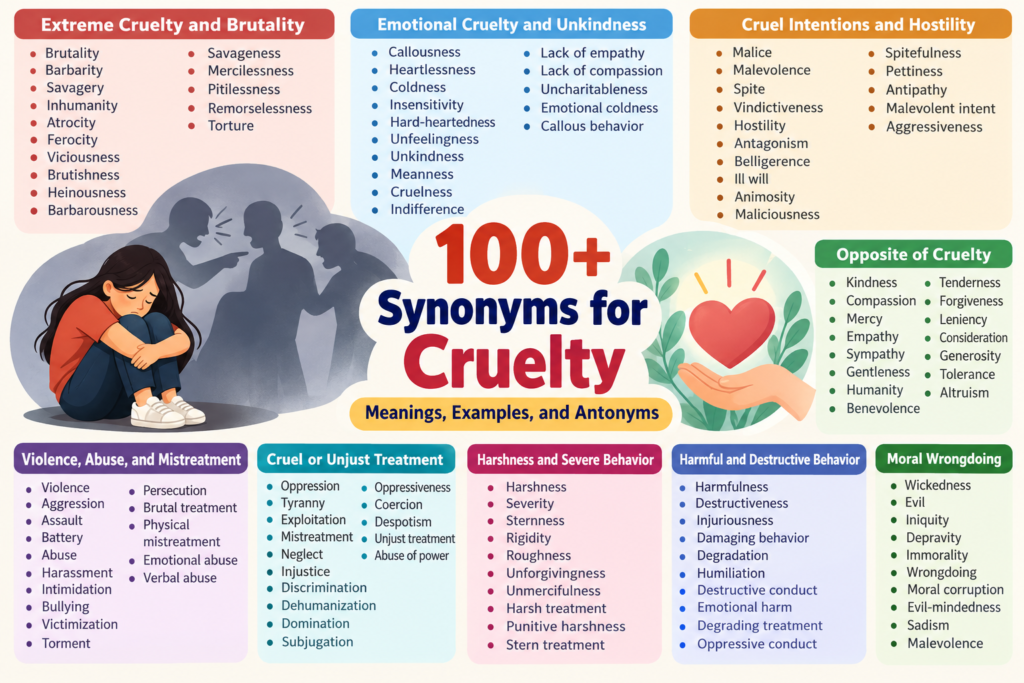
100+ Synonyms and Related Words for Cruelty
The following list includes direct alternatives, words describing harmful intentions, and terms connected to different forms of cruel behavior. Some words are closely related to cruelty rather than exact synonyms, so their meanings and contexts matter.
1. Synonyms for Extreme Cruelty and Brutality
These words are suitable for describing severe violence, shocking mistreatment, or extreme harshness.
| No. | Word | Meaning | Example |
| 1 | Brutality | Extreme violence or harsh treatment | The brutality of the attack shocked witnesses. |
| 2 | Barbarity | Extremely cruel or inhumane behavior | The report described acts of barbarity. |
| 3 | Savagery | Fierce or uncontrolled violence | The story explores the savagery of war. |
| 4 | Inhumanity | A lack of basic human compassion | The incident revealed the inhumanity of the system. |
| 5 | Atrocity | An exceptionally cruel or shocking act | The investigation documented an atrocity. |
| 6 | Ferocity | Intense aggression or force | The argument continued with unexpected ferocity. |
| 7 | Viciousness | A tendency toward severe hostility or harm | The viciousness of the attack frightened the community. |
| 8 | Brutishness | Rough, violent, or insensitive behavior | His brutishness made others uncomfortable. |
| 9 | Heinousness | The quality of being extremely wicked | The court condemned the heinousness of the crime. |
| 10 | Barbarousness | Extreme harshness or inhumanity | The writer criticized the barbarousness of the punishment. |
| 11 | Savageness | Extreme fierceness or violence | The account described the savageness of the battle. |
| 12 | Mercilessness | A refusal to show mercy | The enemy’s mercilessness caused widespread fear. |
| 13 | Pitilessness | A lack of pity for suffering | His pitilessness shocked the witnesses. |
| 14 | Remorselessness | A lack of regret after causing harm | Her remorselessness troubled the investigators. |
| 15 | Torture | Deliberately causing severe physical or mental suffering | The report examined allegations of torture. |
Atrocity is particularly useful when describing a shocking and exceptionally serious act. Brutality usually emphasizes violence, while inhumanity highlights the absence of compassion.
2. Words for Emotional Cruelty and Unkindness
These words help describe hurtful behavior that affects another person’s feelings, confidence, or emotional well-being.
| No. | Word | Meaning | Example |
| 16 | Callousness | Lack of concern for suffering | His callousness upset the grieving family. |
| 17 | Heartlessness | Lack of kindness or sympathy | Her heartlessness damaged their friendship. |
| 18 | Coldness | An unfriendly or emotionally distant attitude | His coldness made communication difficult. |
| 19 | Insensitivity | Failure to consider other people’s feelings | The remark showed insensitivity. |
| 20 | Hard-heartedness | Unwillingness to show sympathy | His hard-heartedness prevented him from helping. |
| 21 | Unfeelingness | Lack of emotional concern | The decision appeared to show unfeelingness. |
| 22 | Unkindness | Behavior that lacks kindness | Small acts of unkindness can hurt deeply. |
| 23 | Meanness | Unpleasant or hurtful behavior | His meanness made the classroom uncomfortable. |
| 24 | Cruelness | The quality of being cruel | The story explores the cruelness of revenge. |
| 25 | Indifference | Lack of interest or concern | Their indifference made the problem worse. |
| 26 | Lack of empathy | Difficulty understanding or caring about others’ feelings | His lack of empathy upset his colleagues. |
| 27 | Lack of compassion | Failure to care about suffering | The policy was criticized for its lack of compassion. |
| 28 | Uncharitableness | An unwillingness to give others the benefit of the doubt | Her uncharitableness caused unnecessary conflict. |
| 29 | Emotional coldness | Lack of emotional warmth | His emotional coldness made the relationship difficult. |
| 30 | Callous behavior | Actions that show little concern for others | The company’s callous behavior angered customers. |
Indifference and cruelty are not always the same. A person may be indifferent without intending to cause harm. Callousness is more appropriate when the person’s lack of concern contributes to another person’s suffering.
3. Words for Cruel Intentions and Hostility
These words describe negative feelings, harmful intentions, or hostile attitudes.
| No. | Word | Meaning | Example |
| 31 | Malice | A desire to cause harm | The message was written with malice. |
| 32 | Malevolence | A strong wish to cause harm or evil | The character’s malevolence shaped the story. |
| 33 | Spite | A desire to hurt someone out of resentment | She acted out of spite. |
| 34 | Vindictiveness | A strong desire for revenge | His vindictiveness prolonged the dispute. |
| 35 | Hostility | An unfriendly or aggressive attitude | Hostility made cooperation difficult. |
| 36 | Antagonism | Active opposition or hostility | Their antagonism affected the entire team. |
| 37 | Belligerence | A confrontational or aggressive manner | His belligerence prevented a peaceful discussion. |
| 38 | Ill will | Unfriendly feelings toward another person | There was considerable ill will between the rivals. |
| 39 | Animosity | Strong dislike or hostility | Years of animosity divided the families. |
| 40 | Maliciousness | The quality of being motivated by malice | The maliciousness of the rumor damaged her reputation. |
| 41 | Spitefulness | A tendency to hurt others out of resentment | His spitefulness made reconciliation harder. |
| 42 | Pettiness | Excessive concern with small grievances | Pettiness turned a minor disagreement into an argument. |
| 43 | Antipathy | A strong feeling of dislike | Their antipathy affected their working relationship. |
| 44 | Malevolent intent | An intention to cause harm | Investigators examined whether the action involved malevolent intent. |
| 45 | Aggressiveness | A tendency to act forcefully or confrontationally | His aggressiveness intimidated the other players. |
Malice describes a harmful intention, while cruelty focuses more directly on the suffering or treatment involved. A person may feel resentment without acting cruelly, so context is important.
4. Words for Violence, Abuse, and Mistreatment
These terms are useful when cruelty involves physical force, threats, harmful conduct, or the misuse of authority.
| No. | Word | Meaning | Example |
| 46 | Violence | Physical force used to cause injury or damage | The campaign promotes peace instead of violence. |
| 47 | Aggression | Forceful or hostile behavior | His aggression frightened the other players. |
| 48 | Assault | An attack or threatening conduct, depending on context | The report described an assault outside the building. |
| 49 | Battery | Unlawful physical contact in legal contexts | The case involved an allegation of battery. |
| 50 | Abuse | Harmful treatment or misuse of power | The center provides help to survivors of abuse. |
| 51 | Harassment | Unwanted conduct that disturbs, threatens, or targets someone | The company investigated the harassment complaint. |
| 52 | Intimidation | Using fear to control or influence someone | The witness reported intimidation. |
| 53 | Bullying | Repeated aggressive behavior involving a power imbalance | The school introduced rules against bullying. |
| 54 | Victimization | Unfairly targeting someone for harm or mistreatment | The policy aims to prevent workplace victimization. |
| 55 | Torment | Severe suffering or the act of causing it | The repeated teasing became a source of torment. |
| 56 | Persecution | Hostile or unfair treatment, often based on identity or beliefs | The family escaped persecution. |
| 57 | Brutal treatment | Extremely harsh or violent treatment | The report documented brutal treatment of detainees. |
| 58 | Physical mistreatment | Harmful treatment involving the body | The investigation examined allegations of physical mistreatment. |
| 59 | Emotional abuse | Behavior that harms another person’s emotional well-being | The counselor explained the effects of emotional abuse. |
| 60 | Verbal abuse | Hurtful or threatening language directed at someone | The employee reported repeated verbal abuse. |
Violence usually refers to physical force. Abuse is broader and can involve physical, emotional, or other forms of harmful treatment. Harassment often involves unwanted conduct, while persecution commonly describes targeted hostility against a person or group.
Also Read: 120+ Synonyms for Evaluation: Meanings, Examples, and How to Use Them
5. Words for Cruel or Unjust Treatment
These terms describe unfair control, exploitation, discrimination, or the misuse of power.
| No. | Word | Meaning | Example |
| 61 | Oppression | Unfair and controlling treatment | The book explores life under oppression. |
| 62 | Tyranny | Cruel or unjust use of power | The citizens protested against tyranny. |
| 63 | Exploitation | Taking unfair advantage of someone | The report examined worker exploitation. |
| 64 | Mistreatment | Treating someone badly or unfairly | The organization investigates mistreatment. |
| 65 | Neglect | Failure to provide necessary care | The inspection uncovered serious neglect. |
| 66 | Injustice | Lack of fairness or justice | The campaign sought to correct an injustice. |
| 67 | Discrimination | Unfair treatment based on a personal characteristic | The company addressed workplace discrimination. |
| 68 | Dehumanization | Treating people as if they lack human worth | The study examined the effects of dehumanization. |
| 69 | Domination | Controlling another person or group | The novel explores domination within the family. |
| 70 | Subjugation | Forcing someone into submission | The history describes the subjugation of a population. |
| 71 | Oppressiveness | A controlling or burdensome quality | The oppressiveness of the rules discouraged discussion. |
| 72 | Coercion | Forcing someone to act through pressure or threats | The agreement was challenged on grounds of coercion. |
| 73 | Despotism | Oppressive or arbitrary rule | The historian discussed the dangers of despotism. |
| 74 | Unjust treatment | Treatment that is unfair or unreasonable | Workers complained about unjust treatment. |
| 75 | Abuse of power | Using authority unfairly or harmfully | The investigation focused on the abuse of power. |
Oppression is especially useful when describing sustained or systematic control. Injustice is broader: something can be unfair without necessarily being cruel.
6. Words for Harshness and Severe Behavior
These words describe severe treatment, strict behavior, or a lack of willingness to forgive.
| No. | Word | Meaning | Example |
| 76 | Harshness | Severe or unkind behavior | The harshness of the criticism discouraged the student. |
| 77 | Severity | The degree of seriousness or strictness | The severity of the punishment raised concerns. |
| 78 | Sternness | A strict or serious manner | Her sternness helped maintain order. |
| 79 | Rigidity | An unwillingness to change or adapt | The rigidity of the rules caused problems. |
| 80 | Roughness | A forceful or unpleasant manner | The roughness of his response surprised the team. |
| 81 | Unforgivingness | Unwillingness to forgive mistakes | His unforgivingness damaged the relationship. |
| 82 | Unmercifulness | A refusal to show mercy | The story describes the unmercifulness of the ruler. |
| 83 | Harsh treatment | Treatment that is severe or unpleasant | The report examined the harsh treatment of workers. |
| 84 | Punitive harshness | Excessive severity in punishment | The school reconsidered its punitive harshness. |
| 85 | Stern treatment | Strict or severe treatment | The students objected to the stern treatment. |
Harshness is not automatically cruelty. Rules, criticism, or discipline can be firm without being cruel. The distinction depends on whether the behavior is justified, proportionate, and considerate of the people affected.
7. Words for Harmful and Destructive Behavior
These words focus on the damage caused by an action or situation.
| No. | Word | Meaning | Example |
| 86 | Harmfulness | The quality of causing harm | The study examined the harmfulness of the practice. |
| 87 | Destructiveness | The tendency to cause serious damage | The destructiveness of the conflict affected generations. |
| 88 | Injuriousness | The quality of causing injury or damage | The court considered the injuriousness of the conduct. |
| 89 | Damaging behavior | Conduct that causes harm | The manager addressed the damaging behavior. |
| 90 | Degradation | Treatment that reduces dignity or self-respect | The rules were criticized for causing degradation. |
| 91 | Humiliation | Making someone feel ashamed or inferior | Public humiliation damaged his confidence. |
| 92 | Destructive conduct | Actions that cause damage or suffering | The mediator addressed the destructive conduct. |
| 93 | Emotional harm | Damage to a person’s emotional well-being | Repeated insults can cause emotional harm. |
| 94 | Degrading treatment | Treatment that undermines dignity | The complaint described degrading treatment. |
| 95 | Oppressive conduct | Behavior that unfairly restricts or controls others | Employees challenged the oppressive conduct. |
These expressions may be more accurate than cruelty when you want to describe the result of an action rather than the intention behind it.
8. Words for Moral Wrongdoing
These terms are especially useful in literature, ethical discussions, and descriptions of serious misconduct.
Also Read: 100+ Synonyms for Already: Definitions, Examples, and Better Alternatives
| No. | Word | Meaning | Example |
| 96 | Wickedness | Serious moral wrongdoing | The novel explores the wickedness of the villain. |
| 97 | Evil | Profoundly immoral or harmful behavior | The story examines the struggle between good and evil. |
| 98 | Iniquity | Gross unfairness or immoral conduct | The speech condemned the iniquity of the system. |
| 99 | Depravity | A state of extreme moral corruption | The novel portrays the depravity of a corrupt leader. |
| 100 | Immorality | Behavior that violates moral principles | The essay discusses the immorality of exploitation. |
| 101 | Wrongdoing | An act that is wrong or improper | The investigation sought evidence of wrongdoing. |
| 102 | Moral corruption | A loss or distortion of ethical principles | The report examines moral corruption among officials. |
| 103 | Evil-mindedness | A tendency toward harmful or wicked intentions | The story portrays the villain’s evil-mindedness. |
| 104 | Sadism | Taking pleasure in another person’s suffering | The fictional character displays sadism. |
| 105 | Malevolence | A desire to cause harm or evil | The character’s malevolence becomes clear later. |
These terms are not all direct synonyms. Wickedness and evil make strong moral judgments, while wrongdoing can describe a specific improper act without suggesting extreme cruelty.
What Is Another Word for a Cruel Person?
If you are describing a person rather than the behavior itself, choose an adjective that matches their actions.
| Word | Meaning | Example |
| Cruel | Causing suffering or showing little compassion | The cruel supervisor insulted the staff. |
| Brutal | Extremely violent or harsh | The brutal attack frightened witnesses. |
| Ruthless | Willing to harm others to achieve a goal | The ruthless competitor ignored the consequences. |
| Callous | Unconcerned about others’ suffering | His callous response upset the family. |
| Heartless | Showing little kindness or sympathy | The heartless remark caused pain. |
| Malicious | Intended to cause harm | She received a malicious message. |
| Vicious | Fiercely aggressive or harmful | The vicious rumor damaged his reputation. |
| Sadistic | Finding pleasure in another person’s suffering | The fictional villain had sadistic tendencies. |
| Merciless | Showing no mercy | The merciless ruler punished his opponents. |
| Spiteful | Motivated by resentment or a desire to hurt | His spiteful comment ended the conversation. |
| Tyrannical | Exercising power in an oppressive way | The tyrannical leader restricted basic freedoms. |
| Inhumane | Lacking compassion for human suffering | The report criticized the inhumane conditions. |
| Unkind | Not considerate or kind | The unkind response upset her. |
| Vindictive | Eager to retaliate | The vindictive character sought revenge. |
| Abusive | Using harmful or cruel treatment | The employee reported abusive conduct. |
For everyday English, cruel, mean, unkind, heartless, and callous are useful choices. For formal writing, words such as malicious, oppressive, inhumane, and vindictive can communicate more specific meanings.
Remember that describing a person as cruel is a judgment about behavior. A single mistake or unkind comment does not necessarily establish someone’s overall character.
What Is the Opposite of Cruelty?
The opposite of cruelty is usually kindness or compassion. Other antonyms for cruel include gentle, merciful, considerate, sympathetic, and humane.
| Antonym | Meaning | Example |
| Kindness | Being friendly and considerate | Her kindness made the new student feel welcome. |
| Compassion | Concern for another person’s suffering | He showed compassion toward the injured animal. |
| Mercy | Choosing not to punish or harm someone when able to do so | The judge showed mercy. |
| Empathy | Understanding another person’s feelings | Empathy helped her understand his reaction. |
| Sympathy | Concern for someone facing difficulty | They expressed sympathy after the loss. |
| Gentleness | A mild and careful manner | The nurse treated the child with gentleness. |
| Humanity | Compassion and respect for human dignity | The volunteers acted with humanity. |
| Benevolence | A desire to do good for others | The organization supported the community through benevolence. |
| Tenderness | Warmth, care, and affection | She spoke to the child with tenderness. |
| Forgiveness | Letting go of resentment or the desire to punish | Forgiveness helped them rebuild trust. |
| Leniency | A willingness to be less strict or severe | The teacher showed leniency after hearing the explanation. |
| Consideration | Thoughtfulness toward other people’s needs | His consideration improved teamwork. |
| Generosity | Willingness to give or help | Their generosity provided food for families in need. |
| Tolerance | Willingness to accept differences | Tolerance encouraged respectful discussion. |
| Altruism | Concern for others’ welfare without focusing on personal gain | Her altruism inspired the volunteers. |
Severity Is to Leniency as Cruelty Is to What?
The most suitable answer is usually kindness or compassion.
Severity and leniency are opposites when discussing strictness or punishment. Cruelty and kindness contrast harmful behavior with considerate behavior, while cruelty and compassion contrast disregard for suffering with concern for it.
Examples:
- Severity versus leniency: The teacher reconsidered the severity of the punishment.
- Cruelty versus kindness: She responded with kindness instead of cruelty.
- Cruelty versus compassion: The caregiver treated the patient with compassion.
The exact antonym depends on the sentence. Mercy may be best when punishment is involved, while gentleness may be better when describing a person’s manner.
How to Choose the Best Synonym for Cruel
Finding a cruel synonym is easy with a thesaurus, but choosing the correct word requires understanding the context.
Identify the Type of Harm
For physical violence, brutality may be appropriate. For emotional indifference, callousness may be clearer. For unfair control, oppression may describe the situation more accurately.
Consider the Intention
Malice describes a desire to hurt someone, while cruelty emphasizes harmful behavior or treatment.
For example, “His malice was obvious” focuses on intention. “His cruelty was obvious” focuses on the nature of his behavior.
Match the Word to the Severity
Atrocity, torture, and brutality carry strong meanings. They should not be used simply to make a sentence sound dramatic.
For ordinary unkind behavior, meanness or harshness may be more appropriate.
Choose Words for Your Audience
Use simple vocabulary when writing for general readers. In academic, historical, legal, or professional writing, more specific terms may help explain what happened.
For example:
Simple: “The children experienced cruel treatment.”
More specific: “The investigation found evidence of neglect and abuse.”
Check the Grammar
Cruel is an adjective, cruelty is a noun, and cruelly is an adverb.
- Adjective: The decision was cruel.
- Noun: The decision showed cruelty.
- Adverb: He spoke cruelly.
A word that has a similar meaning may not fit the same grammatical position.
Also Read: 100+ Synonyms for Affirm With Meanings and Examples
Frequently Asked Questions About Cruelty Synonyms
What is the best synonym for cruelty?
The best synonym depends on the situation. Brutality describes extreme violence, callousness describes a lack of concern, and mistreatment describes harmful or unfair treatment more generally.
What is another word for cruel in English?
Common alternatives include mean, unkind, brutal, harsh, callous, heartless, merciless, and ruthless. Some are stronger than others, so select the word that fits the behavior.
What is the meaning of cruelty in English?
Cruelty means behavior that causes unnecessary pain or suffering or shows little concern for the distress of others. It can involve physical harm, emotional mistreatment, or neglect.
What is the difference between cruel and cruelly?
Cruel is an adjective that describes a person, action, or situation. Cruelly is an adverb that describes how an action is performed.
For example, “a cruel remark” uses cruel as an adjective, while “she spoke cruelly” uses cruelly as an adverb.
What is the difference between cruelty and cruelness?
Both words refer to the quality of being cruel. Cruelty is more common and is generally preferred in formal and everyday writing.
What is another word for extreme cruelty or brutality?
Atrocity, barbarity, savagery, and inhumanity can describe extreme cruelty. The most appropriate choice depends on the seriousness and nature of the event.
What are some synonyms for cruelly?
Depending on the context, alternatives include harshly, viciously, mercilessly, heartlessly, maliciously, and unkindly. These words differ in intensity and meaning.
What is the opposite of cruel?
Common antonyms include kind, compassionate, gentle, merciful, humane, and considerate. Kind is a good general opposite, while compassionate emphasizes concern for suffering.
How do you spell cruel and cruelty?
Cruel is spelled C-R-U-E-L. Cruelty is spelled C-R-U-E-L-T-Y. Cruelly is spelled C-R-U-E-L-L-Y, and cruelties is the plural of cruelty.
Common misspellings include creul, creulty, cruelity, cruilty, and crulity. The correct spelling is cruel or cruelty, depending on the intended word.
What is another word for cruel or unjust treatment?
Mistreatment, abuse, oppression, exploitation, persecution, and injustice are useful alternatives. Oppression often involves unfair control, while exploitation means taking unfair advantage of another person.
What is the difference between cruelty and violence?
Violence generally involves physical force used to cause injury or damage. Cruelty can involve physical violence, but it can also include emotional harm, neglect, humiliation, and other forms of suffering.
What is cruelty in French?
The French noun for cruelty is cruauté. The adjective cruel is written cruel in masculine singular form and cruelle in feminine singular form.
Conclusion
Understanding synonyms for cruelty can help you describe harmful behavior with greater clarity and precision. Words such as brutality, harshness, callousness, malice, mistreatment, oppression, and inhumanity each highlight a different aspect of cruelty.
When searching for another word for cruel, consider whether you are describing physical violence, emotional pain, hostile intentions, or unjust treatment. The same word will not fit every situation.
It is also useful to understand the opposite of cruelty. Kindness, compassion, mercy, and empathy describe qualities that contrast with cruel behavior.
The goal of building vocabulary is not to use the longest or strongest word available. It is to select the word that expresses your meaning accurately, naturally, and respectfully.