100+ Synonyms for Already: Definitions, Examples, and Better Alternatives
Already is one of those small English words that can make a big difference in a sentence. It helps us explain that something has happened, a task is complete, or a situation is true before a particular time. It can also express surprise when something happens sooner than expected.
For example, consider the sentence, “I already sent the invitation.” The word already tells the reader that the invitation was sent before the present moment.
However, using the same word repeatedly can make your writing sound less varied. Learning synonyms for already can help you communicate more clearly in conversations, emails, school assignments, business reports, and other types of writing.
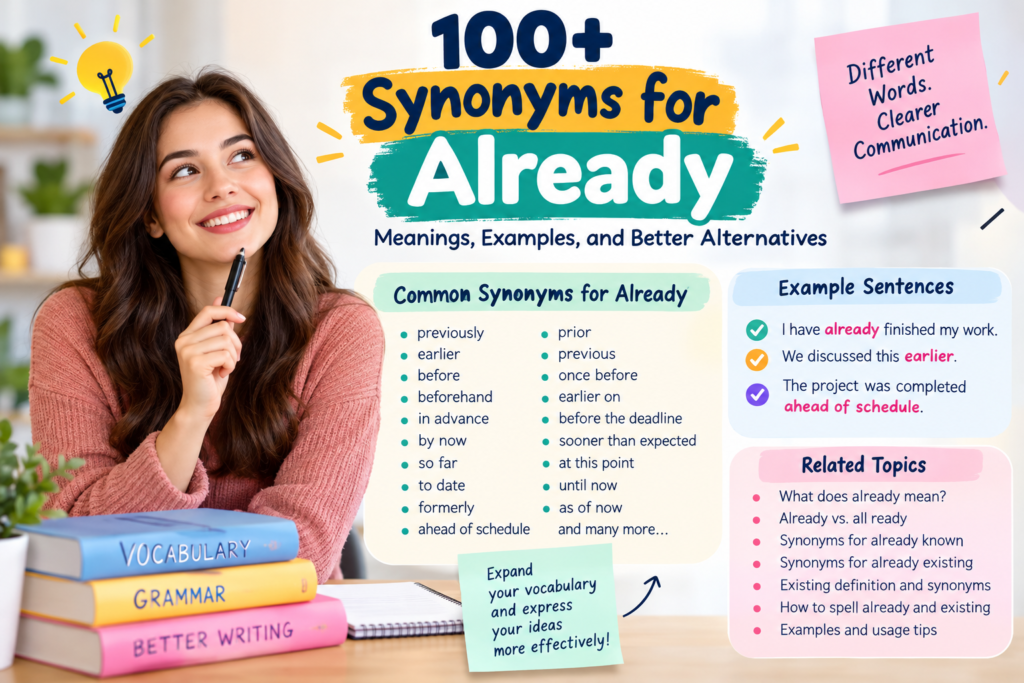
Some useful alternatives include previously, earlier, before, beforehand, and in advance. Other expressions, such as by now, so far, and ahead of schedule, work in specific situations. The important thing is to choose a replacement that preserves your original meaning.
In this guide, you will discover more than 100 relevant words and expressions, learn how to use them naturally, and understand the differences between already, existing, and all ready.
What Does Already Mean?
The definition of already is having happened before now or before a particular time. It can also indicate that something occurred earlier than expected.
Already is an adverb. It adds information about the timing or completion of an action or situation.
Here are some simple examples:
- I have already eaten breakfast.
- She already knows the answer.
- The guests had already arrived when we opened the doors.
- Are you home already?
In the first sentence, already shows that breakfast is finished. In the second, it tells us that the person has the knowledge now. In the third, it establishes which event happened first. In the final example, it may express surprise about an early arrival.
What Is the Best Synonym for Already?
There is no single synonym that fits every sentence. The right choice depends on what you want to emphasize.
| Synonym or expression | Best use | Example |
| Previously | An earlier event or experience | She previously worked in sales. |
| Earlier | A time before another point | We spoke earlier. |
| Before | An earlier occasion | I have visited that place before. |
| By now | Something expected to have happened | The package should be here by now. |
| Beforehand | Before a particular event | We discussed the plan beforehand. |
| In advance | Preparation before a future event | Please book in advance. |
| So far | Progress up to the present | So far, the results are positive. |
| To date | Progress up to now, often in reports | No changes have been reported to date. |
| Formerly | A past situation that may have changed | The building was formerly a school. |
| Ahead of schedule | Earlier than planned | The team finished ahead of schedule. |
These alternatives are related to already, but they do not all mean exactly the same thing. For example, previously refers to an earlier time, while ahead of schedule compares actual progress with a plan.
100+ Synonyms for Already With Meanings and Examples
The following alternatives are grouped by their meaning and purpose. Some are close synonyms, while others are expressions that can communicate a similar idea in the right context.
Also Read: 100+ Synonyms for Affirm With Meanings and Examples
1. Alternatives That Refer to an Earlier Time
These words and phrases are useful when describing something that happened before now or before another event.
- Previously — at an earlier time. Example: I previously worked for a small business.
- Earlier — before the present time or another event. Example: We discussed the issue earlier.
- Before — at a time preceding another event. Example: I have heard that story before.
- Formerly — in the past, often when a situation has changed. Example: The property was formerly a hotel.
- Prior — preceding something else. Example: Prior experience is helpful for this position.
- Prior to — before a specific event. Example: Please arrive prior to the interview.
- Previous — belonging to an earlier time or stage. Example: The previous owner kept the records.
- Preceding — coming before something else. Example: Read the preceding section.
- Pre-existing — present before a particular event or date. Example: The contract covers pre-existing agreements.
- In the past — during an earlier period. Example: We have faced similar challenges in the past.
- Earlier on — at an earlier point in time. Example: She explained the process earlier on.
- Once before — on one previous occasion. Example: I have tried this recipe once before.
- At an earlier time — at a previous point. Example: The document was reviewed at an earlier time.
- At a previous stage — during an earlier phase. Example: The team identified the problem at a previous stage.
- On an earlier occasion — during a previous event. Example: He mentioned the same concern on an earlier occasion.
- Previously mentioned — referred to earlier. Example: The previously mentioned policy remains in effect.
- Earlier stated — expressed at a previous point. Example: The earlier stated conditions still apply.
- Previously recorded — documented before now. Example: The previously recorded figures were checked.
- Previously reported — communicated in an earlier report. Example: The previously reported error has been corrected.
- At some point before — at an earlier but unspecified time. Example: We had discussed the option at some point before.
2. Alternatives That Emphasize Completion
Sometimes, the important point is not simply when something happened but whether a task or action is finished. In these situations, a sentence using a completion-related word may express the idea more naturally.
- Completed — brought to an end. Example: The application is completed.
- Finished — no longer in progress. Example: I finished the report yesterday.
- Done — completed or taken care of. Example: The paperwork is done.
- Accomplished — successfully achieved. Example: The team has accomplished its main goal.
- Fulfilled — satisfied a requirement or obligation. Example: She has fulfilled the requirements.
- Achieved — successfully reached a goal. Example: We achieved our target ahead of time.
- Finalized — brought to its final form. Example: The schedule has been finalized.
- Concluded — brought to an end. Example: The investigation has concluded.
- Settled — resolved or dealt with. Example: The outstanding bill has been settled.
- Resolved — successfully dealt with a problem. Example: The technical issue was resolved.
- Addressed — dealt with a concern or question. Example: We have addressed the main concerns.
- Handled — taken care of. Example: Your request has been handled.
- Processed — dealt with through the required steps. Example: The application has been processed.
- Carried out — performed or completed. Example: The inspection was carried out yesterday.
- Executed — performed or put into effect. Example: The plan was executed successfully.
- Performed — carried out an action. Example: The test has been performed.
- Delivered — provided or completed what was expected. Example: The team delivered the final report.
- Submitted — formally sent for consideration. Example: I submitted the documents before the deadline.
- Acquired — obtained or gained. Example: The company acquired the necessary equipment.
- Secured — successfully obtained or arranged. Example: We secured permission for the event.
These are related expressions rather than direct replacements for already. For example, completed describes the state of a task, whereas already tells us that something happened before a particular time.
3. Alternatives That Mean Earlier Than Expected
When an action happens sooner than planned, these expressions can communicate the timing more precisely.
- Early — before the expected time. Example: She arrived early.
- Ahead of time — before the expected moment. Example: We prepared the presentation ahead of time.
- Ahead of schedule — earlier than planned. Example: The project finished ahead of schedule.
- In advance — before a future event or deadline. Example: Please submit your request in advance.
- Beforehand — before a particular event. Example: We discussed the instructions beforehand.
- Sooner than expected — earlier than anticipated. Example: The results arrived sooner than expected.
- Earlier than planned — before the scheduled time. Example: The repairs ended earlier than planned.
- Ahead of the deadline — before the final due date. Example: She completed the assignment ahead of the deadline.
- Before the due date — earlier than the date something is required. Example: The payment arrived before the due date.
- Well before — considerably earlier than a specific time. Example: We arrived well before departure.
- In good time — early enough to avoid being late. Example: They reached the airport in good time.
- Before the scheduled time — earlier than the arranged time. Example: The meeting ended before the scheduled time.
- Earlier than anticipated — sooner than expected. Example: The shipment arrived earlier than anticipated.
- Ahead of plan — progressing faster than a plan anticipated. Example: The project is ahead of plan.
- Prearranged — arranged before an event. Example: We followed the prearranged schedule.
4. Alternatives That Describe Progress Up to Now
These expressions are particularly useful when discussing work, results, research, and ongoing activities.
- So far — up to the present moment. Example: The project has gone well so far.
- Thus far — up to this point, often in formal writing. Example: The findings have been consistent thus far.
- To date — up to the present time. Example: No major problems have occurred to date.
- Until now — up to the present moment, sometimes suggesting a change. Example: Until now, the process has been straightforward.
- Up to now — throughout the period ending at the present. Example: Everything has worked well up to now.
- Up until now — continuing through the present point. Example: Up until now, we have received no complaints.
- By this point — by the current stage. Example: By this point, the team had completed two phases.
- At this stage — at the present point in a process. Example: At this stage, we have enough information.
- At this point — at the current moment or stage. Example: At this point, the first phase is complete.
- As of now — at the present time. Example: As of now, the office remains open.
- As of today — on the current date. Example: As of today, the revised policy is in effect.
- Up to this point — through the stage being discussed. Example: Up to this point, the results have been encouraging.
- To this point — through the current stage. Example: To this point, the review has found no major issues.
- At present — currently. Example: At present, the system is working.
- Currently — at the present time. Example: The company currently offers three plans.
Remember that so far and to date focus on progress through a period, while already often emphasizes a completed action.
5. Alternatives Related to Preparation and Planning
Use these expressions when the context involves making arrangements or preparing something before it is needed.
- Prepared in advance — made ready beforehand. Example: The materials were prepared in advance.
- Arranged beforehand — organized before the event. Example: Transportation was arranged beforehand.
- Planned in advance — decided or organized earlier. Example: We planned the trip in advance.
- Organized beforehand — put in order before the relevant time. Example: The files were organized beforehand.
- Set up in advance — established or prepared early. Example: The account was set up in advance.
- Preplanned — planned before an event or action. Example: The team followed a preplanned route.
- Predetermined — decided or established beforehand. Example: The test uses predetermined criteria.
- Preapproved — approved before a later step. Example: The expenses were preapproved.
- Preselected — selected before the current stage. Example: The preselected options appeared on the screen.
- Previously scheduled — placed on a schedule earlier. Example: The previously scheduled appointment will continue.
- Previously agreed — agreed upon at an earlier time. Example: The previously agreed terms remain unchanged.
- Agreed upon earlier — settled during an earlier discussion. Example: The price was agreed upon earlier.
- Made ready beforehand — prepared before it was needed. Example: The room was made ready beforehand.
- Previously arranged — organized or agreed upon earlier. Example: The previously arranged visit went ahead.
- Settled beforehand — resolved before an event. Example: The disagreement was settled beforehand.
6. Alternatives Related to Knowledge and Awareness
When already describes knowing something, a time-related synonym may not be the best choice. You may need an expression that describes knowledge, understanding, or awareness.
- Previously known — known at an earlier time. Example: The previously known facts were reviewed.
- Known beforehand — known before a particular event. Example: The risks were known beforehand.
- Familiar with — having knowledge or experience of something. Example: I am familiar with the software.
- Aware of — having knowledge of something. Example: We are aware of the new requirements.
- Previously understood — understood earlier. Example: The previously understood rule was clarified.
- Recognized earlier — identified or acknowledged before now. Example: The pattern was recognized earlier.
- Learned before — acquired knowledge earlier. Example: We learned this rule before.
- Previously established — determined or accepted earlier. Example: The previously established guidelines still apply.
- Previously identified — recognized or named earlier. Example: The previously identified risks remain important.
- Known in advance — known before a particular event. Example: The date was known in advance.
7. Alternatives Related to Decisions and Confirmation
These expressions are useful when talking about decisions, reservations, permissions, or information that has already been checked.
- Decided earlier — chosen at a previous time. Example: We decided earlier to postpone the launch.
- Previously decided — settled before the current moment. Example: The previously decided changes will be implemented.
- Determined earlier — established or concluded earlier. Example: The cause was determined earlier.
- Previously confirmed — verified or approved before now. Example: The reservation was previously confirmed.
- Confirmed in advance — verified before an event. Example: The booking was confirmed in advance.
- Previously verified — checked and established as correct earlier. Example: The previously verified data was retained.
- Verified beforehand — checked before a particular event. Example: All details were verified beforehand.
- Previously approved — approved earlier. Example: The previously approved request can proceed.
- Authorized earlier — officially permitted before the current point. Example: The payment was authorized earlier.
- Agreed earlier — accepted during a previous discussion. Example: We agreed earlier to share the costs.
- Previously settled — resolved before the current time. Example: The previously settled matter was not reopened.
- Established earlier — created or determined previously. Example: The procedure was established earlier.
- Finalized earlier — brought to its final form at an earlier time. Example: The contract was finalized earlier.
- Previously arranged — organized before the present moment. Example: The previously arranged visit went ahead.
- Previously completed — finished during an earlier stage. Example: The previously completed assignment was reviewed.
The list contains more than 100 relevant words and expressions, but some are context-specific alternatives rather than exact synonyms. This distinction helps you select accurate language instead of replacing already with a word that changes your intended meaning.
Already vs. Previously vs. Before vs. Beforehand
These four expressions are often confused because they all relate to time.
| Word | Main purpose | Example |
| Already | Shows that something happened before now or an expected time | I have already eaten. |
| Previously | Refers to an earlier time or experience | She previously lived in Florida. |
| Before | Places an event earlier than another time or event | I have met him before. |
| Beforehand | Refers to preparation or action before a specific event | We planned everything beforehand. |
Consider the sentence, “I have already read this book.” You could say, “I have read this book before,” but the emphasis changes slightly. Already may suggest that reading is complete and no further action is needed. Before simply refers to an earlier reading experience.
Synonyms for Already Existing
The phrase already existing describes something that was present before a particular action, change, or event. It is commonly used in business, education, technology, and general writing.
For example:
- The company wants to improve its already existing website.
- The new rules will apply to already existing accounts.
- We need to consider the already existing arrangements.
In many sentences, existing alone is enough because it already communicates that something is present.
What Is the Definition of Existing?
Existing means being present, available, or in existence. It is the present participle of exist and can also function as an adjective.
Example: The company will update its existing software.
Here, existing describes software that is already in place.
Another Word for Existing
The best existing synonym depends on the context.
| Word | Meaning | Example |
| Current | Present or in effect now | Current policies remain in place. |
| Present | Found in a particular situation | The present system needs improvement. |
| Established | Created or accepted earlier | The established procedure will continue. |
| Pre-existing | Present before a particular event | Pre-existing agreements must be reviewed. |
| Available | Ready to be used or obtained | Existing resources are available to staff. |
| Extant | Still in existence; often formal | The extant records provide useful evidence. |
| Ongoing | Continuing at the present time | The ongoing project needs support. |
| Continuing | Remaining active or in progress | The continuing arrangement remains valid. |
| Operational | Working or functioning | The operational system needs an update. |
| In effect | Currently valid or applicable | The rules are already in effect. |
Existing vs. Pre-Existing
Existing describes something that is present now. Pre-existing highlights that it was present before a particular event or change.
For example:
- Existing customers can access the support service.
- Pre-existing contracts will remain valid after the merger.
The second sentence emphasizes the timing of the contracts in relation to the merger.
Also Read: 100+ Synonyms of Mentor With Meanings, Examples, and Usage Tips
Already vs. All Ready: Meaning and Examples
Already and all ready sound alike, but they have different meanings.
Already is an adverb that refers to timing or completion.
Example: I have already sent the email.
All ready means completely prepared.
Example: We are all ready to leave.
Compare these sentences:
- The guests are already here. They arrived before now.
- The guests are all ready. They are prepared to begin.
When checking the all ready definition, remember that the two-word phrase refers to readiness, not an earlier action.
How Do You Spell Already and Existing?
Correct spelling helps readers understand your writing and makes your content easier to search for.
How to Spell Already
The correct spelling is already: A-L-R-E-A-D-Y.
Common misspellings include alredy, alrady, alreadt, and alrready. These are errors rather than alternative spellings.
Example: I already have the information.
How to Spell Existing
The correct spelling is existing: E-X-I-S-T-I-N-G.
The word comes from exist with the ending -ing.
Exist + ing = existing.
Common misspellings include exsisting, exisiting, exhisting, and excisting.
Example: We need to review the existing policy.
Is Already One Word?
Yes. Already is one word when it refers to timing or completion.
Example: She has already left.
All ready is two words when it means completely prepared.
Example: The team is all ready for the presentation.
How to Use Already Naturally in Everyday English
Already appears in many everyday expressions. Understanding these phrases can help you use the word more naturally.
“I Already Have That”
The phrase “I already have that” means you possess something before the current moment.
Example: “Would you like me to send you another copy?”
“No, thank you. I already have that.”
Another natural option is “I have it already.” You could also say “I have it on hand” when you want to emphasize that something is available.
“I Already Used It”
This expression means you used something before now.
Example: “Can I use the discount code?”
“I already used it.”
Depending on the situation, you could say “I used it earlier” or “I have used it before.” These alternatives may emphasize a different aspect of the timing.
“I Already Did That”
The phrase “I already did that” means an action has been completed.
Example: “Please save your work.”
“I already did that.”
In American English, the simple past is common in this expression. The present perfect is also used in appropriate contexts: “I have already done that.”
“Did This Already”
The phrase “did this already” can be used in a question or statement, depending on the sentence.
Examples:
- Did I do this already?
- I did this already, so I do not need to repeat it.
The expression is common in everyday conversation, especially when someone is checking whether a task has been completed.
Practical Tips for Choosing a Synonym for Already
Before changing already to another word, consider what your sentence is trying to communicate.
Focus on the intended meaning
If you mean that something happened before now, previously or earlier may work. If you mean that an action happened before a planned event, beforehand or in advance may be more suitable.
Check the tense
Already is common with both the simple past and the present perfect in American English.
Examples:
- I already sent the message.
- I have already sent the message.
Both are natural. Previously often fits well when referring to past experience, while by now may express an expectation about the present.
Avoid unnecessary repetition
You do not need to replace every instance of already with a different word. Sometimes the clearest solution is to remove repeated timing information.
Instead of writing, “I already checked the report, and I already reviewed the figures,” you could write, “I checked the report and reviewed the figures.”
Match the expression to your audience
For everyday conversations, before, earlier, and by now are easy to understand. For formal writing, previously and to date may be appropriate. In project updates, ahead of schedule may communicate more precise information.
Also Read: 75+ Synonyms for Carefree: Meanings, Examples, and Better Words to Use
Frequently Asked Questions
1. What is another word for already?
Previously, earlier, and before are useful alternatives in sentences about past events. By now works when referring to an expected outcome, while beforehand is useful for actions that occur before another event.
2. What does already mean?
Already means that something has happened before now or before a particular time. It can also express that an action occurred sooner than expected.
3. What is the part of speech of already?
Already is an adverb. It modifies a statement by adding information about timing, completion, or expectation.
4. What are synonyms for already known?
Previously known, known beforehand, and recognized earlier can work in suitable contexts. Familiar with and aware of are also useful when describing someone’s knowledge or understanding.
5. What is another word for already existing?
Existing, current, established, and pre-existing are related expressions. Existing describes something present now, while pre-existing specifically emphasizes that it was present before a particular event.
6. Is already the same as yet?
No. Already commonly indicates that something has happened, while yet is often used in questions and negative statements to ask or explain whether something has happened by now.
Examples:
- Have you already finished?
- Have you finished yet?
- I have not finished yet.
7. Is already formal or informal?
Already is suitable for both formal and informal English. It is common in conversations, emails, professional reports, and academic writing.
8. What is the difference between already and all ready?
Already refers to timing or completion. All ready means completely prepared.
Example: “The team is already here” describes arrival, while “The team is all ready” describes preparation.
9. What are synonyms for enough?
Enough is not a synonym for already. Depending on context, alternatives for enough include sufficient, adequate, ample, and plenty.
Example: “We have enough time” can become “We have sufficient time.”
10. How do you use already in a sentence?
Place already before the main verb in many sentences, or after the verb be. It can also appear at the end of a sentence for emphasis.
Examples:
- I already know the answer.
- She is already home.
- We have finished already.
11. Can already be used in academic writing?
Yes. Already is appropriate in academic writing when its meaning fits the sentence. Previously, earlier, and to date may be better choices when discussing earlier studies or research progress.
12. What is the difference between already and formerly?
Already usually indicates that something happened before a particular time. Formerly describes a past state or role that may no longer be true.
Example: “The building was formerly a school” describes its past use, whereas “The school had already closed” describes when the closure occurred.
Conclusion
Learning synonyms for already can improve your vocabulary, make your writing more precise, and help you express timing naturally. Previously, earlier, before, and beforehand are useful alternatives, while expressions such as by now, so far, and ahead of schedule have more specific purposes.
It is also helpful to understand related terms such as existing, pre-existing, and all ready. Although these expressions may appear similar, their meanings and grammatical uses are different.
Rather than memorizing a long list and replacing words automatically, focus on the meaning of each sentence. The right expression is the one that communicates your intended message clearly and naturally.