100+ Synonyms for Scapegoat: Meanings, Examples, and Antonyms
Imagine that a team makes a costly mistake, but only one employee gets blamed. The decision involved several people, yet everyone points a finger at the same person. This employee becomes responsible for a problem they did not cause alone. In some cases, they may not have caused it at all.
This situation illustrates the meaning of a scapegoat.
Learning synonyms for scapegoat helps you describe unfair blame, false accusations, manipulation, and misplaced responsibility. Whether you are writing an essay, preparing a workplace report, improving your vocabulary, or speaking everyday English, the right word can make your message clearer.
However, not every word related to blame has the same meaning. A fall guy takes the blame for someone else, a patsy is easily tricked or manipulated, and a whipping boy repeatedly receives criticism or punishment. Understanding these differences will help you choose the most accurate expression.
In this guide, you will find more than 100 relevant words and expressions related to scapegoat, along with simple definitions, original example sentences, synonyms for blaming, scapegoating alternatives, antonyms, and answers to common vocabulary questions.
What Is a Synonym for Scapegoat?
A synonym for scapegoat is a word or expression that describes a person who is unfairly blamed or held responsible for a mistake, failure, or problem.
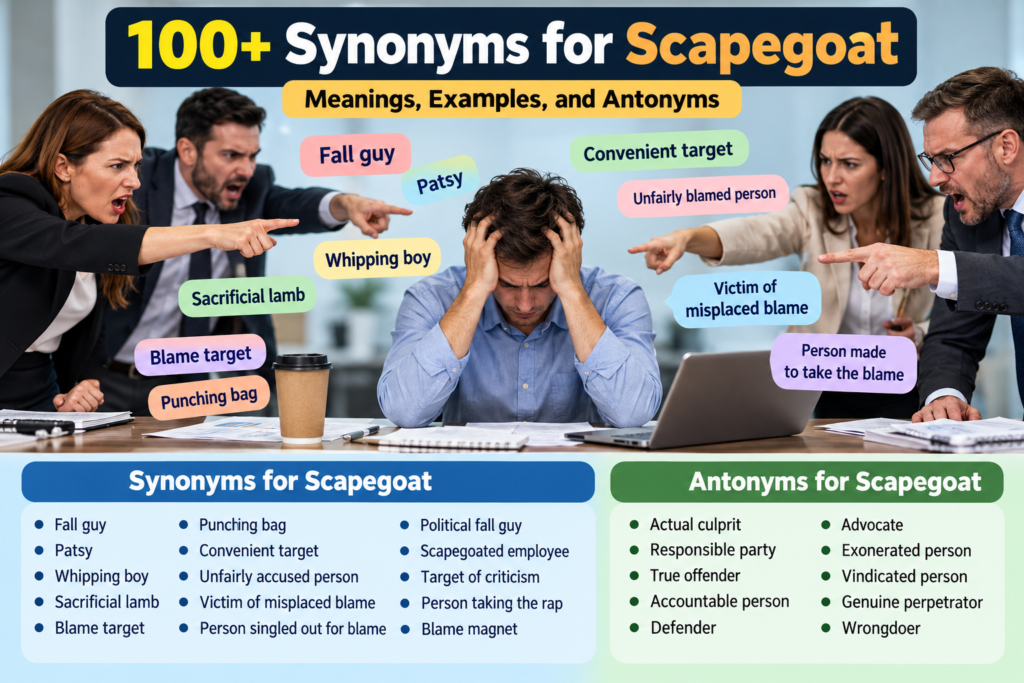
The best-known scapegoat synonyms include:
- Fall guy
- Patsy
- Whipping boy
- Sacrificial lamb
- Blame target
- Punching bag
- Convenient target
- Unfairly blamed person
- Victim of misplaced blame
- Person made to take the blame
For example, if a manager blames an employee for a failed project caused by poor planning across the company, the employee may become the manager’s fall guy.
The phrase victim of unfair blame is more formal and direct. Meanwhile, whipping boy works well when someone receives criticism repeatedly.
The most suitable synonym depends on the context, the tone of your writing, and whether you want to emphasize unfair blame, manipulation, punishment, or responsibility.
Scapegoat Definition, Meaning, and Synonyms
Before exploring the complete list, it helps to understand the word itself.
A scapegoat is a person or group unfairly blamed for something that has gone wrong. Often, the real causes are more complicated, or someone else is trying to avoid responsibility.
The word can be used as both a noun and a verb.
Scapegoat as a noun: The person who receives unfair blame.
Example: The assistant became the scapegoat for the director’s poor decision.
Scapegoat as a verb: To unfairly blame someone for a problem.
Example: The company should not scapegoat its employees for a policy failure.
Scapegoating as a noun: The act or process of placing unfair blame on someone.
Example: Scapegoating prevents a team from understanding what actually went wrong.
The spelling is scapegoat, written as one word. Scape goat and escape goat are common spelling errors when people search for the word.
1. The Best 25 Synonyms for Scapegoat With Meanings and Examples
These are among the most useful alternatives for everyday English, professional writing, and vocabulary development.
1. Fall guy
Meaning: Someone who takes the blame for another person’s mistake or wrongdoing.
Example: The director made the assistant the fall guy for the failed presentation.
2. Patsy
Meaning: A person who is easily tricked, controlled, or used by someone else.
Example: The dishonest contractor treated his business partner like a patsy.
3. Whipping boy
Meaning: Someone who repeatedly receives blame, criticism, or punishment.
Example: Whenever sales dropped, the newest employee became the team’s whipping boy.
4. Sacrificial lamb
Meaning: A person who is sacrificed to protect others or satisfy demands for accountability.
Example: The company dismissed one supervisor as a sacrificial lamb without investigating the wider problems.
Also Read: 200+ Synonyms for Devious: Meaning, Definition, Examples, and Antonyms
5. Blame target
Meaning: Someone who becomes the focus of other people’s blame.
Example: After the event was canceled, the booking manager became the blame target.
6. Punching bag
Meaning: A person who regularly receives anger, complaints, or criticism.
Example: The customer service team became a punching bag for complaints about a policy it did not create.
7. Convenient target
Meaning: Someone who is easy to blame, whether or not they are responsible.
Example: Because she was new to the department, she became a convenient target for everyone’s frustration.
8. Unfairly blamed person
Meaning: Someone held responsible for something they did not cause or do not deserve to be blamed for.
Example: The investigation cleared the unfairly blamed employee.
9. Victim of misplaced blame
Meaning: A person who suffers because responsibility is assigned incorrectly.
Example: The technician was a victim of misplaced blame after the equipment failed.
10. Person made to take the blame
Meaning: Someone pressured or forced to accept responsibility for another person’s actions.
Example: The junior employee was made to take the blame for a decision approved by senior management.
11. Target of blame
Meaning: The person toward whom accusations or criticism are directed.
Example: The committee needed a target of blame after the program failed.
12. Unfairly accused person
Meaning: Someone accused of wrongdoing without a fair or sufficient basis.
Example: The review revealed that the worker was an unfairly accused person.
13. Fall person
Meaning: A person who accepts blame when something goes wrong.
Example: The organization appeared to be searching for a fall person after the incident.
Note: Fall guy is the more established expression in American English.
14. Blame bearer
Meaning: Someone who carries responsibility or blame assigned by others.
Example: One employee became the blame bearer for a problem involving several departments.
15. Pawn
Meaning: Someone used by another person to achieve a particular goal.
Example: The official realized he had been a pawn in a larger political dispute.
16. Stooge
Meaning: Someone who acts for another person or allows themselves to be controlled by them.
Example: The dishonest executive treated the assistant as a stooge.
17. Puppet
Meaning: Someone whose actions are controlled by another person.
Example: Critics described the spokesperson as a puppet of the company’s leadership.
18. Dupe
Meaning: Someone who has been deceived or tricked.
Example: The customer was a dupe in a scheme designed to hide the real culprit.
19. Person under fire
Meaning: Someone facing strong criticism or accusations.
Example: The department head came under fire after the report was published.
20. Convenient scapegoat
Meaning: Someone selected to receive blame because it helps others avoid scrutiny.
Example: The junior manager became a convenient scapegoat for a decision made by the entire board.
21. Wrongly blamed individual
Meaning: A person incorrectly held responsible for a problem.
Example: The audit identified the wrongly blamed individual and corrected the official record.
22. Target of misplaced blame
Meaning: Someone blamed for an issue that has other causes.
Example: The technician became the target of misplaced blame after a system-wide outage.
23. Blamed employee
Meaning: A worker who receives responsibility or criticism for an incident.
Example: The blamed employee explained that the instructions had changed before the deadline.
24. Innocent party
Meaning: Someone who is not responsible for the wrongdoing in question.
Example: The inquiry established that the innocent party had followed the approved procedure.
25. Person singled out for blame
Meaning: Someone deliberately selected to receive criticism or responsibility.
Example: The report found that one worker had been singled out for blame despite shared responsibility.
2. More Scapegoat Synonyms and Similar Words
The following words describe related situations. Some are close synonyms, while others apply only when a particular detail is present.
| No. | Word or phrase | Meaning |
| 26 | Blame victim | Someone who suffers from unfair accusations |
| 27 | Blame magnet | A person who seems to attract criticism |
| 28 | Convenient fall guy | Someone selected to protect others from blame |
| 29 | Person taking the rap | Someone who accepts blame or punishment |
| 30 | Person left holding the bag | Someone left with the consequences or responsibility |
| 31 | Victim of a setup | Someone deliberately placed in a situation that makes them appear guilty |
| 32 | False suspect | Someone incorrectly suspected of wrongdoing |
| 33 | Misidentified culprit | Someone mistakenly identified as responsible |
| 34 | Unjustly accused individual | A person accused unfairly |
| 35 | Unjustly punished person | Someone punished without sufficient justification |
| 36 | Target of accusations | Someone facing accusations |
| 37 | Target of criticism | Someone receiving negative judgment |
| 38 | Person under attack | Someone facing strong opposition or criticism |
| 39 | Person in the firing line | Someone exposed to criticism or blame |
| 40 | Person blamed for others | Someone held responsible for other people’s actions |
| 41 | Scapegoated employee | A worker unfairly blamed for a failure |
| 42 | Scapegoated subordinate | A lower-ranking person blamed by someone above them |
| 43 | Blamed team member | A group member held responsible for a shared problem |
| 44 | Political fall guy | Someone blamed to protect political leaders or interests |
| 45 | Political target | Someone singled out in a political dispute |
| 46 | Public target of blame | Someone publicly held responsible |
| 47 | Victim of group blame | Someone blamed by a group |
| 48 | Target of group hostility | Someone who receives hostility from a group |
| 49 | Social outcast | Someone rejected by a community |
| 50 | Black sheep | A person viewed negatively or as different within a group |
| 51 | Outsider | Someone who does not belong to a group |
| 52 | Misfit | Someone who does not fit comfortably into a group |
| 53 | Mark | A person targeted for a trick or dishonest scheme |
| 54 | Tool | Someone used to serve another person’s interests |
| 55 | Instrument | A person used to achieve another person’s aims |
| 56 | Proxy | Someone acting on behalf of another person |
| 57 | Representative | Someone who acts or speaks for another person or group |
| 58 | Shield | Someone who protects others from criticism or consequences |
| 59 | Buffer | Someone who absorbs pressure or conflict between parties |
| 60 | Intermediary | Someone who stands between two people or groups |
| 61 | Casualty | Someone harmed by an event or conflict |
| 62 | Sufferer | Someone experiencing harm or distress |
| 63 | Victim of injustice | Someone treated unfairly |
| 64 | Person denied a fair hearing | Someone whose side of a dispute is not properly considered |
| 65 | Unjustly targeted person | Someone singled out unfairly |
| 66 | Target of hostility | Someone who receives anger or antagonism |
| 67 | Object of ridicule | Someone who becomes the focus of mockery |
| 68 | Object of contempt | Someone treated with disrespect or disdain |
| 69 | Person publicly blamed | Someone openly held responsible |
| 70 | Person carrying the blame | Someone bearing responsibility assigned by others |
Some entries are descriptive phrases rather than single-word dictionary synonyms. They are included because readers often need a clear alternative that fits a particular sentence.
For example, pawn describes manipulation, while person publicly blamed emphasizes how accusations are made. Neither automatically means the person is innocent, so use these expressions only when the context supports them.
3. Synonyms for Scapegoat by Situation
Choosing another word for scapegoat becomes easier when you consider the setting.
Informal synonyms for scapegoat
Use these expressions in conversations, personal stories, and casual writing:
Also Read: 150+ Synonyms of Impression With Meanings, Examples & Antonyms
- Fall guy
- Patsy
- Whipping boy
- Punching bag
- Blame magnet
- Stooge
- Pawn
- Person taking the rap
- Person left holding the bag
- Convenient target
Example: After the project failed, Daniel became the fall guy even though several people had approved the plan.
Formal synonyms for scapegoat
For reports, essays, and professional documents, clear descriptive expressions are often better than slang.
- Individual unfairly held responsible
- Person wrongly blamed
- Target of misplaced blame
- Unjustly accused individual
- Employee unfairly held accountable
- Person blamed for another’s actions
- Individual singled out for punishment
- Person held responsible without sufficient evidence
- Victim of an unfair accusation
- Person subjected to unjust blame
Example: The review concluded that the employee had been unfairly held responsible for a failure involving several departments.
Workplace synonyms for scapegoat
Workplace scapegoating can occur when a single employee receives blame for a failure caused by wider problems.
Useful alternatives include:
- Fall guy
- Blamed employee
- Scapegoated team member
- Convenient target
- Target of misplaced blame
- Unfairly blamed subordinate
- Person held responsible for a team failure
- Employee singled out for punishment
Example: Rather than examining its unrealistic deadlines, the company blamed one employee for the missed launch.
Political scapegoat synonyms
In politics, scapegoating may involve blaming an individual or group for a complex problem while overlooking other causes.
Related expressions include:
- Political fall guy
- Convenient political target
- Public target of blame
- Person blamed for a policy failure
- Target of political criticism
- Group unfairly blamed for a social problem
Example: The departing official became a political fall guy after the administration’s policy failed.
Political disagreement alone does not establish scapegoating. The term is most appropriate when the blame is unfair or distracts from other relevant responsibility.
4. Synonyms for Scapegoating and Blaming
Scapegoat refers to a person or the act of unfairly blaming someone. Scapegoating describes the process, while blaming is a broader term that can be fair or unfair.
Synonyms for scapegoating
These words and expressions describe actions related to unfair blame:
| Term | Meaning | Example |
| Unfair blaming | Assigning blame without a fair basis | Unfair blaming damaged trust within the team. |
| Blame shifting | Moving responsibility away from oneself | Blame shifting prevented an honest discussion. |
| Finger-pointing | Accusing others instead of solving a problem | The meeting became an exercise in finger-pointing. |
| Passing the buck | Avoiding responsibility by transferring it to someone else | The supervisor kept passing the buck. |
| False accusation | An incorrect claim that someone did something wrong | The false accusation damaged her reputation. |
| Misplaced blame | Responsibility assigned to the wrong person | The investigation uncovered misplaced blame. |
| Singling someone out | Selecting one person for special attention or criticism | The manager singled out a junior worker. |
| Smearing | Trying to damage someone’s reputation through harmful claims | The official accused his rival of smearing him. |
| Vilification | Portraying someone as deserving hatred or contempt | The debate turned into the vilification of a minority group. |
| Demonization | Portraying a person or group as evil or dangerous | Demonization replaced a serious discussion of the issue. |
| Unjust punishment | Punishment that is not deserved or fair | The employee challenged the unjust punishment. |
| Shifting responsibility | Transferring responsibility to someone else | Shifting responsibility concealed the underlying failure. |
| Misattribution of blame | Assigning fault to the wrong source | The review found a misattribution of blame. |
| Blame avoidance | Trying to escape responsibility | Blame avoidance slowed the investigation. |
| Making someone take the fall | Arranging for someone else to accept blame | The manager made the assistant take the fall. |
Synonyms of blame
If you are searching for a synonym for blame or another word for blaming, consider these options:
- Accuse
- Fault
- Criticize
- Condemn
- Reproach
- Censure
- Rebuke
- Denounce
- Hold responsible
- Find at fault
- Point the finger at
- Attribute fault to
- Call out
- Take to task
- Implicate
- Charge
- Disapprove of
- Find accountable
- Lay responsibility on
- Hold answerable
These words have different levels of intensity.
For example, criticize means to express disapproval, while condemn communicates stronger disapproval. Accuse means to claim that someone has done something wrong. Hold responsible focuses on accountability.
Example sentences:
- The supervisor criticized the team’s planning.
- The committee censured the official for violating its rules.
- The company accused the contractor of missing the deadline.
- The investigation held the supplier responsible for the defective materials.
These are synonyms of blame or related expressions, not all direct synonyms for scapegoat.
Synonyms for blaming someone unfairly
When you need to emphasize injustice, use expressions such as:
- Wrongly accusing
- Unfairly blaming
- Falsely accusing
- Unjustly holding responsible
- Pinning the blame on
- Shifting the blame onto
- Making someone take the fall
- Assigning misplaced blame
- Accusing without evidence
- Blaming someone for another person’s mistake
Example: The director pinned the blame on the assistant even though the director had approved the decision.
This is more specific than saying the director blamed the assistant because it suggests that responsibility was unfairly transferred.
5. Scapegoat Synonyms and Antonyms
People searching for a scapegoat synonym and antonym usually want to understand both the meaning of the word and its opposite.
Scapegoat does not have one perfect antonym. Its opposite depends on whether you mean someone who is actually responsible, someone who supports an innocent person, or someone who has been cleared of blame.
Antonyms for scapegoat
| Word or phrase | Meaning | Example |
| Actual culprit | The person who really caused the problem | Investigators identified the actual culprit. |
| True offender | Someone who genuinely committed the wrongdoing | The true offender was identified after the review. |
| Responsible party | The person or group genuinely responsible | The responsible party paid for the damage. |
| Wrongdoer | Someone who has actually done something wrong | The wrongdoer admitted the misconduct. |
| Genuine perpetrator | The person who carried out the harmful act | The inquiry identified the genuine perpetrator. |
| Accountable person | Someone who should answer for their actions | The accountable person explained the decision. |
| Defender | Someone who supports or protects another person | Her colleague became her defender. |
| Advocate | Someone who speaks in support of another person | The advocate challenged the unfair accusation. |
| Exonerated person | Someone officially cleared of blame or wrongdoing | The employee was exonerated after the investigation. |
| Vindicated person | Someone whose position or innocence is supported by later evidence | The worker was vindicated when the report was released. |
Three antonyms for scapegoat
If you need three quick answers, use:
- Actual culprit
- Responsible party
- True offender
These are contextual opposites, not exact dictionary antonyms. They describe a person who is genuinely responsible rather than someone who is unfairly blamed.
Scapegoat antonyms in sentences
- Instead of blaming an innocent employee, the company investigated and identified the actual culprit.
- The inquiry established that the contractor was the responsible party.
- The review identified the true offender and cleared the wrongly accused worker.
These examples show the difference between unfair blame and evidence-based responsibility.
Antonyms of scapegoating
The opposite of scapegoating is not always a single word. Depending on the situation, useful contrasting expressions include:
- Fair accountability
- Accurate attribution of responsibility
- Evidence-based judgment
- Just treatment
- Proper investigation
- Clearing an innocent person
- Holding the correct person accountable
- Recognizing shared responsibility
Example: Rather than scapegoating one worker, the company used evidence-based judgment to identify the actual causes of the failure.
6. Scapegoat vs. Similar Words: Important Differences
Understanding the differences between related terms helps you avoid choosing a word that changes your intended meaning.
Scapegoat vs. fall guy
Both describe someone who takes the blame for a problem, often to protect others.
Fall guy is more informal and commonly suggests that someone else has arranged for the person to accept the blame.
Example: The owner made his assistant the fall guy when the business failed.
Scapegoat vs. patsy
A patsy is someone who is tricked or manipulated. A scapegoat is someone who is unfairly blamed.
A person can be both if someone deceives them and later shifts the blame onto them.
Example: The criminal tricked the customer into carrying a package. The customer was a patsy. If the criminal then blamed the customer for the scheme, the customer also became a scapegoat.
Scapegoat vs. victim
Victim is a broad term for someone harmed by an action or event. Scapegoat specifically involves unfair blame.
Example: A person injured in an accident is a victim, but not necessarily a scapegoat.
Scapegoat vs. culprit
A culprit is someone believed to have caused a problem or committed wrongdoing. A scapegoat is unfairly blamed.
Example: The team initially blamed an innocent employee but later identified the actual culprit.
Scapegoat vs. suspect
A suspect is someone considered a possible participant in wrongdoing. Being a suspect does not prove guilt or automatically mean that someone is being scapegoated.
Example: Investigators questioned a suspect while collecting evidence and later identified another person as responsible.
Scapegoat vs. whipping boy
A whipping boy repeatedly receives blame or punishment. A scapegoat may be unfairly blamed for one incident or a series of incidents.
Example: Every time the team missed its target, the same worker became the whipping boy.
Scapegoat vs. sacrificial lamb
A sacrificial lamb emphasizes sacrificing someone to protect others or satisfy demands for accountability.
Example: The company dismissed one executive as a sacrificial lamb but did not address its deeper management failures.
Scapegoat vs. black sheep
A black sheep is someone considered different or disapproved of within a family or group. The term does not automatically mean that the person is unfairly blamed.
Example: His relatives considered him the black sheep because he chose a different career.
Also Read: Synonyms of Cold: 150+ Alternatives to Improve Your English Vocabulary
7. How to Use Scapegoat in a Sentence
Scapegoat can function as a noun or a verb. The related words scapegoated and scapegoating also appear frequently.
Scapegoat as a noun
- The new employee became the scapegoat for the department’s mistakes.
- The committee looked for a scapegoat after the project failed.
- The investigation revealed that the driver had been treated as a scapegoat.
- The coach refused to make one player the scapegoat for the team’s defeat.
- The public debate turned a small business into a scapegoat for a much wider problem.
Scapegoat as a verb
- The company should not scapegoat its workers for a policy failure.
- Leaders sometimes scapegoat outsiders when they face criticism.
- The report warned against scapegoating one department for a system-wide problem.
- Instead of scapegoating the technician, the team investigated the equipment failure.
- The manager scapegoated an assistant to avoid difficult questions.
Scapegoated as a word
Scapegoated describes someone who has been unfairly blamed.
Examples:
- The scapegoated employee received an apology.
- The report examined the treatment of scapegoated workers.
- Several scapegoated team members were cleared of responsibility.
Scapegoating in a sentence
Scapegoating describes the act or process of unfairly blaming someone.
Examples:
- Scapegoating prevents teams from identifying the real causes of failure.
- The organization introduced a review process to reduce scapegoating.
- Scapegoating an individual will not repair a faulty system.
8. How to Choose the Right Scapegoat Synonym
The right word depends on what you want to communicate.
| Intended meaning | Best choice |
| Someone takes the blame for another person’s mistake | Fall guy |
| Someone is manipulated or deceived | Patsy |
| Someone receives repeated criticism | Whipping boy |
| Someone is sacrificed to protect others | Sacrificial lamb |
| Someone is blamed unfairly at work | Unfairly blamed employee |
| Someone becomes the focus of criticism | Target of blame |
| Someone is accused without sufficient evidence | Unfairly accused person |
| Someone is used to achieve another person’s goal | Pawn |
| Someone receives constant anger or complaints | Punching bag |
| Someone is cleared of wrongdoing | Exonerated person |
| Someone genuinely caused the problem | Actual culprit |
| Someone is responsible for an offense | True offender |
For formal writing, a descriptive phrase such as person unfairly held responsible is often the clearest choice.
For casual conversation, fall guy, patsy, and punching bag can sound more natural.
9. Common Questions About Scapegoat Synonyms
What is another word for scapegoat?
Fall guy is a common informal alternative. Other options include patsy, whipping boy, sacrificial lamb, and blame target. Each emphasizes a slightly different kind of unfair blame or treatment.
What is the synonym of scapegoated?
Useful alternatives include unfairly blamed, wrongly accused, unjustly held responsible, singled out for blame, and made to take the fall.
What is another word for scapegoat informally?
Fall guy, patsy, whipping boy, and punching bag are useful informal expressions. Fall guy focuses on taking blame, while punching bag emphasizes repeated criticism.
What is a scapegoat synonym in formal English?
Person unfairly held responsible, individual wrongly blamed, and target of misplaced blame are suitable formal expressions.
Is scapegoat a noun or a verb?
It can be both. As a noun, it identifies a person or group unfairly blamed. As a verb, it means to unfairly blame someone. Scapegoating describes the process.
What is the synonym for scapegoating?
Related expressions include unfair blaming, blame shifting, finger-pointing, passing the buck, and assigning misplaced blame. The best choice depends on the situation.
What is the difference between scapegoating and blaming?
Blaming means assigning responsibility or fault. Scapegoating is a specific form of unfair blame, often involving someone who is selected to take responsibility for a wider problem.
What are the antonyms of scapegoat?
There is no single exact antonym. Actual culprit, responsible party, and true offender are useful contextual contrasts because they describe someone who is genuinely responsible.
What is another word for escape goat?
The standard word is scapegoat, written as one word. Escape goat is a common spelling mistake rather than a separate English expression.
What does political scapegoat mean?
A political scapegoat is a person or group unfairly blamed for a political, economic, or social problem. The term may apply when public attention is directed toward one target while other causes are ignored.
Can a whole group become a scapegoat?
Yes. A group can be unfairly blamed for a complex problem, even when the causes involve many people, policies, or circumstances.
What is the difference between a scapegoat and a dupe?
A scapegoat is unfairly blamed, while a dupe is deceived. Someone can be both if another person tricks them and then makes them take the blame.
Is scapegoat a negative word?
Yes. It generally suggests that blame has been assigned unfairly. However, the term should be used when the circumstances support that meaning rather than whenever someone receives criticism.
What is the one-word substitution for scapegoat?
Fall guy is a common informal substitute. Patsy may work when manipulation is involved, while victim is broader and does not necessarily mean someone has been blamed.
Conclusion
Learning synonyms for scapegoat gives you more precise ways to discuss unfair blame, manipulation, criticism, and responsibility. Fall guy, patsy, whipping boy, sacrificial lamb, and blame target are among the most useful alternatives, but each has its own meaning and tone.
For formal writing, phrases such as person unfairly held responsible and target of misplaced blame are often clearer. When discussing the opposite of scapegoat, expressions such as actual culprit and responsible party help distinguish unfair accusations from genuine accountability.
The key is to choose words that match the facts. Someone who receives criticism is not automatically a scapegoat, and someone accused of wrongdoing is not necessarily guilty or innocent. Clear language, fair judgment, and accurate descriptions make your writing stronger and your English more natural.