Synonyms of Loud: 200+ Words for Different Sounds and Situations
The word loud describes a sound that has a high volume or is easy to hear. It can refer to music playing through speakers, a person speaking across a room, a crowd cheering at a game, or a machine making an unpleasant noise.
However, not every loud sound is the same. A thunderous explosion sounds different from a shrill whistle. A noisy classroom creates a different feeling from a boisterous party. Choosing the right synonym helps you describe these differences more clearly.
Some words emphasize volume, while others describe pitch, sound quality, excitement, anger, or disturbance. The best synonym for loud depends on what you want readers to imagine.
What Is a Synonym for Loud?
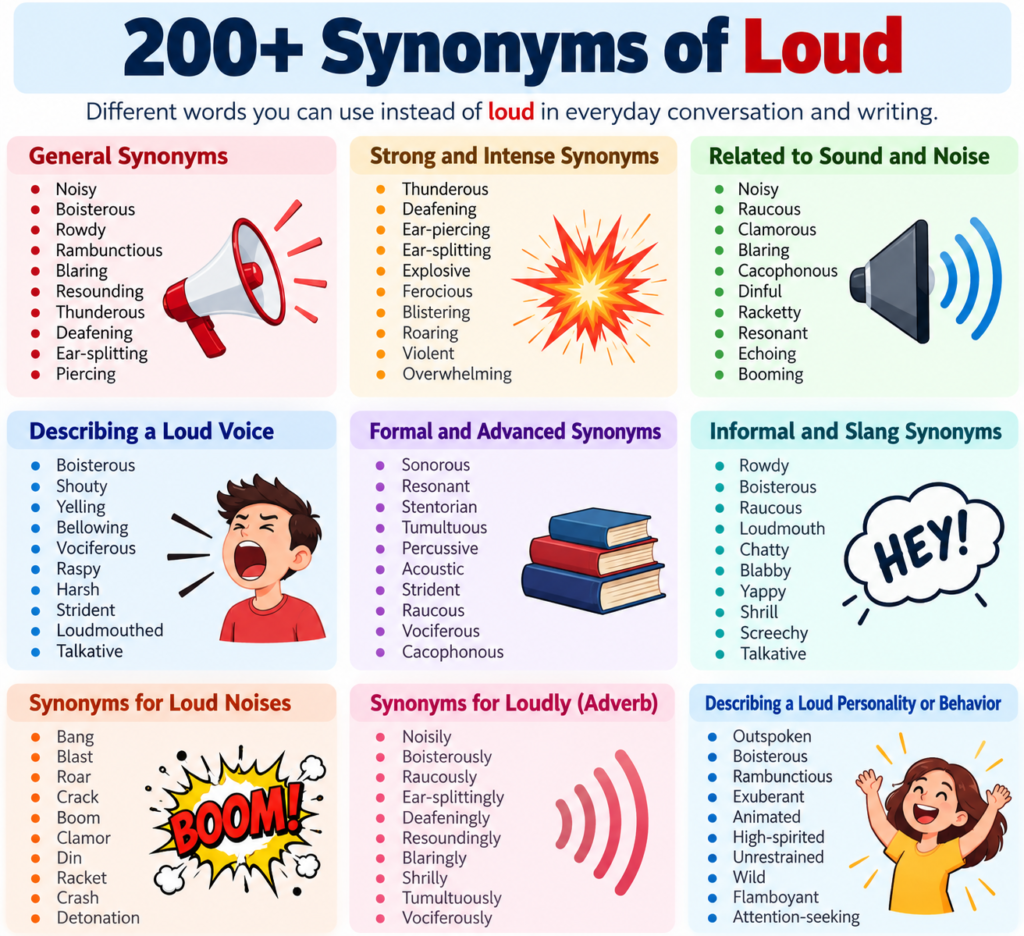
Common synonyms for loud include noisy, booming, deafening, thunderous, blaring, roaring, piercing, and ear-splitting. Each word has a slightly different meaning.
- Noisy describes sound that is often unwanted or distracting.
- Booming refers to a deep, powerful sound.
- Deafening describes sound that is extremely loud.
- Thunderous suggests a deep, heavy, and powerful noise.
- Blaring describes a loud, harsh sound, often from speakers, horns, or alarms.
- Roaring refers to a strong, continuous sound, such as a waterfall or engine.
- Piercing describes a sharp sound that cuts through other noise.
- Ear-splitting means so loud that it feels painful to hear.
For example, you might describe a concert as deafening, a man’s voice as booming, a car horn as blaring, and a busy restaurant as noisy.
The words are related, but they are not always interchangeable. Understanding their differences helps you choose a more accurate word for conversations, schoolwork, stories, reports, and professional writing.
200+ Synonyms of Loud With Meanings and Examples
The following list groups words by their closest meanings and common uses. Some are direct synonyms, while others describe a particular kind of loud sound or a situation in which people make noise. Words that apply only to certain contexts are labeled accordingly.
1. Common Synonyms for Loud
These are useful alternatives for everyday writing and conversation.
| Synonym | Meaning | Example |
| Noisy | Making a lot of sound | The noisy restaurant was full of families. |
| Booming | Producing a deep, powerful sound | His booming voice reached the back row. |
| Deafening | Extremely loud | A deafening cheer filled the stadium. |
| Thunderous | Deep and very powerful | Thunderous applause followed the performance. |
| Roaring | Making a strong, continuous sound | The roaring river rushed past the rocks. |
| Blaring | Making a loud, harsh sound | Music was blaring from the car. |
| Piercing | Sharp and difficult to ignore | A piercing whistle stopped the game. |
| Shrill | High-pitched and sharp | The shrill alarm woke the family. |
| Ear-splitting | Extremely loud and uncomfortable | An ear-splitting siren passed the building. |
| Raucous | Loud, rough, and often unpleasant | Raucous laughter came from the next room. |
| Clamorous | Filled with loud, competing sounds | The clamorous market was crowded at noon. |
| Strident | Loud, harsh, or forceful | A strident voice interrupted the meeting. |
| Resounding | Strong, clear, and often echoing | The announcement received a resounding response. |
| Powerful | Having great strength or impact | The singer had a powerful voice. |
| Forceful | Strong and emphatic | She made a forceful argument. |
| Intense | Strong in degree or effect | The intense drumbeat shook the room. |
| Harsh | Rough or unpleasant to hear | A harsh buzz came from the speaker. |
| Vibrant | Full of energy and life | Vibrant music filled the festival grounds. |
| Strong | Clearly noticeable in volume or effect | A strong blast of sound came from the horn. |
| Prominent | Easily noticed or heard | A prominent buzzing sound came from the machine. |
2. Synonyms for Extremely Loud Sounds
Use these words when ordinary terms such as loud or noisy do not fully express the intensity of a sound.
| Synonym | Meaning | Example |
| Thunderous | Powerful and deep | A thunderous crash shook the windows. |
| Deafening | So loud that hearing becomes difficult | The deafening blast startled everyone. |
| Ear-splitting | Painfully loud | An ear-splitting scream came from the hallway. |
| Explosive | Sudden and powerful | An explosive bang echoed through the building. |
| Overpowering | So strong that it dominates other sounds | Overpowering music drowned out the conversation. |
| Tremendous | Extremely great in size or force | A tremendous roar rose from the crowd. |
| Massive | Very large or powerful | A massive boom echoed across the valley. |
| Colossal | Enormous in scale or impact | A colossal crash came from the construction site. |
| Monumental | Exceptionally large or significant; not a direct synonym for loud | A monumental explosion marked the scene in the film. |
| Intense | Extremely strong | Intense noise filled the workshop. |
| Forceful | Powerful in delivery or impact | A forceful blast of wind rattled the door. |
| Resounding | Loud and clearly heard | A resounding bang startled the dog. |
| Roaring | Very strong and continuous | A roaring engine filled the garage. |
| Bellowing | Producing a deep, loud voice or sound | The bellowing bull startled the visitors. |
| Blasting | Producing sound at very high volume | They were blasting music through the speakers. |
| Thunderous | Heavy and booming | Thunderous drums opened the show. |
| Raging | Moving or acting with great force; context-dependent | The raging waterfall produced a constant roar. |
| Rumbly | Making a low, rolling sound | A rumbly engine could be heard outside. |
| Rumbling | Producing a low, continuous sound | Rumbling thunder moved across the sky. |
| Crashing | Producing a sudden, forceful impact sound | Crashing waves struck the shore. |
Note that words such as massive, colossal, and monumental describe size or importance rather than loudness by themselves. They can add emphasis to a sound when used with a suitable noun, but they are not direct replacements for loud in every sentence.
3. Synonyms for Loud, Harsh, or Unpleasant Noise
These words work well when a sound is irritating, disruptive, rough, or difficult to tolerate.
| Synonym | Meaning | Example |
| Annoying | Causing irritation | An annoying buzz came from the ceiling light. |
| Irritating | Making someone feel bothered | The irritating noise continued all afternoon. |
| Obtrusive | Intruding on attention or space | Obtrusive music disturbed the quiet café. |
| Disruptive | Interrupting normal activity | Disruptive noise affected the meeting. |
| Grating | Rough or unpleasant to hear | His grating laugh drew attention. |
| Jarring | Causing a sudden, unpleasant reaction | A jarring crash broke the silence. |
| Discordant | Lacking harmony | Discordant notes rang through the hall. |
| Harsh | Rough and unpleasant | A harsh screech came from the brakes. |
| Raspy | Rough in sound, often describing a voice | He spoke in a raspy voice. |
| Rasping | Making a rough, scraping sound | A rasping noise came from the old fan. |
| Harrowing | Deeply distressing; not a direct synonym for loud | Harrowing screams filled the dramatic scene. |
| Unpleasant | Not enjoyable to hear | An unpleasant buzzing sound continued. |
| Unbearable | Too difficult to tolerate | The unbearable noise kept everyone awake. |
| Obnoxious | Extremely unpleasant or offensive | Obnoxious music played from the next apartment. |
| Grating | Irritating because of its rough quality | The grating squeal made everyone wince. |
| Clattering | Making repeated hard, sharp sounds | Clattering pans fell onto the kitchen floor. |
| Clanging | Producing a loud metallic ringing sound | Clanging gates echoed through the yard. |
| Rattling | Making repeated shaking or knocking sounds | Rattling windows shook in the wind. |
| Banging | Making loud impact sounds | Someone was banging on the door. |
| Clanking | Making heavy metallic sounds | Clanking tools fell into the metal box. |
| Knocking | Producing repeated impact sounds | Knocking came from the upstairs room. |
| Pounding | Making repeated, heavy beats | Pounding music shook the floor. |
| Thumping | Producing a dull, heavy sound | Thumping footsteps crossed the ceiling. |
| Hammering | Making repeated, forceful impacts | Hammering continued outside the office. |
| Scraping | Making a rough sound as surfaces rub | Scraping chairs disturbed the class. |
| Grinding | Making a harsh friction sound | Grinding machinery filled the factory. |
| Screeching | Making a harsh, high-pitched sound | Screeching tires marked the sudden stop. |
| Squawking | Producing a loud, harsh cry | Squawking birds gathered on the roof. |
| Cacophonous | Characterized by a harsh mixture of sounds | The cacophonous street was full of horns and voices. |
| Din-filled | Filled with loud, confusing noise | The din-filled hall buzzed with activity. |
4. Synonyms for Loud Voices
A loud voice may be deep, sharp, forceful, excited, angry, or simply easy to hear. The words below help describe these differences.
Also Read: Synonyms of Counter: 150+ Alternatives, Definitions, Examples, and Related Words
| Word or phrase | Meaning | Example |
| Booming | Deep and powerful | The teacher used a booming voice. |
| Bellowing | Very loud and deep | He came bellowing across the field. |
| Shouting | Speaking at high volume | She was shouting over the traffic. |
| Yelling | Speaking loudly, often with strong emotion | The children were yelling with excitement. |
| Screaming | Producing an extremely loud, high-pitched cry | The audience screamed when the singer appeared. |
| Hollering | Calling out loudly; informal, especially in American English | He was hollering for his friends. |
| Calling out | Speaking loudly enough to attract attention | She called out to the driver. |
| Crying out | Making a sudden loud expression of pain, fear, or need | He cried out when he saw the injury. |
| Blaring | Speaking or sounding at excessive volume; less usual for ordinary voices | A blaring announcement came through the loudspeaker. |
| Vociferous | Expressing opinions loudly and forcefully | Vociferous fans protested the decision. |
| Strident | Loud and sharp in tone | The speaker’s strident voice carried across the room. |
| Piercing | Sharp and high-pitched | A piercing cry came from the playground. |
| Shrill | Very high-pitched and loud | A shrill voice called from the doorway. |
| Resonant | Full and rich in sound | Her resonant voice filled the theater. |
| Projected | Deliberately made strong enough to reach listeners | His projected voice reached the last row. |
| Authoritative | Expressing confidence or command; not necessarily loud | The coach spoke in an authoritative tone. |
| Forceful | Strong and emphatic | She delivered a forceful warning. |
| Emphatic | Showing strong emphasis | He gave an emphatic reply. |
| Impassioned | Filled with strong emotion | An impassioned speech stirred the audience. |
| Animated | Lively and expressive | She gave an animated explanation. |
| Boisterous | Loud, lively, and energetic | A boisterous group entered the room. |
| Raucous | Loud, rough, and often uncontrolled | Raucous laughter came from the table. |
| Roaring | Very loud, often deep | The crowd gave a roaring welcome. |
| Muffled | Softened or blocked, not loud | A muffled voice came through the wall. |
| Raspy | Rough-sounding | He answered in a raspy voice. |
For a loud voice synonym, choose the word that describes the sound itself. Use booming for a deep voice, shrill for a high-pitched voice, vociferous for forceful public expression, and shouting when someone raises their voice to be heard.
5. Synonyms for Loud Music and Sound Effects
Music, alarms, machinery, vehicles, and natural events each have their own sound qualities. A precise verb often describes them better than the general adjective loud.
| Word | Meaning or typical use | Example |
| Blasting | Playing at very high volume | Music was blasting from the speakers. |
| Blaring | Loud, harsh output | A blaring radio disturbed the neighbors. |
| Booming | Deep, powerful sound | Booming bass filled the club. |
| Thundering | Heavy, rolling noise | Thundering drums opened the concert. |
| Roaring | Strong, continuous sound | The roaring motor drowned out speech. |
| Rattling | Repeated shaking or knocking | A rattling exhaust made the car sound old. |
| Clanging | Metallic ringing | Clanging bells announced the start. |
| Clattering | Repeated hard impacts | Clattering dishes came from the kitchen. |
| Screeching | Harsh, high-pitched noise | Screeching brakes startled pedestrians. |
| Whining | A high, continuous sound | A whining motor came from the basement. |
| Buzzing | A steady vibrating sound | Buzzing speakers interrupted the recording. |
| Humming | A steady, low sound | Humming machinery ran all night. |
| Hissing | A sustained breathy sound | Hissing steam escaped from the pipe. |
| Crackling | A series of small sharp sounds | Crackling firewood burned in the fireplace. |
| Popping | Short, sudden sounds | Popping fireworks lit the sky. |
| Snapping | A sudden sharp sound | Snapping branches broke in the wind. |
| Booming | Deep, echoing sound | A booming cannon sounded in the distance. |
| Rumbling | Low, rolling sound | Rumbling thunder approached the town. |
| Crashing | Forceful impact | Crashing waves hit the seawall. |
| Howling | A long, high or hollow sound | Howling wind passed through the trees. |
| Wailing | A long, high cry or siren sound | Wailing sirens approached the intersection. |
| Blasting | A forceful burst of sound | A blasting horn warned nearby drivers. |
| Pealing | A loud, ringing sound, especially bells | Pealing bells rang across the square. |
| Clattering | A series of hard, sharp sounds | Clattering wheels crossed the tracks. |
| Thumping | Repeated dull beats | Thumping bass traveled through the walls. |
These words are related to loudness, but they describe different sound patterns. For example, humming can be quiet or loud, while blasting usually suggests excessive volume. Select the word that matches both the intensity and the type of sound.
6. Synonyms for Loud Crowds and Excited Groups
When describing a crowd, the best word often reflects how people behave rather than volume alone.
| Word | Meaning | Example |
| Boisterous | Noisy and full of energy | Boisterous fans celebrated outside the stadium. |
| Rowdy | Loud and difficult to control | Rowdy spectators interrupted the match. |
| Raucous | Rough, loud, and disorderly | A raucous crowd filled the town square. |
| Uproarious | Extremely noisy, often from laughter | An uproarious audience enjoyed the comedy show. |
| Vociferous | Loud and outspoken | Vociferous protesters demanded answers. |
| Clamorous | Making a loud mixture of sounds | Clamorous shoppers filled the market. |
| Tumultuous | Noisy, chaotic, and emotionally intense | A tumultuous crowd gathered at the entrance. |
| Jubilant | Expressing great happiness; not necessarily loud | Jubilant supporters cheered their team’s victory. |
| Exuberant | Full of excitement and energy | Exuberant children ran across the playground. |
| Animated | Lively and expressive | An animated group discussed the game. |
| Excitable | Easily stirred into excitement | An excitable crowd reacted to every announcement. |
| Boisterous | Energetic and noisy | Boisterous guests filled the banquet hall. |
| Riotous | Wildly lively or disorderly | Riotous laughter spread through the room. |
| Frenzied | Extremely excited and uncontrolled | A frenzied crowd rushed toward the stage. |
| Hysterical | Showing extreme emotion or uncontrolled laughter | Hysterical laughter filled the classroom. |
| Chaotic | Lacking order or control | A chaotic scene developed near the gate. |
| Frantic | Extremely hurried or anxious | Frantic shouting came from the crowded platform. |
| Rousing | Exciting people to action or enthusiasm | The team received a rousing welcome. |
| Roaring | Making a loud collective sound | Roaring fans filled the arena. |
| Cheering | Shouting approval or encouragement | Cheering supporters welcomed the players. |
| Chanting | Repeating words or phrases together | Chanting demonstrators marched through the street. |
| Shouting | Speaking or calling at high volume | Shouting spectators filled the stands. |
| Yelling | Calling out loudly | Yelling children raced toward the pool. |
| Hollering | Calling loudly, often informally | Hollering fans celebrated the final score. |
| Jeering | Shouting insults or disapproval | Jeering spectators reacted to the referee. |
Some of these terms describe emotion rather than sound. Jubilant and exuberant, for example, are useful when happiness is the main point, but neither automatically means loud.
7. Synonyms for Loudly
Loudly is an adverb. It describes how an action happens, while loud is an adjective that describes a person, object, or sound.
For example:
- Adjective: The loud music disturbed the neighbors.
- Adverb: The music played loudly throughout the evening.
Here are useful alternatives to loudly, grouped by their meaning.
| Alternative | Meaning | Example |
| Noisily | With a lot of noise | The children entered noisily. |
| Boisterously | In a loud, energetic way | The guests laughed boisterously. |
| Deafeningly | At an extremely high volume | The speakers played deafeningly. |
| Thunderously | With a deep, powerful sound | The audience applauded thunderously. |
| Resoundingly | In a strong, clearly heard way | The crowd responded resoundingly. |
| Piercingly | With a sharp, high-pitched sound | The alarm rang piercingly. |
| Shrillly | In a high, sharp tone | She called shrillly from the balcony. |
| Raucously | In a rough, noisy way | The group laughed raucously. |
| Vociferously | Loudly and forcefully | Residents objected vociferously. |
| Stridently | In a harsh, forceful tone | The speaker argued stridently. |
| Forcefully | With strength and emphasis | He spoke forcefully about safety. |
| Emphatically | With strong emphasis | She emphatically rejected the claim. |
| Vehemently | With intense feeling or conviction | The witness vehemently denied the allegation. |
| Explosively | In a sudden, forceful way | He reacted explosively to the news. |
| Abruptly | Suddenly or without warning; not a synonym for loudly | The machine stopped abruptly. |
| Booming | With a deep, powerful sound | His voice carried booming across the hall. |
| Bellowingly | In a bellowing manner; uncommon | He called bellowingly across the field. |
| Shrilly | In a high-pitched, piercing way | The whistle sounded shrilly. |
| Harshly | In a rough or unpleasant manner | The alarm sounded harshly. |
| Clearly | In a way that is easy to hear or understand | Please speak clearly during the recording. |
| Audibly | In a way that can be heard | She sighed audibly. |
| Resonantly | With a full, rich, echoing sound | The bell rang resonantly. |
| Dramatically | In a striking or theatrical way | He dramatically announced the result. |
| Passionately | With strong emotion | She spoke passionately about the issue. |
| Aggressively | In a hostile or forceful manner | He spoke aggressively during the dispute. |
Not all these words mean loudly. Clearly and audibly focus on whether a sound can be heard, while passionately and vehemently describe the speaker’s feelings. Use them only when they fit the sentence.
8. Synonyms for Sudden, Sharp, or Abrupt Sounds
A sudden sound may be loud, but suddenness and loudness are different qualities. A whisper can begin abruptly, and a loud engine can run continuously.
| Word | Meaning | Example |
| Abrupt | Sudden and unexpected | An abrupt bang came from the garage. |
| Sudden | Happening quickly without warning | A sudden crash interrupted the conversation. |
| Startling | Causing surprise or alarm | A startling pop came from the balloon. |
| Jarring | Producing a sharp, unpleasant reaction | A jarring noise broke the silence. |
| Sharp | Quick and clearly defined | A sharp crack echoed through the woods. |
| Crashing | Producing a forceful impact | A crashing sound came from the kitchen. |
| Explosive | Sudden and powerful | An explosive bang shook the door. |
| Snapping | Producing a quick, sharp sound | Snapping twigs alerted the hikers. |
| Popping | Making a short, sudden sound | Popping balloons startled the children. |
| Cracking | Making a sharp breaking sound | A cracking branch fell from the tree. |
| Clapping | Producing a sharp sound by striking hands or objects | Clapping echoed around the hall. |
| Slamming | Closing or striking with force | A slamming door woke the baby. |
| Smashing | Breaking something with a forceful impact | Smashing glass produced a sharp crash. |
| Banging | Striking something loudly | Banging pipes disturbed the residents. |
| Bursting | Breaking open suddenly, sometimes with a bang | A bursting balloon startled the dog. |
| Blasting | Producing a powerful burst of sound | A blasting horn warned the driver. |
| Thudding | Making a dull, heavy impact sound | A thudding noise came from upstairs. |
| Clapping | Making repeated sharp impacts | Clapping hands filled the auditorium. |
| Rapping | Striking a surface with quick, firm taps | Rapping on the window attracted attention. |
| Knocking | Striking a surface repeatedly | Knocking sounded from the front door. |
9. Synonyms for Loud That Describe Strength or Intensity
Sometimes a writer needs to describe a powerful voice, a forceful statement, or a strong sound rather than volume alone.
Also Read: 100+ Synonyms for Scapegoat: Meanings, Examples, and Antonyms
| Word | Meaning | Example |
| Forceful | Strong and assertive | She made a forceful statement. |
| Powerful | Having great strength or impact | A powerful voice filled the theater. |
| Emphatic | Expressing an idea with strong emphasis | He gave an emphatic response. |
| Vehement | Showing intense feeling | She made a vehement objection. |
| Assertive | Expressing oneself confidently | He used an assertive tone during the meeting. |
| Aggressive | Hostile or forceful | An aggressive voice changed the mood of the discussion. |
| Commanding | Having a strong, authoritative presence | The captain spoke in a commanding voice. |
| Authoritative | Sounding confident and in control | The instructor gave an authoritative warning. |
| Vigorous | Energetic and strong | Vigorous debate continued for hours. |
| Intense | Strong in degree or feeling | An intense argument broke out. |
| Passionate | Showing deep emotion | A passionate speech moved the audience. |
| Impassioned | Filled with strong emotion | He delivered an impassioned appeal. |
| Dramatic | Striking or emotionally powerful | A dramatic announcement silenced the room. |
| Striking | Attracting attention strongly | A striking burst of sound came from the stage. |
| Impressive | Producing admiration; not necessarily loud | The singer gave an impressive performance. |
| Resonant | Rich, deep, and full in sound | His resonant voice carried across the room. |
| Robust | Strong and full-bodied | The recording captured a robust drum sound. |
| Full-bodied | Rich and substantial in tone | The full-bodied voice suited the performance. |
| Sonorous | Deep, rich, and pleasant in sound | A sonorous bell rang over the village. |
| Stentorian | Exceptionally loud and powerful, especially of a voice | The coach’s stentorian voice reached the entire field. |
Stentorian is a useful fancy word for loud, especially when describing a powerful voice. Sonorous and resonant are better when the sound is rich and full rather than harsh.
10. Words for Loud, Noisy, and Disturbing Environments
These expressions are especially helpful for describing places, including streets, classrooms, factories, restaurants, and public events.
| Word or phrase | Meaning | Example |
| Noisy | Full of sound | The noisy street was busy at lunchtime. |
| Loud | Producing a strong sound | A loud train passed the station. |
| Bustling | Busy and active, sometimes noisy | The bustling restaurant was full of customers. |
| Hectic | Very busy and rushed | A hectic station echoed with announcements. |
| Chaotic | Disorganized and noisy | A chaotic crowd gathered near the entrance. |
| Clamorous | Filled with competing sounds | The clamorous school hallway buzzed with voices. |
| Din-filled | Full of loud background noise | The din-filled cafeteria made conversation difficult. |
| Raucous | Loud and disorderly | A raucous bar remained busy late into the night. |
| Rowdy | Noisy and uncontrolled | Rowdy spectators disrupted the event. |
| Boisterous | Lively and loud | A boisterous party continued upstairs. |
| Tumultuous | Noisy and confused | A tumultuous scene unfolded in the square. |
| Deafening | Extremely loud | Deafening traffic filled the tunnel. |
| Overwhelming | Too strong to manage comfortably | Overwhelming background noise made the call difficult. |
| Distracting | Taking attention away from something | Distracting music interrupted the lesson. |
| Disruptive | Interfering with normal activity | Disruptive noise delayed the recording. |
| Intrusive | Unwanted and interfering | Intrusive sound came through the thin walls. |
| Obtrusive | Noticeably interfering with an environment | Obtrusive announcements interrupted the quiet lobby. |
| Disturbing | Causing discomfort or concern | A disturbing noise came from the empty house. |
| Unsettling | Causing worry or unease | An unsettling howl came from the woods. |
| Chaotic | Lacking order | Chaotic street noise surrounded the station. |
Words such as bustling and hectic describe activity, not sound alone. They are appropriate when the setting is busy as well as noisy.
11. Descriptive Words for Different Types of Loud Sounds
The following vocabulary can make descriptions more precise, especially in creative writing, journalism, and everyday communication.
| Word | Typical sound or meaning | Example |
| Buzzy | Having a vibrating or buzzing quality | A buzzy sound came from the faulty speaker. |
| Metallic | Having a hard, metal-like tone | A metallic clang echoed through the room. |
| Hollow | Having an empty, echoing quality | A hollow bang came from the wooden door. |
| Booming | Deep and resonant | Booming bass vibrated through the floor. |
| Thundering | Heavy and rolling | Thundering hooves approached the barn. |
| Clattering | Repeated hard impacts | Clattering wheels crossed the bridge. |
| Clanking | Heavy metallic impacts | Clanking chains moved in the wind. |
| Rattling | Rapid shaking or knocking | Rattling shutters struck the window frame. |
| Rumbling | Low, continuous sound | Rumbling machinery ran beneath the building. |
| Roaring | Strong, continuous noise | Roaring water rushed down the slope. |
| Howling | A long, hollow, or high sound | Howling wind swept across the field. |
| Wailing | A sustained high cry | Wailing sirens approached the intersection. |
| Screeching | Harsh and high-pitched | Screeching brakes sounded at the corner. |
| Squawking | A rough, sharp birdlike cry | Squawking parrots filled the garden. |
| Cawing | A harsh crow-like call | Cawing birds gathered on the rooftop. |
| Blaring | Loud, harsh output | A blaring horn sounded behind the bus. |
| Pealing | Loud ringing, often of bells | Pealing bells rang at noon. |
| Clashing | Producing conflicting or striking sounds | Clashing cymbals marked the end of the song. |
| Crashing | A forceful impact or breaking sound | Crashing waves hit the rocks. |
| Crackling | Repeated small, sharp sounds | Crackling branches burned in the fire. |
| Pattering | Repeated light taps | Pattering rain struck the metal roof. |
| Drumming | Repeated rhythmic beats or impacts | Drumming rain covered the sound of speech. |
| Thumping | Dull, heavy repeated beats | Thumping footsteps crossed the hall. |
| Pounding | Heavy repeated strikes | Pounding machinery shook the workshop. |
| Whirring | A steady spinning or mechanical sound | A whirring fan ran above the desk. |
These words describe sound quality rather than volume alone. A whirring fan, for example, can be quiet or loud. Add an intensity word if the volume is important: a loud whirring fan or a deafening mechanical roar.
12. Informal and Slang Words for Loud
In casual American English, some expressions communicate loudness in a relaxed or playful way. Their meanings may depend on the situation.
| Word or phrase | Meaning | Example |
| Blasting | Playing music at high volume | They were blasting music in the backyard. |
| Cranked up | Turned up to a high volume | The radio was cranked up too high. |
| Full blast | At maximum or very high volume | The television was playing at full blast. |
| Piped up | Began speaking, sometimes unexpectedly; not necessarily loudly | A student piped up with a question. |
| Hollering | Calling out loudly | The neighbors were hollering across the yard. |
| Yelling | Speaking at high volume | Stop yelling across the room. |
| Shouting | Speaking loudly to be heard | He was shouting over the music. |
| Making a racket | Making a lot of annoying noise | The kids were making a racket upstairs. |
| Raising the roof | Making a place extremely lively and noisy | The band raised the roof at the concert. |
| Ripping loud | Extremely loud; informal and context-dependent | The speakers were ripping loud. |
| Blasting away | Producing sound continuously and forcefully | The band was blasting away on stage. |
| Ear-busting | Extremely loud; informal | Ear-busting music came from the car. |
| In-your-face | Bold, direct, and attention-grabbing | The performance had an in-your-face sound. |
| Over-the-top | Excessive or exaggerated | The over-the-top sound effects dominated the scene. |
| Cranked | Turned up high, especially a sound system | The stereo was cranked all night. |
These expressions are best suited to casual conversation, dialogue, and informal writing. In a formal report, use more precise terms such as excessive noise, high volume, or disruptive sound.
How to Choose the Best Synonym for Loud
The most useful synonym is the one that describes the sound accurately. Before choosing a replacement, consider the following points.
Consider the volume
If you want to emphasize how powerful a sound is, use words such as deafening, thunderous, ear-splitting, or booming.
Example:
- General: The crowd was loud.
- More precise: The crowd was deafening.
The second sentence communicates a much higher level of sound.
Consider the pitch
Pitch refers to how high or low a sound seems.
- Shrill: A high, sharp sound.
- Piercing: A sharp sound that stands out.
- Booming: A deep, powerful sound.
- Sonorous: A deep, rich, full sound.
- Raspy: A rough voice or sound.
Example: The shrill whistle cut through the deep, booming music.
Consider whether the sound is pleasant
Some loud sounds are exciting, while others are unpleasant.
- Thunderous applause can communicate approval.
- Raucous laughter can suggest rough, uncontrolled amusement.
- Blaring music often suggests excessive volume.
- Grating noise suggests irritation.
- Resounding applause suggests a strong response.
Example: The band played thunderous music, but the blaring speakers made conversation impossible.
Consider the source of the sound
The source can help determine the most natural word.
| Sound source | Useful words |
| Human voice | Booming, bellowing, shouting, vociferous |
| Alarm | Piercing, shrill, blaring, ear-splitting |
| Engine | Roaring, rumbling, rattling, thundering |
| Crowd | Boisterous, raucous, clamorous, tumultuous |
| Music | Blasting, booming, thunderous, overpowering |
| Metal objects | Clanging, clanking, clattering |
| Wind | Howling, roaring, gusting |
| Rain | Pattering, pounding, drumming |
| Explosion | Deafening, explosive, thunderous |
| Laughter | Uproarious, raucous, boisterous |
| Argument | Heated, forceful, vehement, vociferous |
| Traffic | Noisy, blaring, roaring, disruptive |
The table offers common associations, not fixed rules. A word that works for one situation may sound unnatural in another.
Loud vs. Noisy vs. Booming vs. Deafening
These words overlap, but each highlights a different quality.
| Word | Main idea | Example |
| Loud | High volume in general | The television is loud. |
| Noisy | A lot of sound, often unwanted | The office is noisy. |
| Booming | Deep, strong sound | His voice is booming. |
| Deafening | Extremely high volume | The explosion was deafening. |
| Thunderous | Deep, heavy, powerful sound | Thunderous applause filled the hall. |
| Shrill | High-pitched, sharp sound | A shrill alarm rang. |
| Blaring | Excessive, harsh sound | A blaring horn interrupted the conversation. |
| Piercing | Sharp and attention-grabbing | A piercing scream echoed nearby. |
| Raucous | Rough, disorderly sound | Raucous laughter came from the group. |
| Resounding | Strong and clearly heard | The team received a resounding welcome. |
Use loud when you need a general description. Choose noisy when the amount of sound is the problem, booming when the sound is deep, and deafening when the volume is extreme.
What Is a Fancy Word for Loud?
If you need a more advanced or formal synonym, consider these choices:
- Stentorian: Exceptionally loud and powerful, especially a voice.
- Sonorous: Deep, rich, and full in tone.
- Vociferous: Loud and forceful in expressing opinions.
- Clamorous: Filled with competing loud sounds.
- Strident: Harsh, sharp, and forceful.
- Thunderous: Deep and powerfully loud.
- Resounding: Strong, clear, and often echoing.
- Tumultuous: Noisy, chaotic, and emotionally intense.
- Deafening: Extremely loud.
- Pealing: Ringing loudly, especially when describing bells.
For example, “He spoke in a stentorian voice” sounds more formal than “He spoke very loudly.” However, advanced vocabulary is most effective when it adds a precise meaning rather than simply making a sentence sound complicated.
Synonyms for Loud in Different Writing Situations
In school essays
Choose familiar but precise words, such as noisy, powerful, piercing, thunderous, or deafening.
Example: The deafening noise from the stadium made it difficult to hear the announcement.
In stories and creative writing
Use sound-specific words to help readers imagine the scene.
Example: A metallic clang echoed through the empty corridor, followed by a deep rumble from below.
Also Read: 200+ Synonyms for Devious: Meaning, Definition, Examples, and Antonyms
In professional writing
Use neutral descriptions when discussing noise, sound levels, or workplace conditions.
Example: Excessive background noise affected the quality of the recording.
Words such as resounding, forceful, and prominent may also be useful, depending on the meaning.
In casual conversation
Common words and phrases usually work best.
Example: The music was blasting, so we moved to another room.
In descriptive writing
Combine a precise sound word with details about the source or effect.
Example: A piercing siren cut through the rumble of traffic and startled pedestrians.
Common Mistakes When Using Synonyms of Loud
Using noisy when you mean high volume
Noisy often suggests unwanted or distracting sound. Loud simply describes volume.
“The loud announcement” is neutral, while “the noisy announcement” sounds less natural unless the announcement is accompanied by other noise.
Treating every strong word as a synonym
Words such as impressive, fierce, vibrant, dramatic, and violent may describe intensity or emotion, but they do not automatically mean loud.
A vibrant performance may be visually exciting. A fierce argument may involve strong disagreement. Neither must be loud.
Confusing loudness with suddenness
Abrupt, sudden, and unexpected describe timing, not volume.
A loud crash may happen suddenly, but a steady roar can remain loud for hours.
Using an adverb where an adjective is needed
Use loud to describe a noun and loudly to describe an action.
Correct: The loud alarm rang.
Correct: The alarm rang loudly.
Assuming a louder word always improves writing
A sentence does not become clearer simply because it uses a stronger adjective. Match the word to the sound, setting, and intended tone.
Frequently Asked Questions About Synonyms of Loud
What are the five most common synonyms of loud?
Five widely useful choices are noisy, booming, deafening, thunderous, and blaring. Use noisy for unwanted sound, booming for a deep voice or sound, deafening for extreme volume, thunderous for a powerful sound, and blaring for harsh sound from a speaker, horn, or alarm.
What is the opposite of loud?
Common opposites include quiet, soft, silent, faint, hushed, muted, and low. Their meanings differ slightly. Silent means no sound, while quiet means little sound. Faint describes a sound that is difficult to hear.
What is a synonym for a loud voice?
Booming, bellowing, resonant, stentorian, and powerful can describe a strong voice. Shouting, yelling, and hollering describe the act of speaking or calling at high volume. Choose according to the voice’s quality and the speaker’s behavior.
What is another word for a loud noise?
Crash, bang, boom, roar, blast, clang, and rumble are useful alternatives when they match the sound. A crash often suggests impact, a bang is a sudden loud noise, a boom is deep, and a rumble is low and continuous.
What is a synonym for a loud person?
The best word depends on the person’s behavior. Boisterous describes someone who is noisy and energetic. Vociferous describes someone who expresses opinions loudly. Rowdy suggests uncontrolled behavior. Loudmouth is an informal, often insulting term for someone who talks too loudly or too much.
What is another word for loud music?
Blaring, booming, blasting, thunderous, and overpowering can describe loud music. Blasting suggests very high playback volume, booming emphasizes deep bass, and overpowering suggests the music dominates the surroundings.
What is a synonym for loudly in a sentence?
Possible alternatives include noisily, boisterously, thunderously, vociferously, and forcefully. The correct choice depends on whether the action is noisy, energetic, powerful, or emotionally intense.
What is a synonym for a loud crowd?
Boisterous, raucous, clamorous, rowdy, and tumultuous are common choices. Boisterous emphasizes lively energy, raucous suggests rough noise, and tumultuous describes a noisy and chaotic situation.
What is the difference between deafening and ear-splitting?
Both describe extremely loud sound. Deafening emphasizes a volume so high that hearing becomes difficult. Ear-splitting emphasizes a sharp or painfully intense sound.
What is a synonym for loud in formal writing?
Resounding, forceful, prominent, powerful, and intense may suit formal writing, depending on the sentence. Stentorian and sonorous are more specialized words for certain types of voices or tones.
Can impressive be used as a synonym for loud?
Not in most cases. Impressive describes something that creates admiration or has a strong effect. A performance may be impressive because of its skill, even when it is quiet. Use powerful, thunderous, or deafening if you specifically mean loudness.
Are loud and noisy interchangeable?
Sometimes, but not always. Loud refers mainly to volume, whereas noisy often suggests a large amount of sound or unwanted disturbance. A loud speaker can be clear and pleasant, while a noisy room may contain many overlapping conversations.
Conclusion
There are many ways to describe loud sounds, voices, music, crowds, and noisy environments. The best synonym depends on the volume, pitch, sound quality, source, and emotional effect.
Use booming for a deep voice, piercing for a sharp sound, blaring for harsh music or alarms, thunderous for powerful noise, and deafening for extreme volume. For groups of people, boisterous, raucous, and vociferous can add useful details about their behavior.
The goal is not to use the most complicated word. It is to choose the word that communicates the sound accurately and naturally. A precise synonym makes your writing easier to understand and helps readers imagine exactly what you mean.